
Mind map
The Origin of Cells
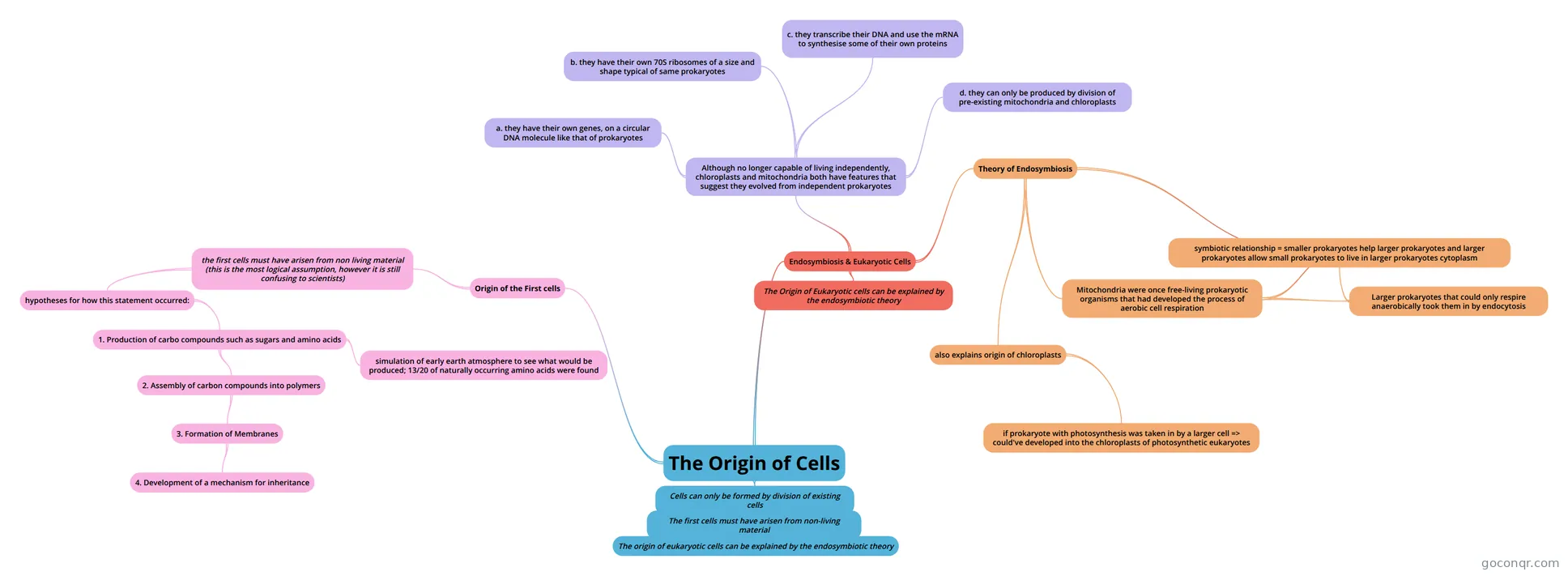
Mind map: The Origin of Cells
Map content
The Origin of Cells
Cells can only be formed by division of existing cells
- The first cells must have arisen from non-living material
- The origin of eukaryotic cells can be explained by the endosymbiotic theory
- The first cells must have arisen from non-living material
Origin of the First cells
- the first cells must have arisen from non living material (this is the most logical assumption, however it is still confusing to scientists)
- hypotheses for how this statement occurred:
- 1. Production of carbo compounds such as sugars and amino acids
- simulation of early earth atmosphere to see what would be produced; 13/20 of naturally occurring amino acids were found
- 2. Assembly of carbon compounds into polymers
- 3. Formation of Membranes
- 4. Development of a mechanism for inheritance
- 3. Formation of Membranes
- 1. Production of carbo compounds such as sugars and amino acids
- hypotheses for how this statement occurred:
- the first cells must have arisen from non living material (this is the most logical assumption, however it is still confusing to scientists)
Endosymbiosis & Eukaryotic Cells
- The Origin of Eukaryotic cells can be explained by the endosymbiotic theory
- Theory of Endosymbiosis
- Mitochondria were once free-living prokaryotic organisms that had developed the process of aerobic cell respiration
- Larger prokaryotes that could only respire anaerobically took them in by endocytosis
- symbiotic relationship = smaller prokaryotes help larger prokaryotes and larger prokaryotes allow small prokaryotes to live in larger prokaryotes cytoplasm
- Larger prokaryotes that could only respire anaerobically took them in by endocytosis
- also explains origin of chloroplasts
- if prokaryote with photosynthesis was taken in by a larger cell => could've developed into the chloroplasts of photosynthetic eukaryotes
- Mitochondria were once free-living prokaryotic organisms that had developed the process of aerobic cell respiration
- Although no longer capable of living independently, chloroplasts and mitochondria both have features that suggest they evolved from independent prokaryotes
- a. they have their own genes, on a circular DNA molecule like that of prokaryotes
- b. they have their own 70S ribosomes of a size and shape typical of same prokaryotes
- c. they transcribe their DNA and use the mRNA to synthesise some of their own proteins
- d. they can only be produced by division of pre-existing mitochondria and chloroplasts
Information
- Description
- Biology Biology Mind Map on The Origin of Cells, created by Felix Bain on 12/11/2017.
- Created by
- Felix Bain
- Views
- 2
- Rating