
Mind map
5 Agents of Evolutionary Change
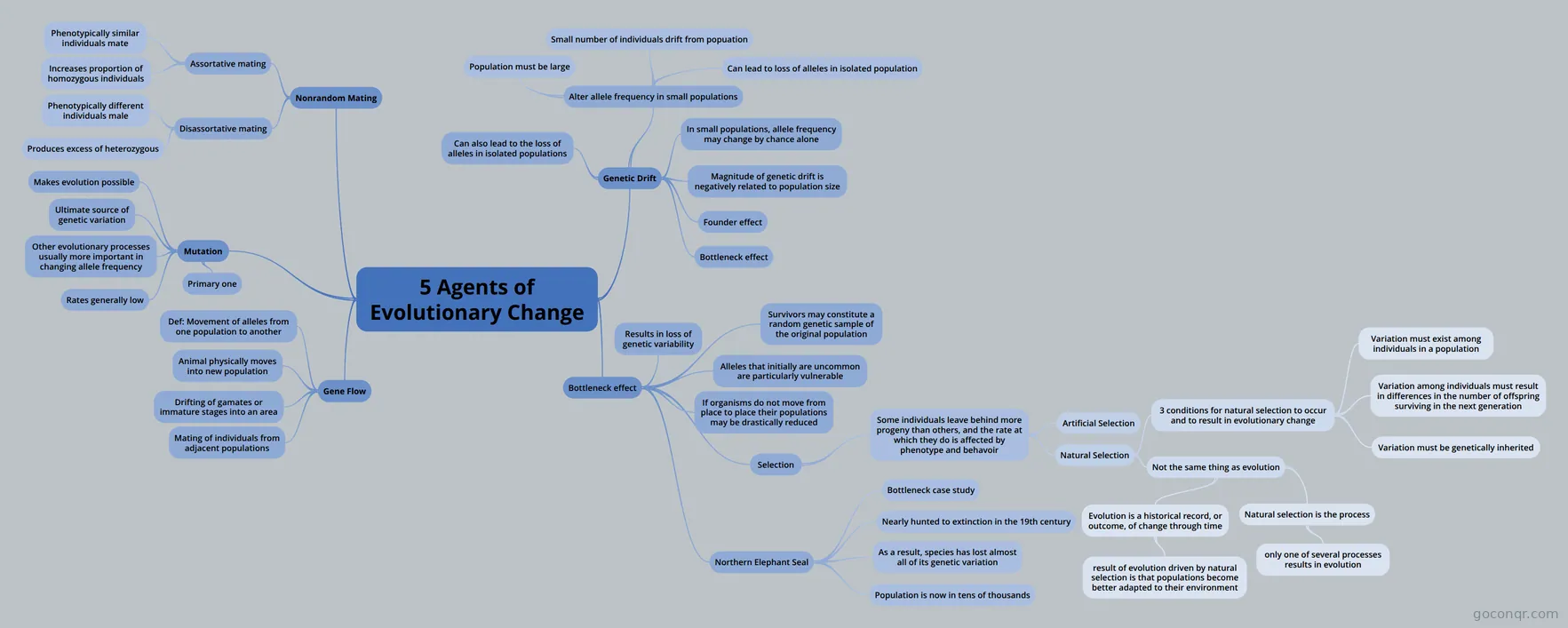
Mind map: 5 agents of evolutionary change
Map content
5 Agents of Evolutionary Change
Mutation
- Primary one
- Rates generally low
- Other evolutionary processes usually more important in changing allele frequency
- Ultimate source of genetic variation
- Makes evolution possible
Gene Flow
- Def: Movement of alleles from one population to another
- Animal physically moves into new population
- Drifting of gamates or immature stages into an area
- Mating of individuals from adjacent populations
Nonrandom Mating
- Assortative mating
- Phenotypically similar individuals mate
- Increases proportion of homozygous individuals
- Disassortative mating
- Phenotypically different individuals male
- Produces excess of heterozygous
- Assortative mating
Genetic Drift
- In small populations, allele frequency may change by chance alone
- Magnitude of genetic drift is negatively related to population size
- Founder effect
- Bottleneck effect
- Alter allele frequency in small populations
- Population must be large
- Small number of individuals drift from popuation
- Can lead to loss of alleles in isolated population
- Can also lead to the loss of alleles in isolated populations
Bottleneck effect
- If organisms do not move from place to place their populations may be drastically reduced
- Survivors may constitute a random genetic sample of the original population
- Results in loss of genetic variability
- Alleles that initially are uncommon are particularly vulnerable
- Northern Elephant Seal
- Bottleneck case study
- Nearly hunted to extinction in the 19th century
- As a result, species has lost almost all of its genetic variation
- Population is now in tens of thousands
- Selection
- Some individuals leave behind more progeny than others, and the rate at which they do is affected by phenotype and behavoir
- Artificial Selection
- Natural Selection
- Not the same thing as evolution
- Natural selection is the process
- only one of several processes results in evolution
- Evolution is a historical record, or outcome, of change through time
- result of evolution driven by natural selection is that populations become better adapted to their environment
- Natural selection is the process
- 3 conditions for natural selection to occur and to result in evolutionary change
- Variation must exist among individuals in a population
- Variation among individuals must result in differences in the number of offspring surviving in the next generation
- Variation must be genetically inherited
- Not the same thing as evolution
- Some individuals leave behind more progeny than others, and the rate at which they do is affected by phenotype and behavoir
Information
- Description
- Biology (Chapter 20: Genes within Populations) Mind Map on 5 Agents of Evolutionary Change, created by Alicia McCormack on 22/11/2017.
- Created by
- Alicia McCormack
- Views
- 1
- Rating
More on Population Genetics and Evolutionary Mechanisms