
Mind map
Photosynthesis
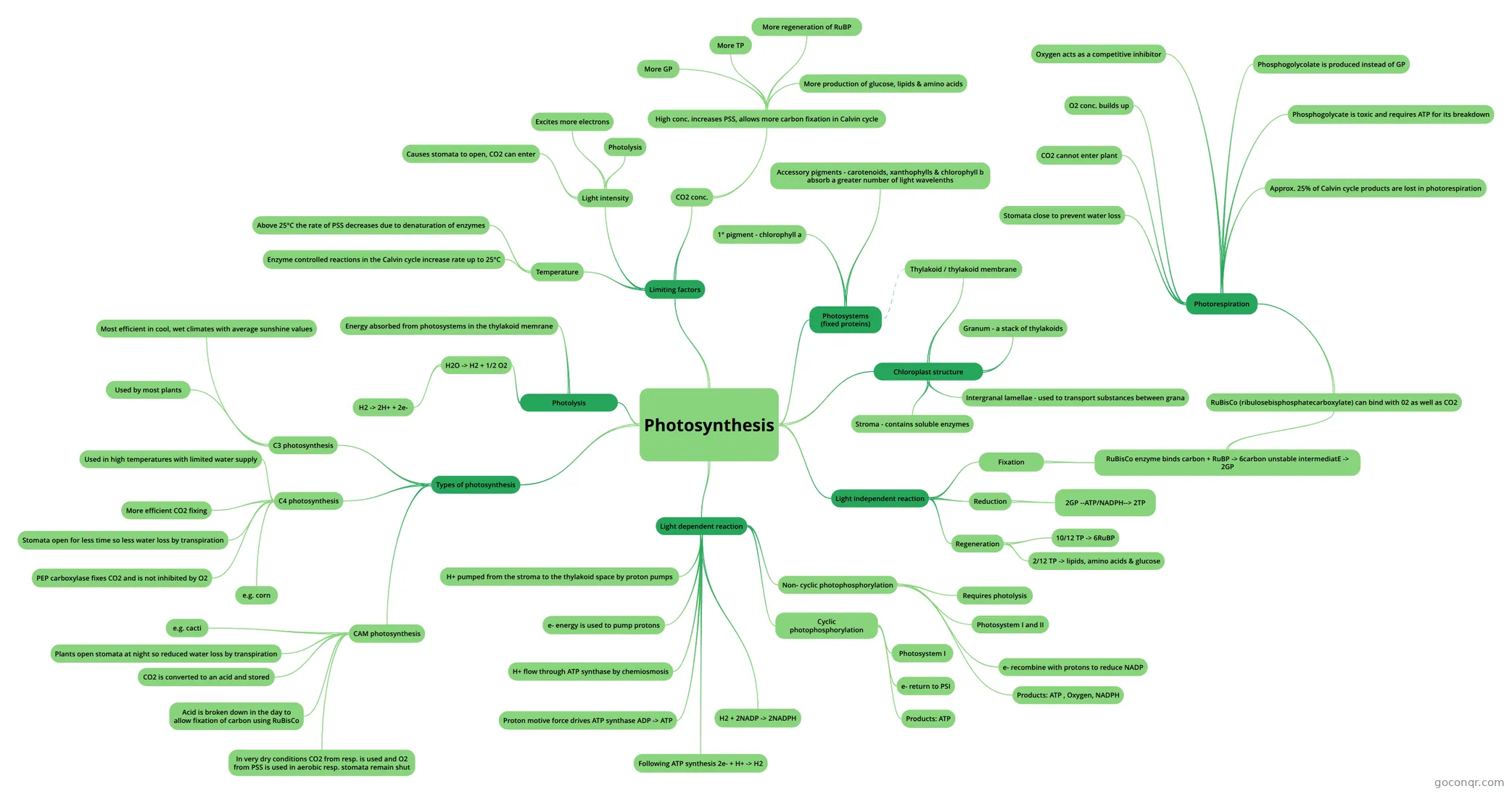
Mind map: Photosynthesis
Map content
Photosynthesis
Chloroplast structure
- Stroma - contains soluble enzymes
- Granum - a stack of thylakoids
- Intergranal lamellae - used to transport substances between grana
- Thylakoid / thylakoid membrane
Photosystems (fixed proteins)
- 1° pigment - chlorophyll a
- Accessory pigments - carotenoids, xanthophylls & chlorophyll b absorb a greater number of light wavelenths
Light dependent reaction
- H+ pumped from the stroma to the thylakoid space by proton pumps
- H+ flow through ATP synthase by chemiosmosis
- Proton motive force drives ATP synthase ADP -> ATP
- e- energy is used to pump protons
- Following ATP synthesis 2e- + H+ -> H2
- H2 + 2NADP -> 2NADPH
- Non- cyclic photophosphorylation
- Photosystem I and II
- Requires photolysis
- e- recombine with protons to reduce NADP
- Products: ATP , Oxygen, NADPH
- Cyclic photophosphorylation
- Photosystem I
- e- return to PSI
- Products: ATP
Photolysis
- Energy absorbed from photosystems in the thylakoid memrane
- H2O -> H2 + 1/2 O2
- H2 -> 2H+ + 2e-
Light independent reaction
- Fixation
- RuBisCo enzyme binds carbon + RuBP -> 6carbon unstable intermediatE -> 2GP
- RuBisCo (ribulosebisphosphatecarboxylate) can bind with 02 as well as CO2
- Photorespiration
- Stomata close to prevent water loss
- CO2 cannot enter plant
- O2 conc. builds up
- Oxygen acts as a competitive inhibitor
- Phosphogolycolate is produced instead of GP
- Phosphogolycate is toxic and requires ATP for its breakdown
- Approx. 25% of Calvin cycle products are lost in photorespiration
- Photorespiration
- RuBisCo (ribulosebisphosphatecarboxylate) can bind with 02 as well as CO2
- RuBisCo enzyme binds carbon + RuBP -> 6carbon unstable intermediatE -> 2GP
- Reduction
- 2GP --ATP/NADPH--> 2TP
- Regeneration
- 10/12 TP -> 6RuBP
- 2/12 TP -> lipids, amino acids & glucose
- Fixation
Types of photosynthesis
- C3 photosynthesis
- Used by most plants
- Most efficient in cool, wet climates with average sunshine values
- C4 photosynthesis
- Used in high temperatures with limited water supply
- More efficient CO2 fixing
- Stomata open for less time so less water loss by transpiration
- PEP carboxylase fixes CO2 and is not inhibited by O2
- e.g. corn
- CAM photosynthesis
- Plants open stomata at night so reduced water loss by transpiration
- CO2 is converted to an acid and stored
- Acid is broken down in the day to allow fixation of carbon using RuBisCo
- In very dry conditions CO2 from resp. is used and O2 from PSS is used in aerobic resp. stomata remain shut
- e.g. cacti
- C3 photosynthesis
Limiting factors
- Temperature
- Enzyme controlled reactions in the Calvin cycle increase rate up to 25°C
- Above 25°C the rate of PSS decreases due to denaturation of enzymes
- Light intensity
- Causes stomata to open, CO2 can enter
- Excites more electrons
- Photolysis
- CO2 conc.
- High conc. increases PSS, allows more carbon fixation in Calvin cycle
- More GP
- More TP
- More regeneration of RuBP
- More production of glucose, lipids & amino acids
- High conc. increases PSS, allows more carbon fixation in Calvin cycle
- Temperature
Information
- Description
- A2 Biology Mind Map on Photosynthesis, created by Bethany Harley on 16/01/2018.
- Created by
- Bethany Harley
- Views
- 1
- Rating