
Mind map
Research Methods
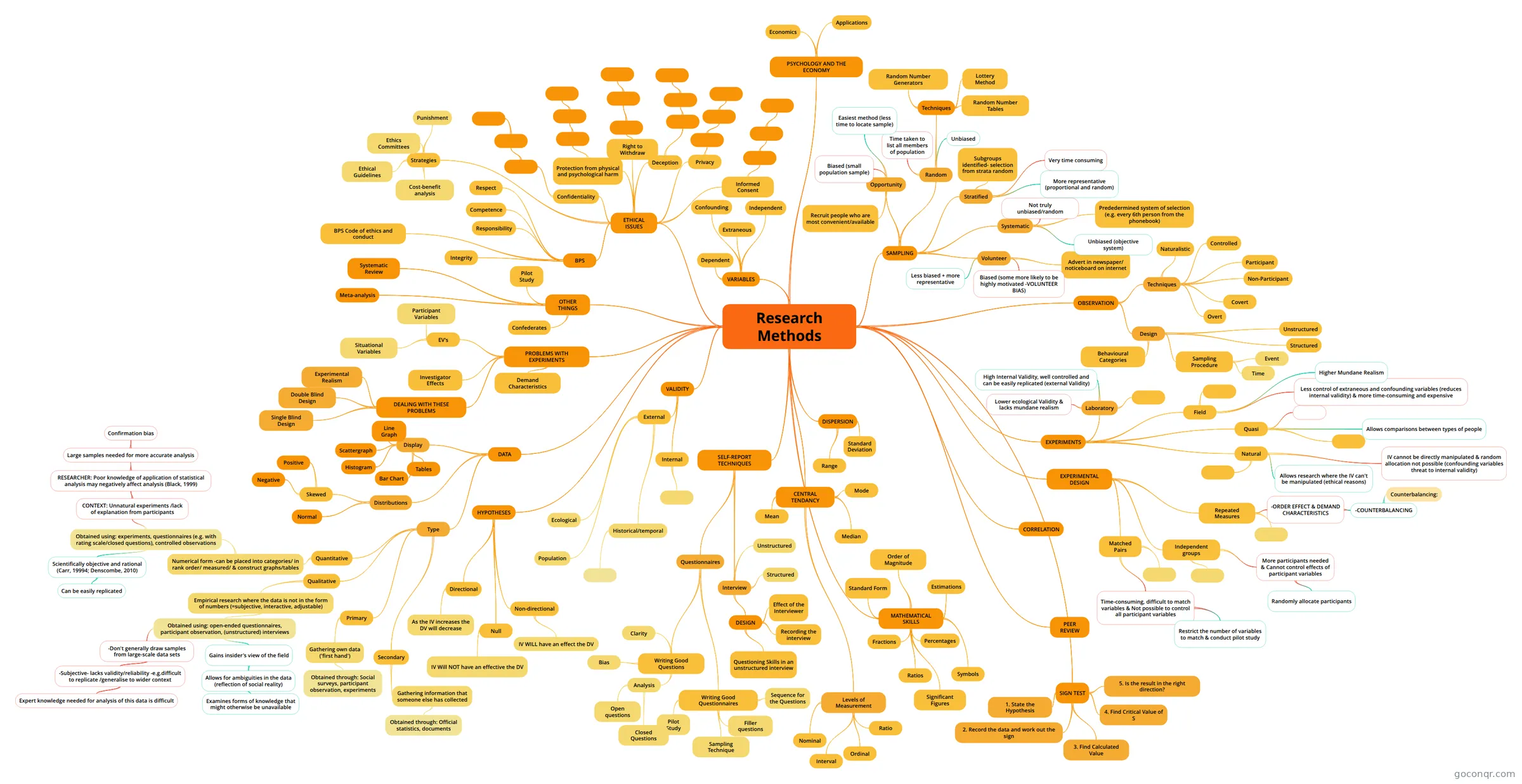
Mind map: Research methods
Map content
Research Methods
SAMPLING
- Opportunity
- Easiest method (less time to locate sample)
- Biased (small population sample)
- Recruit people who are most convenient/available
- Stratified
- Subgroups identified- selection from strata random
- Very time consuming
- More representative (proportional and random)
- Systematic
- Prededermined system of selection (e.g. every 6th person from the phonebook)
- Not truly unbiased/random
- Unbiased (objective system)
- Volunteer
- Advert in newspaper/ noticeboard on internet
- Less biased + more representative
- Biased (some more likely to be highly motivated -VOLUNTEER BIAS)
- Random
- Unbiased
- Time taken to list all members of population
- Techniques
- Random Number Generators
- Lottery Method
- Random Number Tables
- Opportunity
EXPERIMENTS
- Laboratory
- Lower ecological Validity & lacks mundane realism
- High Internal Validity, well controlled and can be easily replicated (external Validity)
- Field
- Less control of extraneous and confounding variables (reduces internal validity) & more time-consuming and expensive
- Higher Mundane Realism
- Natural
- Allows research where the IV can't be manipulated (ethical reasons)
- IV cannot be directly manipulated & random allocation not possible (confounding variables threat to internal validity)
- Quasi
- Allows comparisons between types of people
- Laboratory
ETHICAL ISSUES
- Deception
- Right to Withdraw
- Protection from physical and psychological harm
- Confidentiality
- Privacy
- Informed Consent
- BPS
- Respect
- Competence
- Responsibility
- Integrity
- BPS Code of ethics and conduct
- Strategies
- Cost-benefit analysis
- Ethical Guidelines
- Ethics Committees
- Punishment
- Deception
HYPOTHESES
- Null
- IV Will NOT have an effective the DV
- Directional
- As the IV increases the DV will decrease
- Non-directional
- IV WILL have an effect the DV
- Null
VALIDITY
- External
- Ecological
- Population
- Historical/temporal
- Internal
- External
VARIABLES
- Independent
- Dependent
- Confounding
- Extraneous
OTHER THINGS
- Pilot Study
- Confederates
- Systematic Review
- Meta-analysis
EXPERIMENTAL DESIGN
- Repeated Measures
- -ORDER EFFECT & DEMAND CHARACTERISTICS
- -COUNTERBALANCING
- Counterbalancing:
- -COUNTERBALANCING
- -ORDER EFFECT & DEMAND CHARACTERISTICS
- Independent groups
- More participants needed & Cannot control effects of participant variables
- Randomly allocate participants
- More participants needed & Cannot control effects of participant variables
- Matched Pairs
- Time-consuming, difficult to match variables & Not possible to control all participant variables
- Restrict the number of variables to match & conduct pilot study
- Time-consuming, difficult to match variables & Not possible to control all participant variables
- Repeated Measures
PROBLEMS WITH EXPERIMENTS
- Demand Characteristics
- Investigator Effects
- DEALING WITH THESE PROBLEMS
- Single Blind Design
- Double Blind Design
- Experimental Realism
- EV's
- Participant Variables
- Situational Variables
OBSERVATION
- Design
- Unstructured
- Structured
- Behavioural Categories
- Sampling Procedure
- Event
- Time
- Techniques
- Naturalistic
- Overt
- Participant
- Controlled
- Non-Participant
- Covert
- Design
SELF-REPORT TECHNIQUES
- Questionnaires
- Writing Good Questions
- Analysis
- Open questions
- Closed Questions
- Clarity
- Bias
- Analysis
- Writing Good Questionnaires
- Filler questions
- Sequence for the Questions
- Sampling Technique
- Pilot Study
- Writing Good Questions
- Interview
- Structured
- Unstructured
- DESIGN
- Effect of the Interviewer
- Recording the interview
- Questioning Skills in an unstructured interview
- Questionnaires
CORRELATION
MATHEMATICAL SKILLS
- Percentages
- Ratios
- Fractions
- Estimations
- Standard Form
- Significant Figures
- Symbols
- Order of Magnitude
CENTRAL TENDANCY
- Mode
- Median
- Mean
- Levels of Measurement
- Nominal
- Ordinal
- Interval
- Ratio
DISPERSION
- Range
- Standard Deviation
DATA
- Display
- Tables
- Bar Chart
- Histogram
- Line Graph
- Scattergraph
- Type
- Qualitative
- Empirical research where the data is not in the form of numbers (=subjective, interactive, adjustable)
- Obtained using: open-ended questionnaires, participant observation, (unstructured) interviews
- -Don't generally draw samples from large-scale data sets
- -Subjective- lacks validity/reliability -e.g.difficult to replicate /generalise to wider context
- Expert knowledge needed for analysis of this data is difficult
- -Subjective- lacks validity/reliability -e.g.difficult to replicate /generalise to wider context
- Gains insider's view of the field
- Allows for ambiguities in the data (reflection of social reality)
- Examines forms of knowledge that might otherwise be unavailable
- Allows for ambiguities in the data (reflection of social reality)
- -Don't generally draw samples from large-scale data sets
- Obtained using: open-ended questionnaires, participant observation, (unstructured) interviews
- Empirical research where the data is not in the form of numbers (=subjective, interactive, adjustable)
- Quantitative
- Numerical form -can be placed into categories/ in rank order/ measured/ & construct graphs/tables
- Obtained using: experiments, questionnaires (e.g. with rating scale/closed questions), controlled observations
- CONTEXT: Unnatural experiments /lack of explanation from participants
- RESEARCHER: Poor knowledge of application of statistical analysis may negatively affect analysis (Black, 1999)
- Large samples needed for more accurate analysis
- Confirmation bias
- Large samples needed for more accurate analysis
- RESEARCHER: Poor knowledge of application of statistical analysis may negatively affect analysis (Black, 1999)
- Scientifically objective and rational (Carr, 19994; Denscombe, 2010)
- Can be easily replicated
- CONTEXT: Unnatural experiments /lack of explanation from participants
- Obtained using: experiments, questionnaires (e.g. with rating scale/closed questions), controlled observations
- Numerical form -can be placed into categories/ in rank order/ measured/ & construct graphs/tables
- Primary
- Gathering own data ('first hand')
- Obtained through: Social surveys, participant observation, experiments
- Gathering own data ('first hand')
- Secondary
- Gathering information that someone else has collected
- Obtained through: Official statistics, documents
- Gathering information that someone else has collected
- Qualitative
- Distributions
- Skewed
- Positive
- Negative
- Normal
- Skewed
- Display
SIGN TEST
- 1. State the Hypothesis
- 2. Record the data and work out the sign
- 3. Find Calculated Value
- 4. Find Critical Value of S
- 5. Is the result in the right direction?
PSYCHOLOGY AND THE ECONOMY
- Applications
- Economics
PEER REVIEW
Information
- Description
- AS level Psychology Mind Map on Research Methods, created by Isabel Knight on 09/02/2018.
- Created by
- Isabel Knight
- Views
- 0
- Rating