
Mind map
Climate Change
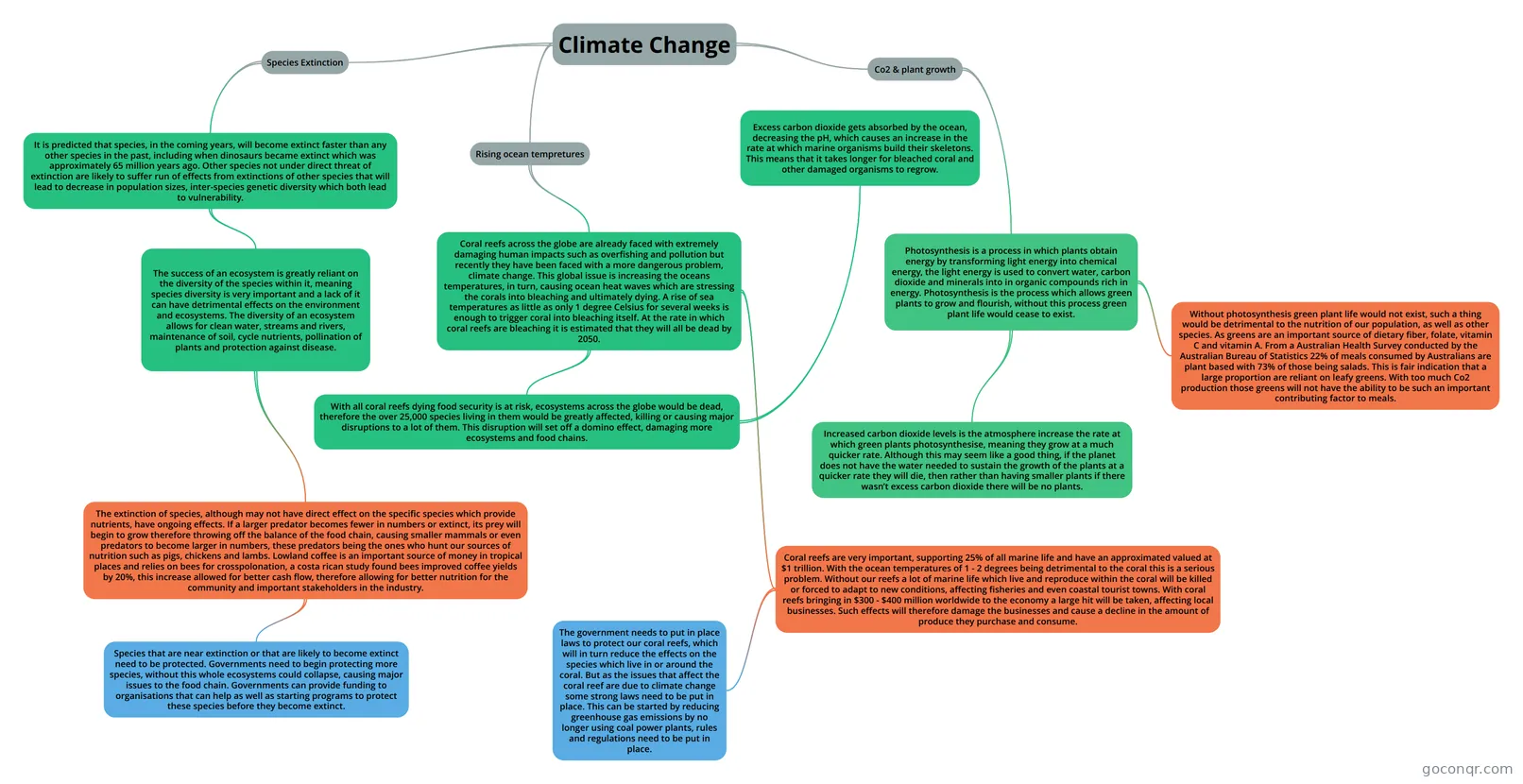
Mind map: climate change
Map content
Climate Change
Rising ocean tempretures
- Coral reefs across the globe are already faced with extremely damaging human impacts such as overfishing and pollution but recently they have been faced with a more dangerous problem, climate change. This global issue is increasing the oceans temperatures, in turn, causing ocean heat waves which are stressing the corals into bleaching and ultimately dying. A rise of sea temperatures as little as only 1 degree Celsius for several weeks is enough to trigger coral into bleaching itself. At the rate in which coral reefs are bleaching it is estimated that they will all be dead by 2050.
- With all coral reefs dying food security is at risk, ecosystems across the globe would be dead, therefore the over 25,000 species living in them would be greatly affected, killing or causing major disruptions to a lot of them. This disruption will set off a domino effect, damaging more ecosystems and food chains.
- Excess carbon dioxide gets absorbed by the ocean, decreasing the pH, which causes an increase in the rate at which marine organisms build their skeletons. This means that it takes longer for bleached coral and other damaged organisms to regrow.
- Coral reefs are very important, supporting 25% of all marine life and have an approximated valued at $1 trillion. With the ocean temperatures of 1 - 2 degrees being detrimental to the coral this is a serious problem. Without our reefs a lot of marine life which live and reproduce within the coral will be killed or forced to adapt to new conditions, affecting fisheries and even coastal tourist towns. With coral reefs bringing in $300 - $400 million worldwide to the economy a large hit will be taken, affecting local businesses. Such effects will therefore damage the businesses and cause a decline in the amount of produce they purchase and consume.
- The government needs to put in place laws to protect our coral reefs, which will in turn reduce the effects on the species which live in or around the coral. But as the issues that affect the coral reef are due to climate change some strong laws need to be put in place. This can be started by reducing greenhouse gas emissions by no longer using coal power plants, rules and regulations need to be put in place.
- With all coral reefs dying food security is at risk, ecosystems across the globe would be dead, therefore the over 25,000 species living in them would be greatly affected, killing or causing major disruptions to a lot of them. This disruption will set off a domino effect, damaging more ecosystems and food chains.
- Coral reefs across the globe are already faced with extremely damaging human impacts such as overfishing and pollution but recently they have been faced with a more dangerous problem, climate change. This global issue is increasing the oceans temperatures, in turn, causing ocean heat waves which are stressing the corals into bleaching and ultimately dying. A rise of sea temperatures as little as only 1 degree Celsius for several weeks is enough to trigger coral into bleaching itself. At the rate in which coral reefs are bleaching it is estimated that they will all be dead by 2050.
Co2 & plant growth
- Photosynthesis is a process in which plants obtain energy by transforming light energy into chemical energy, the light energy is used to convert water, carbon dioxide and minerals into in organic compounds rich in energy. Photosynthesis is the process which allows green plants to grow and flourish, without this process green plant life would cease to exist.
- Increased carbon dioxide levels is the atmosphere increase the rate at which green plants photosynthesise, meaning they grow at a much quicker rate. Although this may seem like a good thing, if the planet does not have the water needed to sustain the growth of the plants at a quicker rate they will die, then rather than having smaller plants if there wasn’t excess carbon dioxide there will be no plants.
- Without photosynthesis green plant life would not exist, such a thing would be detrimental to the nutrition of our population, as well as other species. As greens are an important source of dietary fiber, folate, vitamin C and vitamin A. From a Australian Health Survey conducted by the Australian Bureau of Statistics 22% of meals consumed by Australians are plant based with 73% of those being salads. This is fair indication that a large proportion are reliant on leafy greens. With too much Co2 production those greens will not have the ability to be such an important contributing factor to meals.
- Photosynthesis is a process in which plants obtain energy by transforming light energy into chemical energy, the light energy is used to convert water, carbon dioxide and minerals into in organic compounds rich in energy. Photosynthesis is the process which allows green plants to grow and flourish, without this process green plant life would cease to exist.
Species Extinction
- It is predicted that species, in the coming years, will become extinct faster than any other species in the past, including when dinosaurs became extinct which was approximately 65 million years ago. Other species not under direct threat of extinction are likely to suffer run of effects from extinctions of other species that will lead to decrease in population sizes, inter-species genetic diversity which both lead to vulnerability.
- The success of an ecosystem is greatly reliant on the diversity of the species within it, meaning species diversity is very important and a lack of it can have detrimental effects on the environment and ecosystems. The diversity of an ecosystem allows for clean water, streams and rivers, maintenance of soil, cycle nutrients, pollination of plants and protection against disease.
- The extinction of species, although may not have direct effect on the specific species which provide nutrients, have ongoing effects. If a larger predator becomes fewer in numbers or extinct, its prey will begin to grow therefore throwing off the balance of the food chain, causing smaller mammals or even predators to become larger in numbers, these predators being the ones who hunt our sources of nutrition such as pigs, chickens and lambs. Lowland coffee is an important source of money in tropical places and relies on bees for crosspolonation, a costa rican study found bees improved coffee yields by 20%, this increase allowed for better cash flow, therefore allowing for better nutrition for the community and important stakeholders in the industry.
- Species that are near extinction or that are likely to become extinct need to be protected. Governments need to begin protecting more species, without this whole ecosystems could collapse, causing major issues to the food chain. Governments can provide funding to organisations that can help as well as starting programs to protect these species before they become extinct.
- The extinction of species, although may not have direct effect on the specific species which provide nutrients, have ongoing effects. If a larger predator becomes fewer in numbers or extinct, its prey will begin to grow therefore throwing off the balance of the food chain, causing smaller mammals or even predators to become larger in numbers, these predators being the ones who hunt our sources of nutrition such as pigs, chickens and lambs. Lowland coffee is an important source of money in tropical places and relies on bees for crosspolonation, a costa rican study found bees improved coffee yields by 20%, this increase allowed for better cash flow, therefore allowing for better nutrition for the community and important stakeholders in the industry.
- The success of an ecosystem is greatly reliant on the diversity of the species within it, meaning species diversity is very important and a lack of it can have detrimental effects on the environment and ecosystems. The diversity of an ecosystem allows for clean water, streams and rivers, maintenance of soil, cycle nutrients, pollination of plants and protection against disease.
- It is predicted that species, in the coming years, will become extinct faster than any other species in the past, including when dinosaurs became extinct which was approximately 65 million years ago. Other species not under direct threat of extinction are likely to suffer run of effects from extinctions of other species that will lead to decrease in population sizes, inter-species genetic diversity which both lead to vulnerability.
Information
- Description
- Mind Map on Climate Change, created by Chloe Brannigan on 26/03/2018.
- Created by
- Chloe Brannigan
- Views
- 1
- Rating
More on Effects of climate change