
Mind map
Microbiology
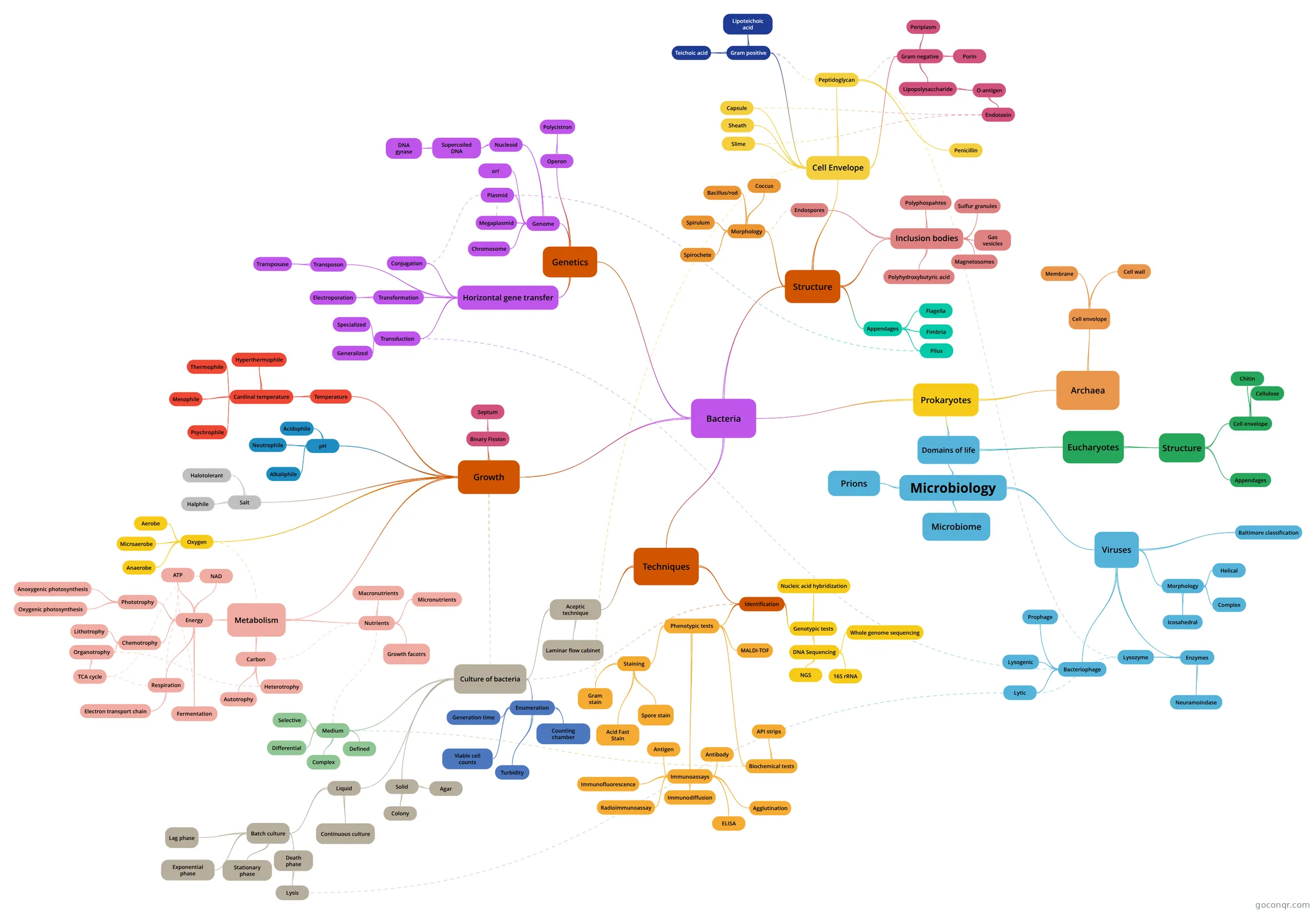
Mind map: Microbiology
Map content
Microbiology
Domains of life
- Prokaryotes
- Unicellular organisms that lake a nucleus and membrane bound organelles.
- Bacteria
- A domain of prokaryotic life.
- Structure
- Cell Envelope
- Peptidoglycan
- Polysaccharide crosslinked with peptide chains. A major component of bacterial cell walls.
- Penicillin
- β-lactam antibiotic discovered by Alexander Fleming. Produced by Penicillium species of Fungi. Prevents cross linking of peptidoglycan.
- Gram positive
- Descriptive of a bacterium that stains purple when performing the Gram stain. Indicates that the organism has cell envelope that consists of one membrane and a thick peptidoglycan layer.
- Lipoteichoic acid
- A component of Gram positive cell walls. Consist of chains of teichcoic acid linked covalently linked to lipids in the cell membrane.
- Teichoic acid
- Component of Gram-positive cell wall. A polymer of glycerol/ribitol phosphates and carbohydrates.
- Gram negative
- Descriptive of a bacterium that stains pink when performing the Gram stain. Indicates that the organism has cell envelope that consists of two membranes either side of a thin peptidoglycan layer.
- Periplasm
- Space between the cytoplasmic and outer membranes in Gram negative bacteria.
- Porin
- Protein channels in outer membrane of Gram-negative bacteria that allow passive diffusion into the periplasm and environment.
- Lipopolysaccharide
- Molecule of lipid covalently linked to a polysaccharide (O-antigen), present in the outer membrane of Gram-negative bacteria.
- O-antigen
- The saccharide component of lipopolysaccharide.
- Endotoxin
- Refers to the O-antigen of lipopolysaccharide in the outer membrane of Gram-negative bacteria. Can induce an immune response.
- Capsule
- A polysaccharide layer that exists outside of the cell envelope.
- Slime
- Descriptive of a bacterial capsule that is diffusing into the surrounding medium. Slime layer is looser than a capsule.
- Sheath
- Extracellular structure produced by certain bacteria for protection. A single sheath may contain 100s of cells.
- Peptidoglycan
- Appendages
- Pilus
- Prokaryotic appendage usually required for conjugation.
- Fimbria
- Prokaryotic appendage for attachment (to other organisms, surfaces or hosts).
- Flagella
- Prokaryotic appendage for motility.
- Pilus
- Inclusion bodies
- An aggregate of a substance that occurs in the cytoplasm.
- Polyphospahtes
- Phosphate storage moleule
- Sulfur granules
- Inclusions of insoluble sulfur, generated by sulfide oxidation
- Gas vesicles
- Prokaryotic inclusion body, used to help organisms float
- Magnetosomes
- Inclusion body present in certain bacteria consisting of magnetic iron particles.
- Polyhydroxybutyric acid
- Polymer produced by bacteria for storage of carbon.
- Endospores
- A structure produced by some Gram-positive bacteria. Are a dormant form of the cell, that are highly resist to heat, UV, desiccation, etc.
- Morphology
- Coccus
- A spherical-shaped cell
- Bacillus/rod
- Descriptive of a rod-shaped cell
- Spirulum
- Descriptive of a spiralled cell morphology
- Spirochete
- Descriptive of a cell with ‘corkscrew’ morphology.
- Coccus
- Cell Envelope
- Genetics
- Horizontal gene transfer
- Non-inherited transfer of genetic material between organisms; typically between different species/strain.
- Conjugation
- The transfer of genetical material, typically plasmids, by cell-to-cell contact. Plasmids are plaicated by rolling circle replication.
- Transformation
- Mechanism of horizontal gene transfer where DNA is taken up from the environment by ‘competent’ cells.
- Electroporation
- Laboratory technique of inducing transformation of bacteria by electric shock. Important for introducing cloning vectors into hosts.
- Transduction
- Mechanism of horizontal gene transfer where DNA is transferred from organism to organism by a viral vector. Can be generalized or specialized depending on whether the virus in integrated into the host genome.
- Specialized
- Specialized transduction occurs when a virus/phage has integrated into a genome. When the virus is excised from the genome, the flanking regions of DNA are co-excised and packaged into the capsid.
- Generalized
- Occurswhen random fragments of DNA are packaged into the viral capsid.
- Transposon
- A ‘jumping gene’. In its simplest form a gene encoding a transposase flanked by inverted repeats.
- Transposase
- Enzyme responsible for moving a transposon.
- Genome
- In bacteria, refers to all the chromosomes and plasmids in a cell.
- Plasmid
- Extrachromosomal DNA present in certain prokaryotes. Typically small, circular and contain non-essential genes.
- Chromosome
- In bacteria, a usually circular piece of DNA that encodes genes that are essential for the organism to grow.
- Megaplasmid
- A large plasmid, >1 Mb. Could be considered a small chromosome in some circumstances.
- ori
- The origin of replication in bacterial chromosomes and plasmids.
- Nucleoid
- Organisation of nucleic acid in a bacterial cell, consisting of supercoiled DNA and nucleoid proteins.
- Supercoiled DNA
- Descriptive of DNA that is overwound. Helps 'package' DNA.
- DNA gyrase
- Enzyme responsible for DNA supercoiling.
- Operon
- A functioning unit of DNA containing a cluster of genes under the control of a single promoter.
- Polycistron
- mRNA that contains the transcribed sequences of multiple genes
- Horizontal gene transfer
- Growth
- Binary Fission
- Process of cell division in bacteria
- Septum
- Region of a bacterial cell that constricts during binary fission.
- Temperature
- Cardinal temperature
- The temperature at which an organism ceases to grow.
- Hyperthermophile
- Organism (from Archaea and Bacteria) that grows optimally above 80 °C.
- Thermophile
- Organism that grows optimally above 60°C.
- Mesophile
- Organism that grows optimally between 20 and 45°C.
- Psychrophile
- Organism that grows optimally below 20°C.
- Cardinal temperature
- pH
- Acidophile
- Organism that grows optimally at acidic pH; typically below pH 4.
- Neutrophile
- An organism that grows optimally around pH 7.
- Alkaliphile
- Organism that grows optimally at alkali pH; typically above pH 10.
- Acidophile
- Salt
- Halphile
- Organism that grows optimally in high concentrations of salt.
- Halotolerant
- Organism that can grow in high concentrations of salt but grows optimally at low salt concentrations.
- Halphile
- Oxygen
- Aerobe
- An organism that requires oxygen for growth.
- Microaerobe
- Descriptive of an organism that only grows in the presence of low concentrations of oxygen.
- Anaerobe
- An organism that does not require oxygen for growth.
- Aerobe
- Metabolism
- Energy
- Phototrophy
- The use of light as an energy source
- Anoxygenic photosynthesis
- Photosynthetic process which doesn’t generate oxygen, i.e. use something other than water as the electron donor.
- Oxygenic photosynthesis
- Photosynthetic process which generates oxygen, i.e. uses water as the electron donor.
- Chemotrophy
- The use of chemicals as an energy source
- Lithotrophy
- The use of inorganic compounds as electron donors in respiration.
- Organotrophy
- The use of organic compounds as sources of electrons (usually via NADH).
- TCA cycle
- Cycle of reactions that generates converts acetate to CO2 generating NADH.
- Respiration
- The process in which electrons are transferred from an electron donor (e.g. NADH; H2) to electron acceptor (e.g. O2; NO3) to generate a proton motive force, which in turn is used to generate ATP by oxidative phosphorylation.
- Electron transport chain
- A chain of proteins, mostly in the cell membrane, that is responsible for electron transfer from a donor to an acceptor, generating a proton gradient across the membrane which is used for oxidative phosphylation (ATP) production.
- Fermentation
- The process which produces ATP by substrate-level phosphorylation. The substrate is both the electron donor and the electron acceptor.
- ATP
- Adenosine TriPhosphate. Energy currency in the cell.
- NAD
- Nicotin Adenine Dinucleotide. Used as electron currency in cells. Oxidised - NAD+; reduced NADH.
- Phototrophy
- Carbon
- Autotrophy
- Where organisms derive cell carbon from fixing CO2.
- Heterotrophy
- Where organisms derive cell carbon from organic sources
- Autotrophy
- Nutrients
- Macronutrients
- Nutrients required in large amounts
- Micronutrients
- Nutrients required in trace amounts
- Growth facotrs
- Organic micronutrients e.g. vitamins.
- Macronutrients
- Energy
- Binary Fission
- Techniques
- Identification
- Phenotypic tests
- Staining
- Gram stain
- A staining procedure that allows the differentiation of bacteria based on the structure of their cell envelope.
- Acid Fast Stain
- Staining procedure used for Mycobacterium. Also called Ziehl-Neelsen stain.
- Spore stain
- Staining procedure that allows differentiation between spores and vegetative and dead stain.
- Gram stain
- Biochemical tests
- Tests that often use dyes to determine the presence of certain enzymes or metabolic capabilities, such as catalase, cytochomre oxidase, tryptophanase, coagulase, B-galactosidase etc. These test require culturing of the organism and the dye is often present in the growth medium.
- API strips
- Commercially available strips that combine multiple biochemical tests.
- MALDI-TOF
- Matrix-Assisted Laser Desorption/Ionisation Time of Flight Mass Spectrometry. A method that analyses complex samples giving a bacterial species a ‘finger-print’ based on its protein profile.
- Immunoassays
- A procedure for detecting or measuring antigens or antibodies, which can be specific for individual strains of bacteria.
- Immunofluorescence
- A technique used for visualising biological samples using antibodies linked to a fluorescent probe.
- Immunodiffusion
- An immunoassay for detecting or measuring antibodies and antigens by their precipitation when diffused together through a gel.
- Agglutination
- The process that occurs if an antigen is mixed with its corresponding antibody.
- Radioimmunoassay
- Immunoassay using a radiolabelled (radioactive) antibody.
- ELISA
- Enzyme-Linked ImmunoSorbent Assay. Immunoassay that uses antibodies linked to enzymes to detect the presence of antigen or other antibodies.
- Antigen
- A component (particularly of a pathogen) that produces an immune response. Typically protein or polysaccharide.
- Antibody
- A large Y-shaped protein produced by the immune system to neutralize pathogens.
- Staining
- Genotypic tests
- Nucleic acid hybridization
- Technique used to identify microorganisms or the presence certain genes. Nucleotide probes linked to a fluorescent probe are added to cells and hybridise to complementary sequences in the genome, if they are present.
- DNA Sequencing
- 16S rRNA
- Subunit of prokaryotic ribosome that is used to identify organisms and determine evolutionary relationships between them.
- Whole genome sequencing
- The whole genome of an organism is sequenced (chromosomes and plasmids) to give accurate information about identity and metabolic capabilities (e.g. antibiotic resistance).
- NGS
- Next Generation Sequencing. Sequencing technologies that produce large amounts of high-throughput data. Allows the identification of multiple organisms in a complex sample without culturing.
- 16S rRNA
- Nucleic acid hybridization
- Phenotypic tests
- Aceptic technique
- The practice and procedures used to prevent contamination by microorganisms.
- Culture of bacteria
- Solid
- Agar
- Inert gelling agent used to provide a solid growth medium for microorganisms.
- Colony
- A visible mass of microorganisms all originating from a single cell, therefore a colony consists of bacteria that are all genetically identical.
- Agar
- Liquid
- Batch culture
- A culture of organisms in a fixed volume of medium with fixed amounts nutrients.
- Lag phase
- Period on a bacterial growth curve where little to no increase in number is observed. Cells are adjusting to a new environment at this stage.
- Stationary phase
- Stage of growth in batch culture when cells stop dividing due to exhausting nutrients.
- Exponential phase
- Period of growth in a batch culture where cells are dividing. Also called log phase.
- Death phase
- The phase in batch culture when organisms die off.
- Lysis
- The bursting of cells, releasing contents of the cytoplasm.
- Continuous culture
- A technique for culturing microorganisms in a steady state; cells are harvested at the same rate that nutrients are added. Other factors such as pH are also kept constant.
- Batch culture
- Medium
- A liquid or solid containing the components to support growth of microorganisms.
- Selective
- A type of growth media which allows growth of a specific organism but inhibits growth of others.
- Differential
- A type of growth media which allows differentiation between properties; typically contain an indicator such as dye.
- Complex
- A type of growth media which does not contained defined amounts of nutrients; typically contain digests of plant and animal products e.g. casein (from milk), yeast extract, beef extract, etc.
- Defined
- A type of growth media which contains defined amounts of nutrients.
- Enumeration
- Generation time
- The time it takes for a population of organisms to double in size.
- Counting chamber
- A specialist slide that allows counting of cells under a microscope.
- Viable cell counts
- A measure of cells that are alive and capable of growth. Involves plating cultures onto solid media and counting colonies.
- Turbidity
- Enumeration method that equates light absorbance in a spectrophotometer to cell nubmer/biomass.
- Generation time
- Solid
- Laminar flow cabinet
- Enclosed bench designed to prevent contamination of biological samples by blowing filtered air towards the user.
- Identification
- Archaea
- A domain of prokaryotic life.
- Cell envolope
- Single membrane Cell Wall in most, but not all species
- Membrane
- Cell wall
- Consists of an S-layer
- Eucharyotes
- Unicellular or multicellular organisms that have DNA surrounded by a nucleus and possess membrane bound organelles.
- Structure
- Cell envelope
- Consist of a single membrane with/without a cell wall.
- Chitin
- Cell wall present in fungi.
- Cellulose
- Appendages
- Cell envelope
- Prokaryotes
Viruses
- Bacteriophage
- A virus that infects bacteria.
- Prophage
- A phage that has integrated into the host genome.
- Lytic
- Phage/viral life cycle where the DNA remains separate from the host DNA.
- Lysogenic
- Phage/viral life cycle where the viral DNA is incorporated into the host genome. The lytic cycle is then activated at later time.
- Morphology
- Icosahedral
- Helical
- Complex
- Enzymes
- Lysozyme
- Enzyme that catalyses catalyzes the hydrolysis of 1,4-beta-linkages between N-acetylmuramic acid and N-acetyl-D-glucosamine residues in peptidoglycan.
- Neuramoindase
- Protein on the surface of some viruses that facilitates its release from the cell.
- Lysozyme
- Baltimore classification
- Bacteriophage
Prions
- An infectious protein particle that causes (typically) neurodegenerative disease.
Microbiome
- All the microorganisms in a particular environment (e.g. gut, soil etc).
Information
- Description
- Biology Mind Map on Microbiology, created by Tom Osborne on 27/06/2018.
- Created by
- Tom Osborne
- Views
- 172
- Rating