
Mind map
PA
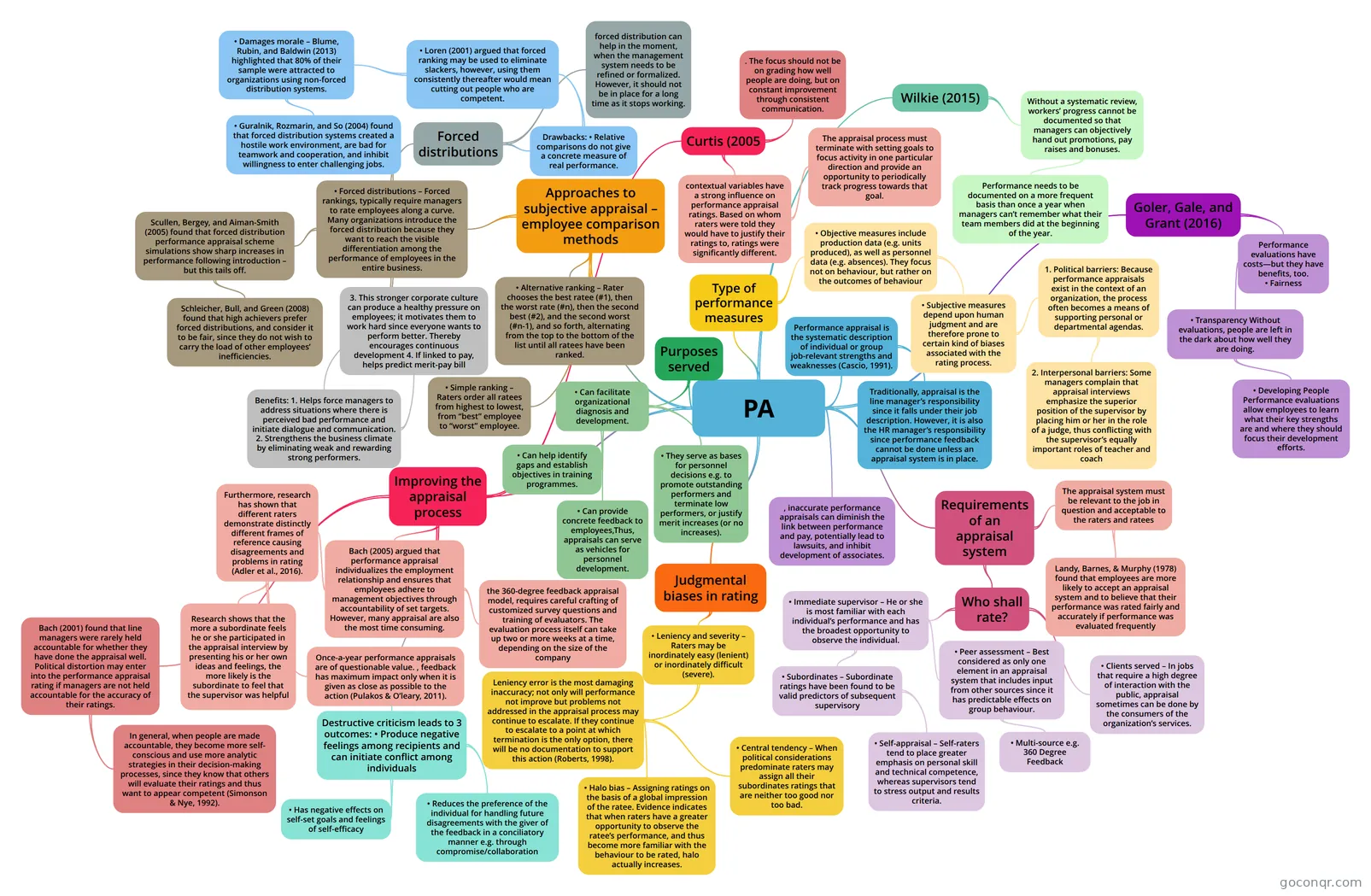
Mind map: Performance appraisal
Map content
PA
Performance appraisal is the systematic description of individual or group job-relevant strengths and weaknesses (Cascio, 1991).
- Traditionally, appraisal is the line manager’s responsibility since it falls under their job description. However, it is also the HR manager’s responsibility since performance feedback cannot be done unless an appraisal system is in place.
Purposes served
- • Can facilitate organizational diagnosis and development.
- • They serve as bases for personnel decisions e.g. to promote outstanding performers and terminate low performers, or justify merit increases (or no increases).
- • Can help identify gaps and establish objectives in training programmes.
- • Can provide concrete feedback to employees,Thus, appraisals can serve as vehicles for personnel development.
- • Can facilitate organizational diagnosis and development.
, inaccurate performance appraisals can diminish the link between performance and pay, potentially lead to lawsuits, and inhibit development of associates.
Type of performance measures
- • Objective measures include production data (e.g. units produced), as well as personnel data (e.g. absences). They focus not on behaviour, but rather on the outcomes of behaviour
- • Subjective measures depend upon human judgment and are therefore prone to certain kind of biases associated with the rating process.
- 1. Political barriers: Because performance appraisals exist in the context of an organization, the process often becomes a means of supporting personal or departmental agendas.
- 2. Interpersonal barriers: Some managers complain that appraisal interviews emphasize the superior position of the supervisor by placing him or her in the role of a judge, thus conflicting with the supervisor’s equally important roles of teacher and coach
- 1. Political barriers: Because performance appraisals exist in the context of an organization, the process often becomes a means of supporting personal or departmental agendas.
- • Subjective measures depend upon human judgment and are therefore prone to certain kind of biases associated with the rating process.
- • Objective measures include production data (e.g. units produced), as well as personnel data (e.g. absences). They focus not on behaviour, but rather on the outcomes of behaviour
Requirements of an appraisal system
- The appraisal system must be relevant to the job in question and acceptable to the raters and ratees
- Landy, Barnes, & Murphy (1978) found that employees are more likely to accept an appraisal system and to believe that their performance was rated fairly and accurately if performance was evaluated frequently
- Who shall rate?
- • Immediate supervisor – He or she is most familiar with each individual’s performance and has the broadest opportunity to observe the individual.
- • Peer assessment – Best considered as only one element in an appraisal system that includes input from other sources since it has predictable effects on group behaviour.
- • Multi-source e.g. 360 Degree Feedback
- • Subordinates – Subordinate ratings have been found to be valid predictors of subsequent supervisory
- • Self-appraisal – Self-raters tend to place greater emphasis on personal skill and technical competence, whereas supervisors tend to stress output and results criteria.
- • Peer assessment – Best considered as only one element in an appraisal system that includes input from other sources since it has predictable effects on group behaviour.
- • Clients served – In jobs that require a high degree of interaction with the public, appraisal sometimes can be done by the consumers of the organization’s services.
- • Immediate supervisor – He or she is most familiar with each individual’s performance and has the broadest opportunity to observe the individual.
- The appraisal system must be relevant to the job in question and acceptable to the raters and ratees
Judgmental biases in rating
- • Leniency and severity – Raters may be inordinately easy (lenient) or inordinately difficult (severe).
- Leniency error is the most damaging inaccuracy; not only will performance not improve but problems not addressed in the appraisal process may continue to escalate. If they continue to escalate to a point at which termination is the only option, there will be no documentation to support this action (Roberts, 1998).
- • Central tendency – When political considerations predominate raters may assign all their subordinates ratings that are neither too good nor too bad.
- • Halo bias – Assigning ratings on the basis of a global impression of the ratee. Evidence indicates that when raters have a greater opportunity to observe the ratee’s performance, and thus become more familiar with the behaviour to be rated, halo actually increases.
- Leniency error is the most damaging inaccuracy; not only will performance not improve but problems not addressed in the appraisal process may continue to escalate. If they continue to escalate to a point at which termination is the only option, there will be no documentation to support this action (Roberts, 1998).
- • Leniency and severity – Raters may be inordinately easy (lenient) or inordinately difficult (severe).
Approaches to subjective appraisal – employee comparison methods
- • Simple ranking – Raters order all ratees from highest to lowest, from “best” employee to “worst” employee.
- • Alternative ranking – Rater chooses the best ratee (#1), then the worst rate (#n), then the second best (#2), and the second worst (#n-1), and so forth, alternating from the top to the bottom of the list until all ratees have been ranked.
- • Forced distributions – Forced rankings, typically require managers to rate employees along a curve. Many organizations introduce the forced distribution because they want to reach the visible differentiation among the performance of employees in the entire business.
- Benefits: 1. Helps force managers to address situations where there is perceived bad performance and initiate dialogue and communication. 2. Strengthens the business climate by eliminating weak and rewarding strong performers.
- 3. This stronger corporate culture can produce a healthy pressure on employees; it motivates them to work hard since everyone wants to perform better. Thereby encourages continuous development 4. If linked to pay, helps predict merit-pay bill
- Scullen, Bergey, and Aiman-Smith (2005) found that forced distribution performance appraisal scheme simulations show sharp increases in performance following introduction – but this tails off.
- Schleicher, Bull, and Green (2008) found that high achievers prefer forced distributions, and consider it to be fair, since they do not wish to carry the load of other employees’ inefficiencies.
- Forced distributions
- Drawbacks: • Relative comparisons do not give a concrete measure of real performance.
- • Loren (2001) argued that forced ranking may be used to eliminate slackers, however, using them consistently thereafter would mean cutting out people who are competent.
- • Damages morale – Blume, Rubin, and Baldwin (2013) highlighted that 80% of their sample were attracted to organizations using non-forced distribution systems.
- • Guralnik, Rozmarin, and So (2004) found that forced distribution systems created a hostile work environment, are bad for teamwork and cooperation, and inhibit willingness to enter challenging jobs.
- • Damages morale – Blume, Rubin, and Baldwin (2013) highlighted that 80% of their sample were attracted to organizations using non-forced distribution systems.
- • Loren (2001) argued that forced ranking may be used to eliminate slackers, however, using them consistently thereafter would mean cutting out people who are competent.
- forced distribution can help in the moment, when the management system needs to be refined or formalized. However, it should not be in place for a long time as it stops working.
- Drawbacks: • Relative comparisons do not give a concrete measure of real performance.
- Benefits: 1. Helps force managers to address situations where there is perceived bad performance and initiate dialogue and communication. 2. Strengthens the business climate by eliminating weak and rewarding strong performers.
Improving the appraisal process
- Bach (2005) argued that performance appraisal individualizes the employment relationship and ensures that employees adhere to management objectives through accountability of set targets. However, many appraisal are also the most time consuming.
- the 360-degree feedback appraisal model, requires careful crafting of customized survey questions and training of evaluators. The evaluation process itself can take up two or more weeks at a time, depending on the size of the company
- Furthermore, research has shown that different raters demonstrate distinctly different frames of reference causing disagreements and problems in rating (Adler et al., 2016).
- Once-a-year performance appraisals are of questionable value. , feedback has maximum impact only when it is given as close as possible to the action (Pulakos & O’leary, 2011).
- Research shows that the more a subordinate feels he or she participated in the appraisal interview by presenting his or her own ideas and feelings, the more likely is the subordinate to feel that the supervisor was helpful
- Destructive criticism leads to 3 outcomes: • Produce negative feelings among recipients and can initiate conflict among individuals
- • Reduces the preference of the individual for handling future disagreements with the giver of the feedback in a conciliatory manner e.g. through compromise/collaboration
- • Has negative effects on self-set goals and feelings of self-efficacy
- Bach (2001) found that line managers were rarely held accountable for whether they have done the appraisal well. Political distortion may enter into the performance appraisal rating if managers are not held accountable for the accuracy of their ratings.
- In general, when people are made accountable, they become more self- conscious and use more analytic strategies in their decision-making processes, since they know that others will evaluate their ratings and thus want to appear competent (Simonson & Nye, 1992).
- Curtis (2005
- contextual variables have a strong influence on performance appraisal ratings. Based on whom raters were told they would have to justify their ratings to, ratings were significantly different.
- The appraisal process must terminate with setting goals to focus activity in one particular direction and provide an opportunity to periodically track progress towards that goal.
- . The focus should not be on grading how well people are doing, but on constant improvement through consistent communication.
- contextual variables have a strong influence on performance appraisal ratings. Based on whom raters were told they would have to justify their ratings to, ratings were significantly different.
- Bach (2005) argued that performance appraisal individualizes the employment relationship and ensures that employees adhere to management objectives through accountability of set targets. However, many appraisal are also the most time consuming.
Wilkie (2015)
- Without a systematic review, workers’ progress cannot be documented so that managers can objectively hand out promotions, pay raises and bonuses.
- Performance needs to be documented on a more frequent basis than once a year when managers can’t remember what their team members did at the beginning of the year.
- Without a systematic review, workers’ progress cannot be documented so that managers can objectively hand out promotions, pay raises and bonuses.
Goler, Gale, and Grant (2016)
- Performance evaluations have costs—but they have benefits, too. • Fairness
- • Transparency Without evaluations, people are left in the dark about how well they are doing.
- • Developing People Performance evaluations allow employees to learn what their key strengths are and where they should focus their development efforts.
- • Transparency Without evaluations, people are left in the dark about how well they are doing.
- Performance evaluations have costs—but they have benefits, too. • Fairness
Information
- Description
- Mind Map on PA, created by Tiffany Afia on 22/08/2018.
- Created by
- Tiffany Afia
- Views
- 0
- Rating