
Mind map
WCC VCE PE: Training Programs- whats involved
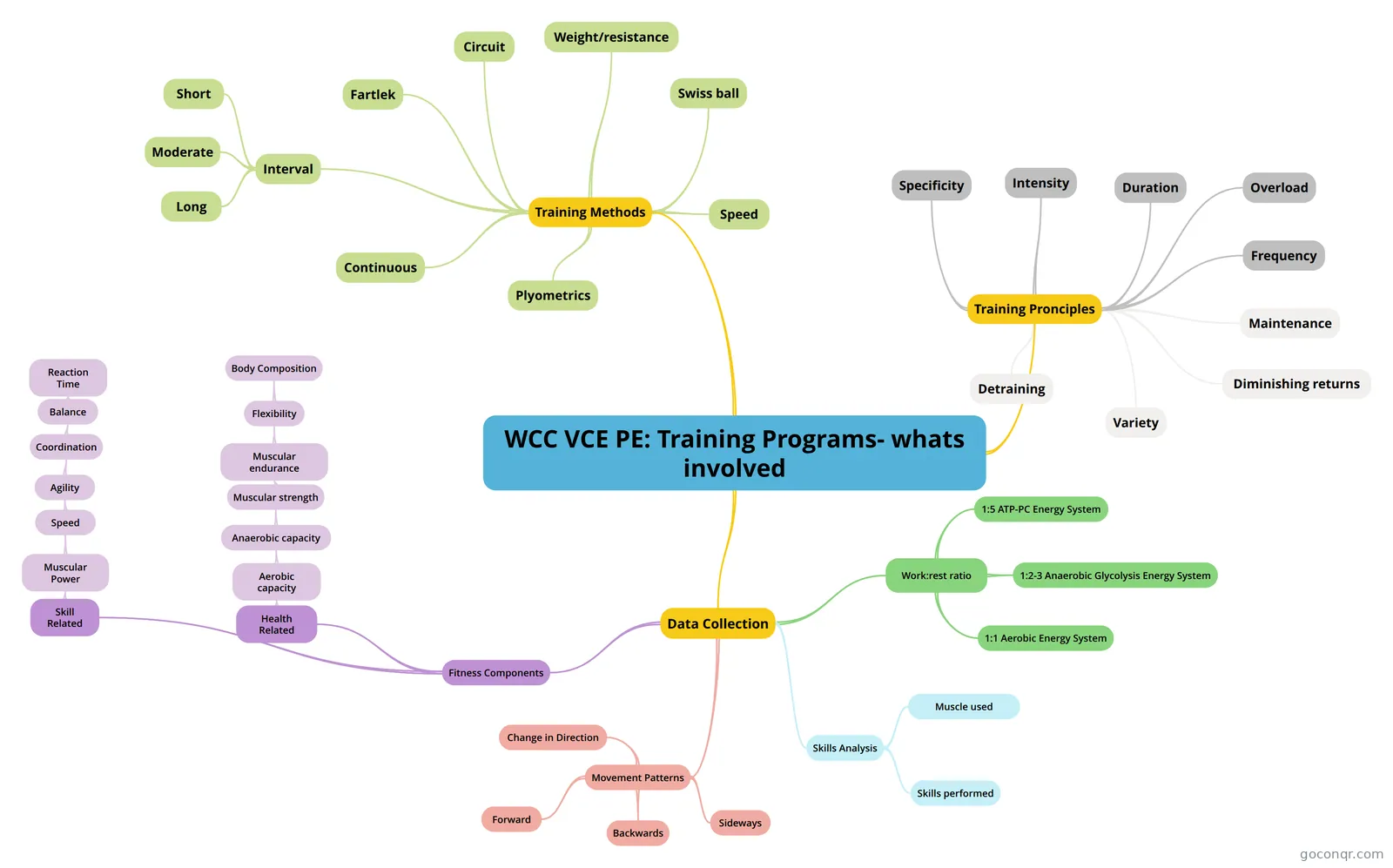
Mind map: VCE PE training programs
Map content
WCC VCE PE: Training Programs- whats involved
Data Collection
- Conduct to see what are the key areas that need to be incorperated into a training program
- Skills Analysis
- Muscle used
- Skills performed
- Work:rest ratio
- 1:5 ATP-PC Energy System
- 1:2-3 Anaerobic Glycolysis Energy System
- 1:1 Aerobic Energy System
- Movement Patterns
- Forward
- Backwards
- Sideways
- Change in Direction
- Fitness Components
- Physical fitness is considered a measure of the body’s ability to function efficiently, effectively and without injury in work and leisure activities, to pursue recreational activities and to cope with emergency situations.
- Health Related
- Health-related fitness components are those that are more important to health than to athletic or sporting ability
- Aerobic capacity
- The ability of our Cardiovascular and respiratory systems to supply oxygen to working muscles during exercise;
- Anaerobic capacity
- the ability of the body to produce energy without using oxygen
- Muscular strength
- the amount of force that a muscle or group of muscles can exert against resistance in a single maximal contraction
- Muscular endurance
- The ability of a muscle or muscle group to sustain repeated contractions for an extended period of time whilst resisting fatigue
- Flexibility
- The ability to move our joints through their full range of movement
- Body Composition
- the relative percentage of body fat compared to lean body mass
- Skill Related
- Skill-related components improve a person’s physical performance in motor skills.
- Muscular Power
- An explosive contraction of the muscles. A contraction with speed and force
- Speed
- The ability to move all or part of the body as quickly as possible from one point to another
- Agility
- the ability to change direction quickly whilst maintaing balance
- Coordination
- The ability to carry out a series of movements smoothly and efficiently based on input from the senses
- Balance
- the ability to maintain body equilibrium while stationary (static) or moving (dynamic)
- Reaction Time
- the amount of time from receiving a stimulus to starting a response
Training Methods
- Continuous
- Interval
- Long
- Moderate
- Short
- Fartlek
- Circuit
- Weight/resistance
- Plyometrics
- Speed
- Swiss ball
Training Pronciples
- SIDOF
- Specificity
- Training needs to be specific to the activity you are training for. The Fitness components, Energy Systems, Muscle groups & Movement Patterns.
- Intensity
- Intensity will depend on what energy system you are focusing on. AEROBIC ZONE: 70-85% max HR ANAEROBIC ZONE: 85-100% max HR Can be measured by METS, Borgs RPE, %maxHR, talk test
- Duration
- Can mean 2 things 1) How long a session lasts (at least 30mins for aerobic activities) 2) How long a training program goes for (12 weeks to see improvement in aerobic capacity)
- Overload
- Overload should be applied when adaptations have occurred in the athletes body. GUIDELINES only change one factor at a time Intensity change by max 2% Duration (work or rest), Load (sets/reps/weight) by max 10%
- Frequency
- To Improve: minimum of 3 sessions per week To Maintain: minimum of 2 sessions per week
- Maintenance
- To maintain ones current fitness levels, you must train at least 2 times per week
- Diminishing returns
- The closer an athlete gets to the genetic potential, the harder/slower it will be for them to improve
- Variety
- Incorporating variety into a training program will aid in the motivation of the athlete. Can be done by changing the type of activity (running>cycling), Location (treadmill>park) or who you train with.
- Detraining
Information
- Description
- An outline of what steps and knowledge you need to succesfully set up a training program
- Created by
- Tim Hodge
- Views
- 296
- Tags
- Rating