
Mind map
Ch. 20/24: Population Genetics
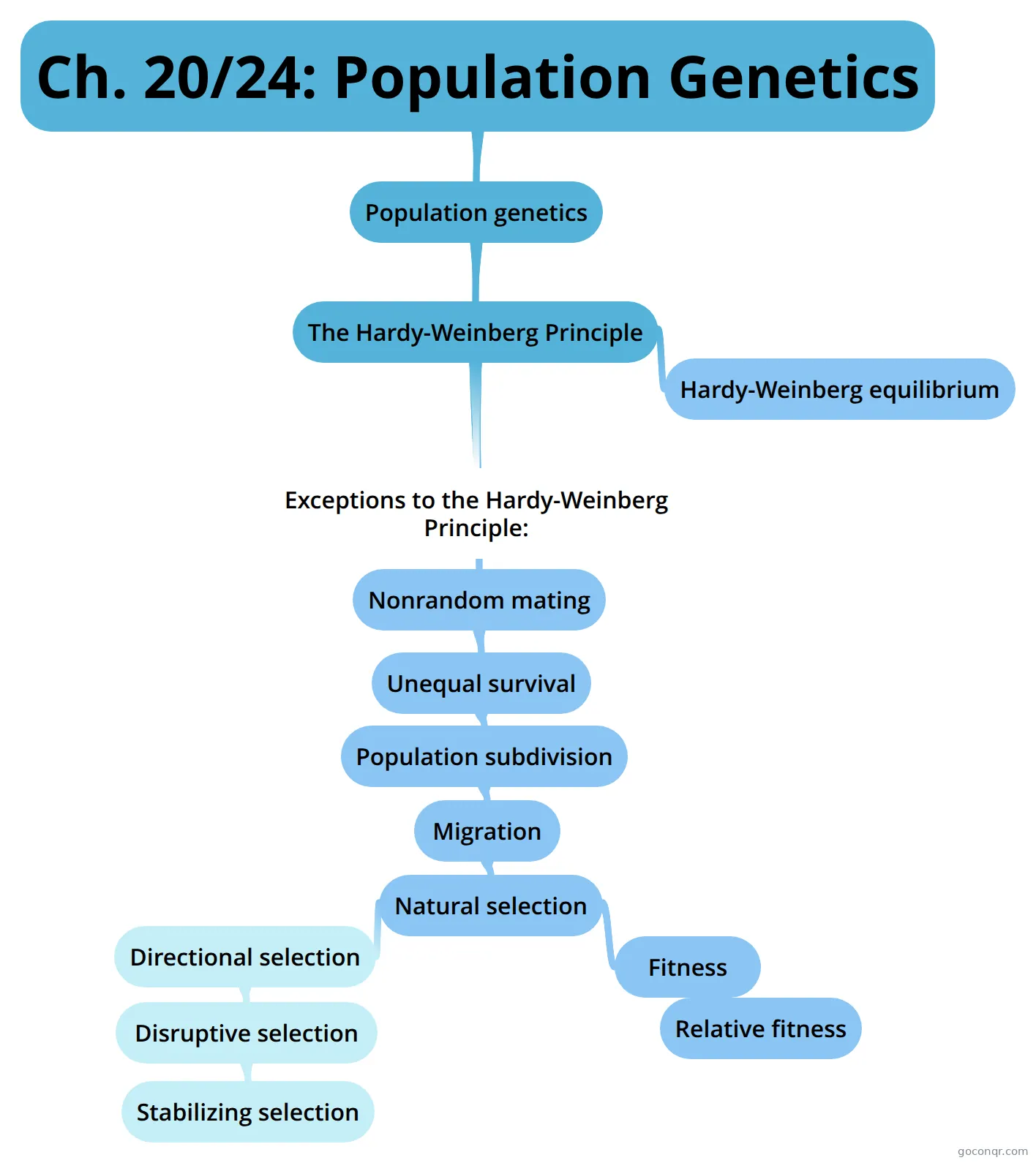
Mind map: Population genetics
Map content
Ch. 20/24: Population Genetics
Population genetics
- :studies genes in groups of individuals and includes studies of -allelic variation among individuals -transmission of allelic variants from parents to offspring generation after generation -temporal changes in the genetic makeup of a population due to systematic random evolutionary forces
- The Hardy-Weinberg Principle
- :describes a mathematical relationship between allele frequencies and genotype frequencies and allow the prediction of a population's genotype frequencies from its allele frequencies Hardy-Weinberg assumes: -random mating -infinite population size (no genetic drift) -no mutation -no genetic mutation -no natural selection
- Hardy-Weinberg equilibrium
- If mating is random and no differential survival or reproduction exists among members of the population, the hardy Weinberg genotype frequencies persist generation after generation
- Exceptions to the Hardy-Weinberg Principle:
- Nonrandom mating
- . mating between genetically related individuals - mating between individuals with similar phenotypes
- Unequal survival
- zygotes produced from random mating have different survival rates
- Population subdivision
- in nature, populations may be subdivided sue to geographical or ecological barriers ex. grey squirrels
- Migration
- the introduction of genes by recent migrations can alter allele and genotype frequencies within a population and disrupt hardy weinberg
- Natural selection
- :selection for survival and reproduction in the face of competition -measured by fitness
- Fitness
- symbolized by w : the ability to survive and reproduce -the average fitness of a population is calculated by averaging the fitness of individuals . 0 if it dies or fails to reproduce 1 if it survives and produces offspring 2 if it survives and produces 2 offspring
- Relative fitness
- Ex. moths In each environment, the fitness of the superior genotype is defines as 1. the fitness of the inferior genotype is expressed as a deviation from 1 - the fitness deviation, s, is the selection coefficient and measures the intensity of natural selection acting on the genotypes in the population
- Directional selection
- favors values of a trait at one end of its distribution
- Disruptive selection
- favors extreme values of a trait at the expense of intermediate values
- Stabilizing selection
- favors intermediate values of a trait
Information
- Description
- Second year undergraduate Genetics Mind Map on Ch. 20/24: Population Genetics, created by Deb A on 12/11/2018.
- Created by
- Deb A
- Views
- 0
- Rating