
Mind map
Gas Exchange in Insects & Fish
Map content
Gas Exchange in Insects & Fish
Single-Celled Organisms
- Microscopic size = Very easy for gas exchange!
- SA/V ratio = Massive
- Diffusion is across only 1 cell membrane = v.little distance to travel
- Take in oxygen and get rid of CO2 easily
- If there is a cell wall, no barrier to gas exchange as completely permeable
Insects
- Multi-celled organisms
- Cannot rely on diffusion for gas ex.
- Surfaces that exchange gasses also facilitate water loss = Problem for insects
- Cannot rely on diffusion for gas ex.
- Covered in waxy coating to help stop water loss, but it's fairly impermeable to gases
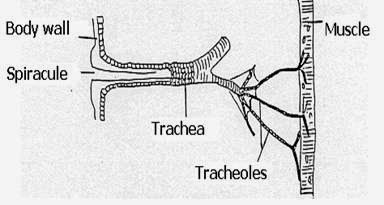
- Tracheal System developed for gas exchange
- Tiny holes called spiracles
- Spiracles lead to tubes Tracheae
- Tubes lines with Chitin - impermeable to gasses & adds structural strength
- Splits off into smaller TRACHEOLES = gas exchange surfaces. Not lines with chitin.
- Loads of tracheoles = huge surface area for gas exchange
- Tracheole ends filled with water
- When insect is active, water is withdrawn for more efficient diffusion
- Tracheole ends filled with water
- Located near respiring tissues for efficient diffusion
- Loads of tracheoles = huge surface area for gas exchange
- Spiracles lead to tubes Tracheae
- Some insects have valve systems that control the size of the spiracles to control water loss
- Valves only open when respiration rate & need for Oxygen is high and excess CO2 is detected
- e.g. locusts
- Tiny holes called spiracles
- Multi-celled organisms
Larger insects
- Have trachea can expand and contract called air sacs
- Move with expansion and contraction of the abdomen and thorax
- Gas exchange system completely independent from circulatory system
- Move with expansion and contraction of the abdomen and thorax
- Have trachea can expand and contract called air sacs
Aquatic Insects & Larvae
- Larvae = immature insect
- Adaptations to allow gas exchange
- Some larvae have gill like structures on abdomen
- Situated near openings to tracheae
- Have no working spiracles
- Provide massive surface area for gas exchange
- Continually move to provide continuous flow of oxygenated water around them
- Some larvae have elongated breathing tubes
- Connect to tracheal system and act as snorkels to get oxygen from the air
- Adult insects: Some beetles attach air bubble to abdomen for oxygen when diving. Others trap oxygen in the hairs on their legs
- Some larvae have gill like structures on abdomen
- Larvae in poorly oxygenated water have haemoglobin in their body fluids, which has a much higher affinity to oxygen than human hgb.
Bony Fish
- Diffusion not possible
- Relatively large in size
- Waterproof skin
- Internal Gills deveoped to absorb oxygen from surrounding water
- Gills provide large surface area for gas exch. Very short diffusion distance; high conc. gradient
- Diffusion not possible
Gill Structure
- Internal, located behind the head.
- Made of gill filaments, stacked very closley together.
- Each filament covered with gill lamellae, at right angles to filaments to offer maximum surface area.
- How fish perform gas exchange:
- Take in water through their mouth & direct over gills
- Gills open and water is expelled from the body
- Gas exchange takes place as water moves over the gills and blood flows through the gill lamellae in the opposite direction
- Steep concentration gradient maintained by current flow.
- Gas exchange takes place as water moves over the gills and blood flows through the gill lamellae in the opposite direction
- Gills open and water is expelled from the body
- Take in water through their mouth & direct over gills
Images and files in the map
Information
- Description
- Mind Map on Gas Exchange in Insects & Fish, created by Ellie Robinson on 14-11-2018.
- Created by
- Ellie Robinson
- Views
- 4
- Rating