
Mind map
White Blood Cells
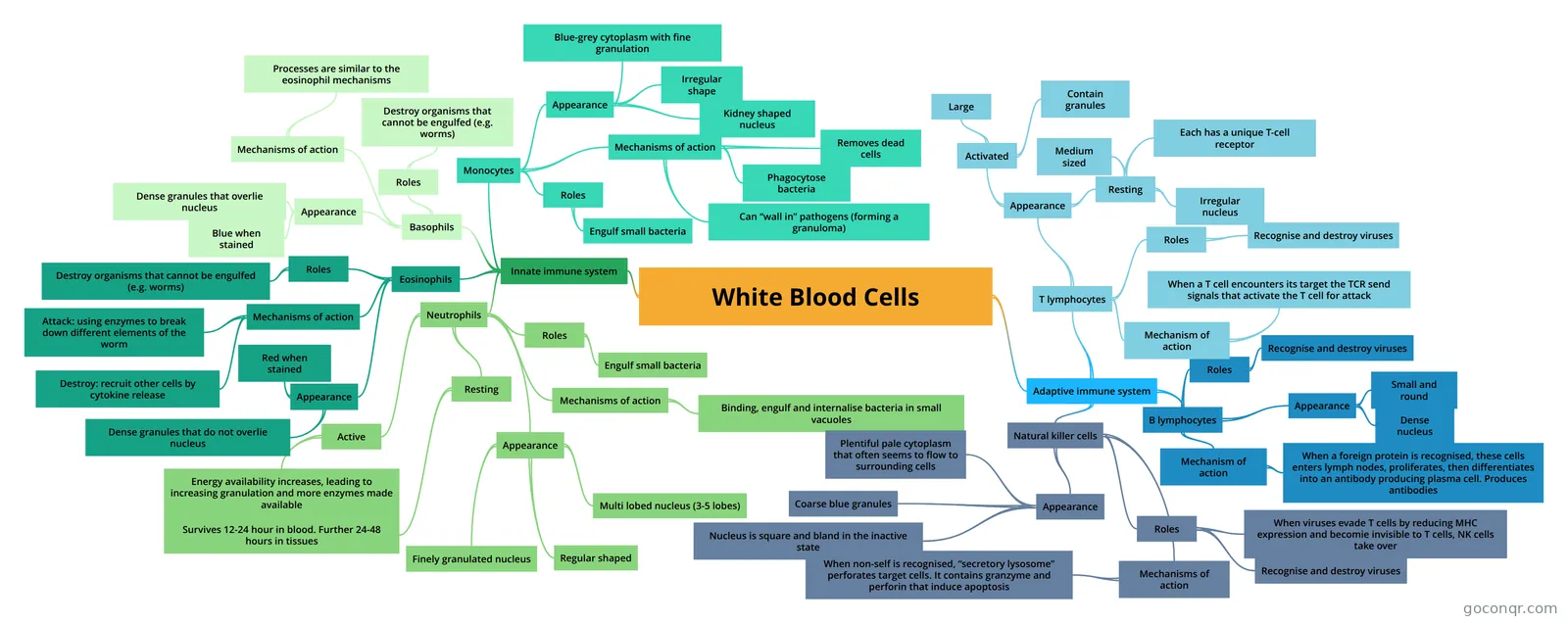
Mind map: White blood cells
Map content
White Blood Cells
Innate immune system
- Neutrophils
- Roles
- Engulf small bacteria
- Mechanisms of action
- Binding, engulf and internalise bacteria in small vacuoles
- Appearance
- Multi lobed nucleus (3-5 lobes)
- Regular shaped
- Finely granulated nucleus
- Resting
- Survives 12-24 hour in blood. Further 24-48 hours in tissues
- Active
- Energy availability increases, leading to increasing granulation and more enzymes made available
- Roles
- Monocytes
- Roles
- Engulf small bacteria
- Mechanisms of action
- Can “wall in” pathogens (forming a granuloma)
- Phagocytose bacteria
- Removes dead cells
- Appearance
- Irregular shape
- Kidney shaped nucleus
- Blue-grey cytoplasm with fine granulation
- Roles
- Basophils
- Roles
- Destroy organisms that cannot be engulfed (e.g. worms)
- Mechanisms of action
- Processes are similar to the eosinophil mechanisms
- Appearance
- Dense granules that overlie nucleus
- Blue when stained
- Roles
- Eosinophils
- Roles
- Destroy organisms that cannot be engulfed (e.g. worms)
- Mechanisms of action
- Attack: using enzymes to break down different elements of the worm
- Destroy: recruit other cells by cytokine release
- Appearance
- Dense granules that do not overlie nucleus
- Red when stained
- Roles
- Neutrophils
Adaptive immune system
- Natural killer cells
- Roles
- Recognise and destroy viruses
- When viruses evade T cells by reducing MHC expression and becomie invisible to T cells, NK cells take over
- Appearance
- Plentiful pale cytoplasm that often seems to flow to surrounding cells
- Nucleus is square and bland in the inactive state
- Coarse blue granules
- Mechanisms of action
- When non-self is recognised, “secretory lysosome” perforates target cells. It contains granzyme and perforin that induce apoptosis
- Roles
- T lymphocytes
- Roles
- Recognise and destroy viruses
- Appearance
- Resting
- Medium sized
- Irregular nucleus
- Each has a unique T-cell receptor
- Activated
- Large
- Contain granules
- Resting
- Mechanism of action
- When a T cell encounters its target the TCR send signals that activate the T cell for attack
- Roles
- B lymphocytes
- Roles
- Recognise and destroy viruses
- Appearance
- Small and round
- Dense nucleus
- Mechanism of action
- When a foreign protein is recognised, these cells enters lymph nodes, proliferates, then differentiates into an antibody producing plasma cell. Produces antibodies
- Roles
- Natural killer cells
Information
- Description
- Mind Map on White Blood Cells, created by Charlotte James on 13/12/2018.
- Created by
- Charlotte James
- Views
- 0
- Rating