
Mind map
Sociology - Theories
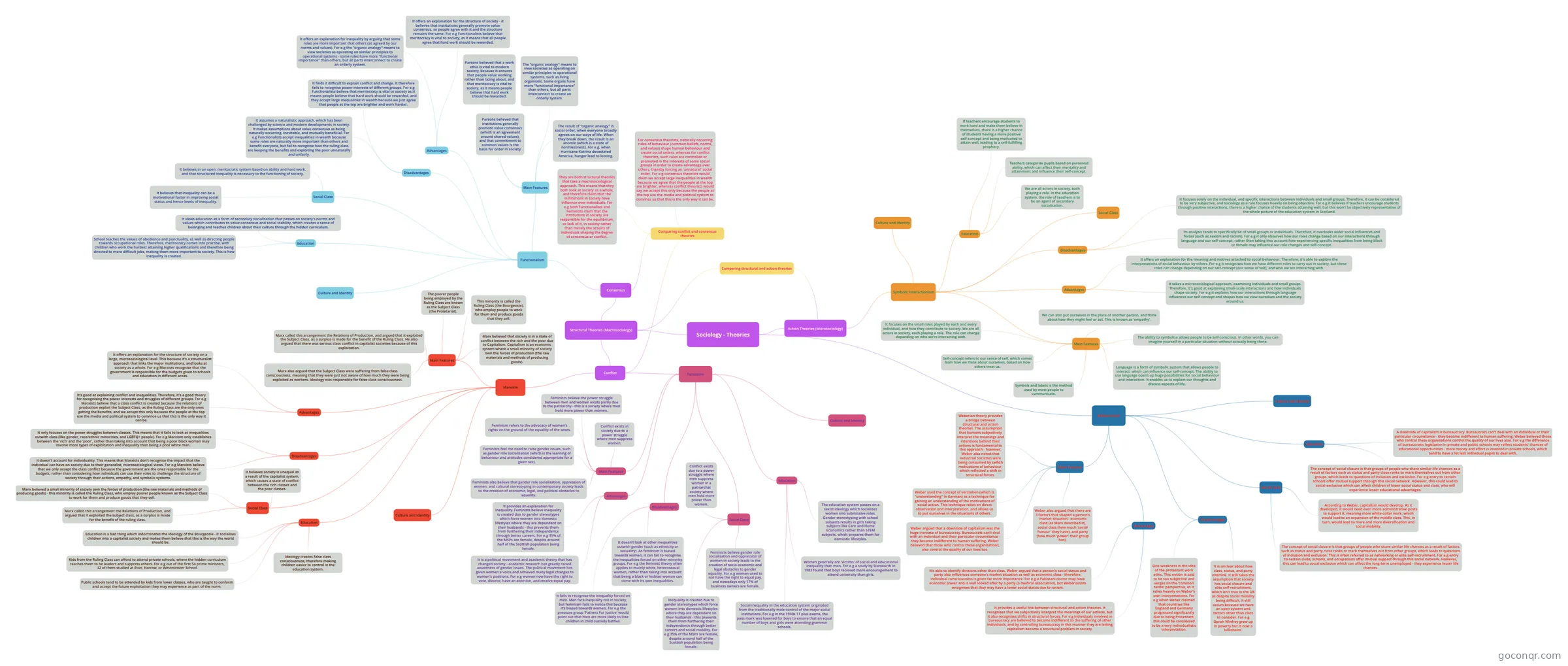
Mind map: sociology theories
Map content
Sociology - Theories
Structural Theories (Macrosociology)
- Comparing structural and action theories
- Consensus
- Functionalism
- Main Features
- Parsons believed that institutions generally promote value consensus (which is an agreement around shared values), and that commitment to common values is the basis for order in society.
- Parsons believed that a work ethic is vital to modern society, because it ensures that people value working rather than lazing about, and that meritocracy is vital to society, as it means people believe that hard work should be rewarded.
- The "organic analogy" means to view societies as operating on similar principles to operational systems, such as living organisms. Some organs have more "functional importance" than others, but all parts interconnect to create an orderly system.
- The result of "organic analogy" is social order, when everyone broadly agrees on our ways of life. When they break down, the result is an anomie (which is a state of normlessness). For e.g. when Hurricane Katrina devastated America, hunger lead to looting.
- Advantages
- It offers an explanation for the structure of society - it believes that institutions generally promote value consensus, so people agree with it and the structure remains the same. For e.g Functionalists believe that meritocracy is vital to society, as it means that all people agree that hard work should be rewarded.
- It offers an explanation for inequality by arguing that some roles are more important that others (as agreed by our norms and values). For e.g the "organic analogy" means to view societies as operating on similar principles to operational systems - some roles have more "functional importance" than others, but all parts interconnect to create an orderly system.
- Disadvantages
- It finds it difficult to explain conflict and change. It therefore fails to recognise power interests of different groups. For e.g Functionalists believe that meritocracy is vital to society as it means people believe that hard work should be rewarded, and they accept large inequalities in wealth because we just agree that people at the top are brighter and work harder.
- It assumes a naturalistic approach, which has been challenged by science and modern developments in society. It makes assumptions about value consensus as being naturally occurring, inevitable, and mutually beneficial. For e.g Functionalists accept inequalities in wealth because some roles are naturally more important than others and benefit everyone, but fail to recognise how the ruling class are keeping the benefits and exploiting the poor unnaturally and unfairly.
- Social Class
- It believes in an open, meritocratic system based on ability and hard work, and that structured inequality is necessary to the functioning of society.
- It believes that inequality can be a motivational factor in improving social status and hence levels of inequality.
- Education
- It views education as a form of secondary socialisation that passes on society's norms and values which contributes to value consensus and social stability, which creates a sense of belonging and teaches children about their culture through the hidden curriculum.
- School teaches the values of obedience and punctuality, as well as directing people towards occupational roles. Therefore, meritocracy comes into practise, with children who work the hardest attaining higher qualifications and therefore being directed to more difficult jobs, making them more important to society. This is how inequality is created.
- Culture and Identity
- Main Features
- Comparing conflict and consensus theories
- They are both structural theories that take a macrosociological approach. This means that they both look at society as a whole, and therefore claim that the institutions in society have influence over individuals. For e.g both Functionalists and Feminists claim that the institutions in society are responsible for the equilibrium, or lack of it, in society rather than merely the actions of individuals shaping the degree of consensus or conflict.
- Functionalism
- Conflict
- Marxism
- Main Features
- Marx believed that society is in a state of conflict between the rich and the poor due to Capitalism. Capitalism is an economic system where a small minority of society own the forces of production (the raw materials and methods of producing goods).
- This minority is called the Ruling Class (the Bourgeosie), who employ people to work for them and produce goods that they sell.
- The poorer people being employed by the Ruling Class are known as the Subject Class (the Proletariat).
- Marx called this arrangement the Relations of Production, and argued that it exploited the Subject Class, as a surplus is made for the benefit of the Ruling Class. He also argued that there was serious class conflict in capitalist societies because of this exploitation.
- Marx also argued that the Subject Class were suffering from false class consciousness, meaning that they were just not aware of how much they were being exploited as workers. Ideology was responsible for false class consciousness.
- Advantages
- It offers an explanation for the structure of society on a large, microsociological level. This because it's a structuralist approach that links the major institutions, and looks at society as a whole. For e.g Marxists recognise that the government is responsible for the budgets given to schools and education in different areas.
- It's good at explaining conflict and inequalities. Therefore, it's a good theory for recognising the power interests and struggles of different groups. For e.g Marxists believe that a class conflict is created because the relations of production exploit the Subject Class, as the Ruling Class are the only ones getting the benefits, and we accept this only because the people at the top use the media and political system to convince us that this is the only way it can be.
- Disadvantages
- It only focuses on the power struggles between classes. This means that it fails to look at inequalities outwith class (like gender, race/ethnic minorities, and LGBTQ+ people). For e.g Marxism only establishes between the 'rich' and the 'poor', rather than taking into account that being a poor black woman may involve more types of exploitation and inequality than being a poor white man.
- It doesn't account for individuality. This means that Marxists don't recognise the impact that the individual can have on society due to their generalist, microsociological views. For e.g Marxists believe that we only accept the class conflict because the government are the ones responsible for the budgets, rather than considering how individuals can use their roles to challenge the structure of society through their actions, empathy, and symbolic systems.
- Social Class
- It believes society is unequal as a result of the capitalist system, which causes a state of conflict between the rich classes and the poor classes.
- Marx believed a small minority of society own the forces of production (the raw materials and methods of producing goods) - this minority is called the Ruling Class, who employ poorer people known as the Subject Class to work for them and produce goods that they sell.
- Marx called this arrangement the Relations of Production, and argued that it exploited the subject class, as a surplus is made for the benefit of the ruling class.
- Education
- Education is a bad thing which indoctrinates the ideology of the Bourgeosie - it socialises children into a capitalist society and makes them believe that this is the way the world should be.
- Kids from the Ruling Class can afford to attend private schools, where the hidden curriculum teaches them to be leaders and suppress others. For e.g out of the first 54 prime ministers, 32 of them studied at Eton, Harrow, or Westminster School.
- Public schools tend to be attended by kids from lower classes, who are taught to conform and accept the future exploitation they may experience as part of the norm.
- Ideology creates false class consciousness, therefore making children easier to control in the education system.
- Culture and Identity
- Main Features
- Feminism
- Main Features
- Conflict exists in society due to a power struggle where men suppress women.
- Feminists believe the power struggle between men and women exists partly due to the patriarchy - this is a society where men hold more power than women.
- Feminism refers to the advocacy of women's rights on the ground of the equality of the sexes.
- Feminists feel the need to raise gender issues, such as gender role socialisation (which is the learning of behaviour and attitudes considered appropriate for a given sex).
- Feminists also believe that gender role socialisation, oppression of women, and cultural stereotyping in contemporary society leads to the creation of economic, legal, and political obstacles to equality.
- Advantages
- It provides an explanation for inequality. Feminists believe inequality is created due to gender stereotypes which force women into domestic lifestyles where they are dependant on their husbands - this prevents them from furthering their independence through better careers. For e.g 35% of the MSPs are female, despite around half of the Scottish population being female.
- It is a political movement and academic theory that has changed society - academic research has greatly raised awareness of gender issues. The political movement has given women a voice and achieved many legal changes to women's positions. For e.g women now have the right to vote, divorce, have an abortion, and receive equal pay.
- Disadvantages
- It fails to recognise the inequality forced on men. Men face inequality too in society, but feminism fails to notice this because it's biased towards women. For e.g the pressure group 'Fathers For Justice' would point out that men are more likely to lose children in child custody battles.
- It doesn't look at other inequalities outwith gender (such as ethnicity or sexuality). As feminism is biased towards women, it can fail to recognise the inequalities forced on other minority groups. For e.g the feminist theory often applies to mainly white, heterosexual women, rather than taking into account that being a black or lesbian woman can come with its own inequalities.
- Social Class
- Conflict exists due to a power struggle where men suppress women in a patriarchal society where men hold more power than women.
- Inequality is created due to gender stereotypes which force women into domestic lifestyles where they are dependant on their husbands - this prevents them from furthering their independence through better careers and social mobility. For e.g 35% of the MSPs are female, despite around half of the Scottish population being female.
- Feminists believe gender role socialisation and oppression of women in society leads to the creation of socio-economic and legal obstacles to gender equality. For e.g women used to not have the right to equal pay, and nowadays only 17% of business owners are female.
- Education
- Social inequality in the education system originated from the traditionally male control of the major social institutions. For e.g in the 1940s 11 plus exams, the pass mark was lowered for boys to ensure that an equal number of boys and girls were attending grammar schools.
- Women generally are 'victims' of social and educational inequality than men. For e.g a study by Stanworth in 1983 found that boys received more encouragement to attend university than girls.
- The education system passes on a sexist ideology which socialises women into submissive roles. Gender stereotyping with school subjects results in girls taking subjects like Care and Home Economics rather than STEM subjects, which prepares them for domestic lifestyles.
- Culture and Identity
- Main Features
- For consensus theorists, naturally occurring rules of behaviour (common beliefs, norms, and values) shape human behaviour and create social orders, whereas for conflict theorists, such rules are controlled or promoted in the interests of some social groups in order to create advantage over others, thereby forcing an 'unnatural' social order. For e.g consensus theorists would claim we accept large inequalities in wealth because we agree that the people at the top are brighter, whereas conflict theorists would say we accept this only because the people at the top use the media and political system to convince us that this is the only way it can be.
- Marxism
- Comparing structural and action theories
Action Theories (Microsociology)
- Symbolic Interactionism
- Main Features
- It focuses on the small roles played by each and every individual, and how they contribute to society. We are all actors in society, each playing a role. The role can change depending on who we're interacting with.
- Self-concept refers to our sense of self, which comes from how we think about ourselves, based on how others treat us.
- Symbols and labels is the method used by most people to communicate.
- Language is a form of symbolic system that allows people to interact, which can influence our self-concept. The ability to use language opens up huge possibilities for social behaviour and interaction. It enables us to explain our thoughts and discuss aspects of life.
- The ability to symbolise allows people to be self-conscious. In other words, you can imagine yourself in a particular situation without actually being there.
- We can also put ourselves in the place of another person, and think about how they might feel or act. This is known as 'empathy'.
- Advantages
- It takes a microsociological approach, examining individuals and small groups. Therefore, it's good at explaining small-scale interactions and how individuals shape society. For e.g it explains how our interactions through language influences our self-concept and shapes how we view ourselves and the society around us.
- It offers an explanation for the meaning and motives attached to social behaviour. Therefore, it's able to explore the interpretations of social behaviour by others. For e.g it recognises how we have different roles to carry out in society, but these roles can change depending on our self-concept (our sense of self), and who we are interacting with.
- Disadvantages
- Its analysis tends to specifically be of small groups or individuals. Therefore, it overlooks wider social influences and forces (such as sexism and racism). For e.g it only observes how our roles change based on our interactions through language and our self-concept, rather than taking into account how experiencing specific inequalities from being black or female may influence our role changes and self-concept.
- It focuses solely on the individual, and specific interactions between individuals and small groups. Therefore, it can be considered to be very subjective, and sociology as a rule focuses heavily on being objective. For e.g it believes if teachers encourage students through positive interactions, there is a higher chance of the students attaining well, but this won't be objectively representative of the whole picture of the education system in Scotland.
- Social Class
- Education
- We are all actors in society, each playing a role. In the education system, the role of teachers is to be an agent of secondary socialisation.
- Teachers categorise pupils based on perceived ability, which can affect their mentality and attainment and influence their self-concept.
- If teachers encourage students to work hard and make them believe in themselves, there is a higher chance of students having a more positive self-concept and being motivated to attain well, leading to a self-fulfilling prophecy.
- Culture and Identity
- Main Features
- Symbolic Interactionism
Weberianism
- Main Features
- Weberian theory provides a bridge between structural and action theories. The assumption that humans subjectively interpret the meanings and intentions behind their actions is fundamental to this approach - however, Weber also noted that industrial societies were being consumed by selfish motivations of behaviour, which reflected a shift in structural forces.
- Weber used the concept of verstehen (which is "understanding" in German) as a technique for gaining an understanding of the motivations of social action. This technique relies on direct observation and interpretation, and allows us to put ourselves in the situations of others.
- Weber argued that a downside of capitalism was the huge increase of bureaucracy. Bureaucrats can't deal with an individual and their particular circumstance - they become indifferent to human suffering. Weber believed that those who control these organisations, also control the quality of our lives too.
- Weber also argued that there are 3 factors that shaped a person's 'market situation': economic class (as Marx described it), social class (how much 'social honour' they have), and party (how much 'power' their group has).
- Advantages
- It's able to identify divisions other than class. Weber argued that a person's social status and party also influences someone's market situation as well as economic class - therefore, individual consciousness is given far more importance. For e.g a Pakistani doctor may have economic power and is well looked after by a party (a medical association), but Weberianism recognises that they may have a lower social status due to racism.
- It provides a useful link between structural and action theories. It recognises that we subjectively interpret the meanings of our actions, but it also recognises shifts in structural forces. For e.g individuals involved in bureaucracy are believed to become indifferent to the suffering of other individuals, and by controlling bureaucracy in this manner they are letting capitalism become a structural problem in society.
- Disadvantages
- One weakness is the idea of the protestant work ethic. This notion is said to be too subjective and verges on the 'common sense' perspective, as it relies heavily on Weber's own interpretations. For e.g when Weber claimed that countries like England and Germany progressed significantly due to being Protestant, this could be considered to be a very individualistic interpretation.
- It is unclear about how class, status, and party interlink. It still takes the assumption that society has social closure and elite self-recruitment, which isn't true in the UK as despite social mobility being difficult, it still occurs because we have an open system and factors other than class to consider. For e.g Oprah Winfrey grew up in poverty but is now a billionaire.
- Social Class
- The concept of social closure is that groups of people who share similar life chances as a result of factors such as status and party close ranks to mark themselves out from other groups, which leads to questions of inclusion and exclusion. This is often referred to as networking or elite self-recruitment. For e.g entry to certain clubs, schools, and occupations offer mutual support through this social network. However, this can lead to social exclusion which can affect the long-term unemployed - they experience lesser life chances.
- According to Weber, capitalism would develop. As it developed, it would need even more administrative posts to support it, meaning more white-collar work, which would lead to an expansion of the middle class. This, in turn, would lead to more and more diversification and social mobility.
- Education
- The concept of social closure is that groups of people who share similar life chances as a result of factors such as status and party close ranks to mark themselves out from other groups, which leads to questions of inclusion and exclusion. For e.g entry to certain schools offer mutual support through this social network. However, this could lead to social exclusion which can affect children of lower social status and class, who will experience lesser educational advantages.
- A downside of capitalism is bureaucracy. Bureaucrats can't deal with an individual or their particular circumstance - they become indifferent to human suffering. Weber believed those who control these organisations control the quality of our lives also. For e.g the difference of bureaucratic legislation in private and public schools may reflect students' chances of educational opportunities - more money and effort is invested in private schools, which tend to have a lot less individual pupils to deal with.
- Culture and Identity
- Main Features
Information
- Description
- Everything I need to know about the theories
- Created by
- Orla Davey
- Views
- 19
- Rating