
Mind map
Consumer Deceleration (Husemann et al, 2019)
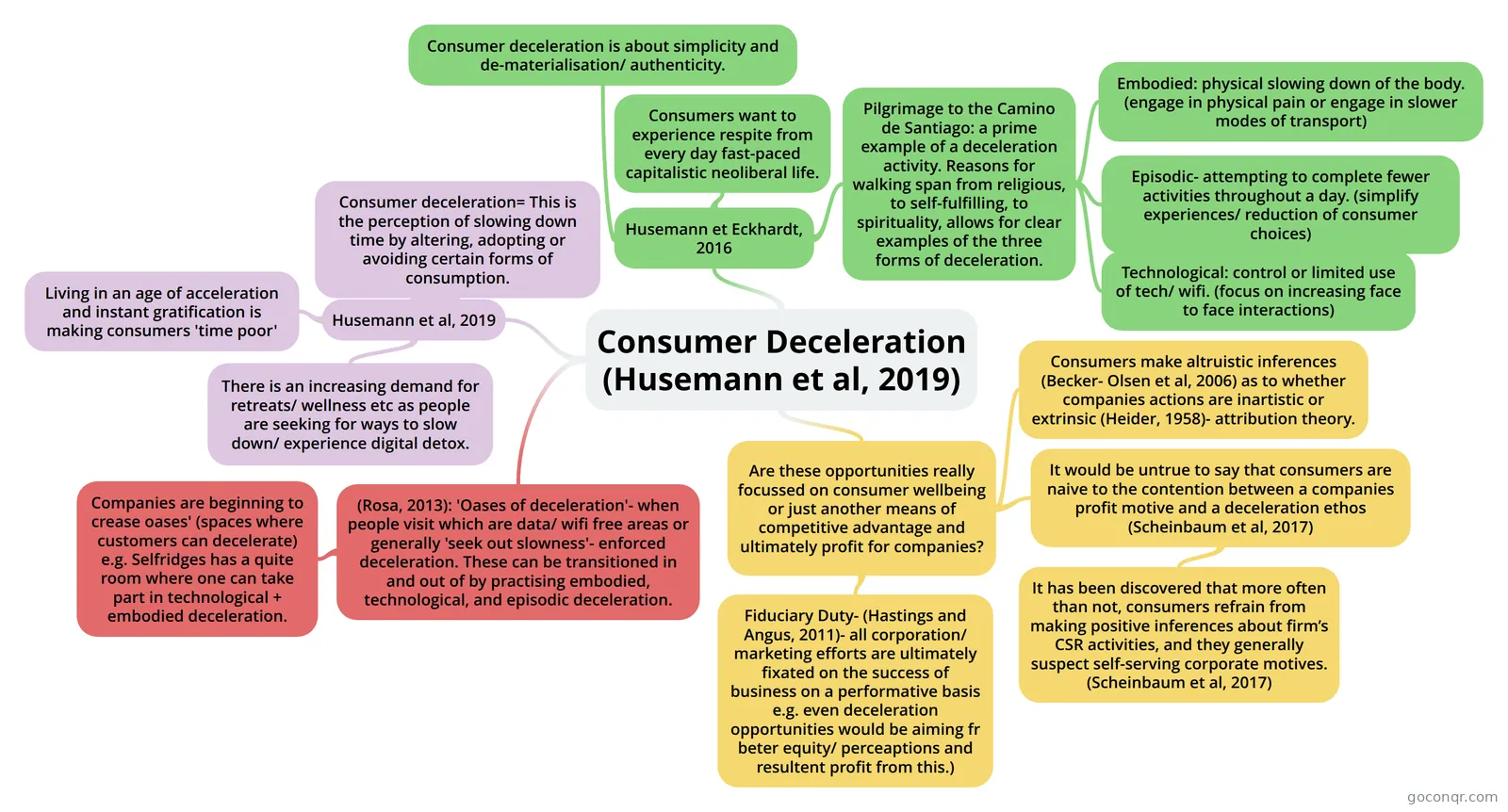
Mind map: consumer deceleration
Map content
Consumer Deceleration (Husemann et al, 2019)
Husemann et al, 2019
- Living in an age of acceleration and instant gratification is making consumers 'time poor'
- There is an increasing demand for retreats/ wellness etc as people are seeking for ways to slow down/ experience digital detox.
- Consumer deceleration= This is the perception of slowing down time by altering, adopting or avoiding certain forms of consumption.
Husemann et Eckhardt, 2016
- Consumers want to experience respite from every day fast-paced capitalistic neoliberal life.
- Pilgrimage to the Camino de Santiago: a prime example of a deceleration activity. Reasons for walking span from religious, to self-fulfilling, to spirituality, allows for clear examples of the three forms of deceleration.
- Embodied: physical slowing down of the body. (engage in physical pain or engage in slower modes of transport)
- Technological: control or limited use of tech/ wifi. (focus on increasing face to face interactions)
- Episodic- attempting to complete fewer activities throughout a day. (simplify experiences/ reduction of consumer choices)
- Consumer deceleration is about simplicity and de-materialisation/ authenticity.
(Rosa, 2013): 'Oases of deceleration'- when people visit which are data/ wifi free areas or generally 'seek out slowness'- enforced deceleration. These can be transitioned in and out of by practising embodied, technological, and episodic deceleration.
- Companies are beginning to crease oases' (spaces where customers can decelerate) e.g. Selfridges has a quite room where one can take part in technological + embodied deceleration.
Are these opportunities really focussed on consumer wellbeing or just another means of competitive advantage and ultimately profit for companies?
- Consumers make altruistic inferences (Becker- Olsen et al, 2006) as to whether companies actions are inartistic or extrinsic (Heider, 1958)- attribution theory.
- It would be untrue to say that consumers are naive to the contention between a companies profit motive and a deceleration ethos (Scheinbaum et al, 2017)
- It has been discovered that more often than not, consumers refrain from making positive inferences about firm’s CSR activities, and they generally suspect self-serving corporate motives. (Scheinbaum et al, 2017)
- Fiduciary Duty- (Hastings and Angus, 2011)- all corporation/ marketing efforts are ultimately fixated on the success of business on a performative basis e.g. even deceleration opportunities would be aiming fr beter equity/ perceaptions and resultent profit from this.)
Information
- Description
- Marketing Mind Map on Consumer Deceleration (Husemann et al, 2019), created by Jessica Field on 12/05/2019.
- Created by
- Jessica Field
- Views
- 1
- Rating