
Mind map
Psychology- Relationships
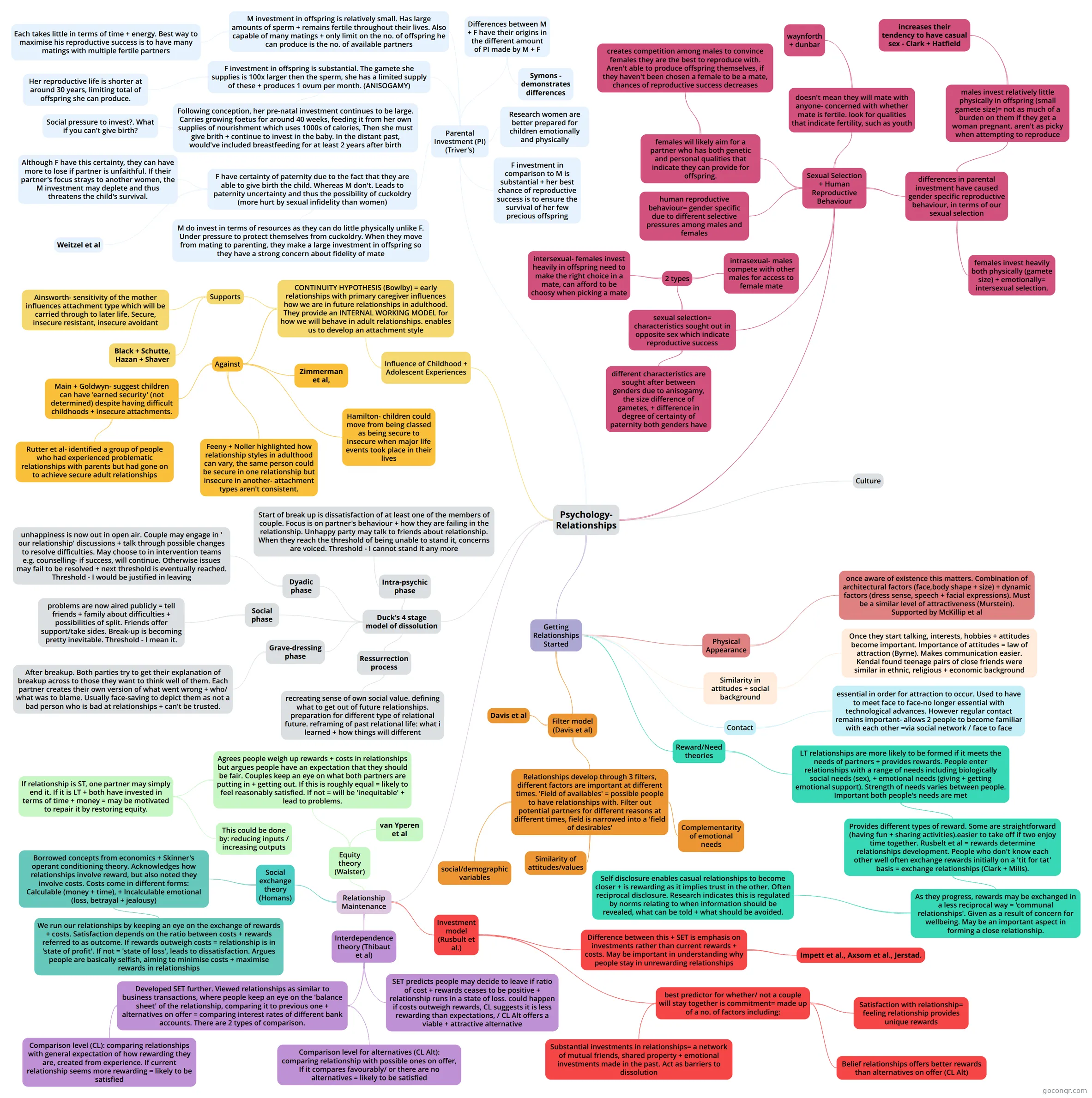
Mind map: Relationship Theories and Development
Map content
Psychology- Relationships
Sexual Selection + Human Reproductive Behaviour
- sexual selection= characteristics sought out in opposite sex which indicate reproductive success
- different characteristics are sought after between genders due to anisogamy, the size difference of gametes, + difference in degree of certainty of paternity both genders have
- 2 types
- intersexual- females invest heavily in offspring need to make the right choice in a mate, can afford to be choosy when picking a mate
- intrasexual- males compete with other males for access to female mate
- human reproductive behaviour= gender specific due to different selective pressures among males and females
- females wil likely aim for a partner who has both genetic and personal qualities that indicate they can provide for offspring.
- creates competition among males to convince females they are the best to reproduce with. Aren't able to produce offspring themselves, if they haven't been chosen a female to be a mate, chances of reproductive success decreases
- doesn't mean they will mate with anyone- concerned with whether mate is fertile. look for qualities that indicate fertility, such as youth
- waynforth + dunbar
- differences in parental investment have caused gender specific reproductive behaviour, in terms of our sexual selection
- females invest heavily both physically (gamete size) + emotionally= intersexual selection.
- males invest relatively little physically in offspring (small gamete size)= not as much of a burden on them if they get a woman pregnant. aren't as picky when attempting to reproduce
- increases their tendency to have casual sex - Clark + Hatfield
- sexual selection= characteristics sought out in opposite sex which indicate reproductive success
Parental Investment (PI) (Triver's)
- Differences between M + F have their origins in the different amount of PI made by M + F
- Symons - demonstrates differences
- M investment in offspring is relatively small. Has large amounts of sperm + remains fertile throughout their lives. Also capable of many matings + only limit on the no. of offspring he can produce is the no. of available partners
- Each takes little in terms of time + energy. Best way to maximise his reproductive success is to have many matings with multiple fertile partners
- F investment in offspring is substantial. The gamete she supplies is 100x larger then the sperm, she has a limited supply of these + produces 1 ovum per month. (ANISOGAMY)
- Her reproductive life is shorter at around 30 years, limiting total of offspring she can produce.
- Following conception, her pre-natal investment continues to be large. Carries growing foetus for around 40 weeks, feeding it from her own supplies of nourishment which uses 1000s of calories, Then she must give brith + continue to invest in the baby. In the distant past, would've included breastfeeding for at least 2 years after birth
- Social pressure to invest?. What if you can't give birth?
- F have certainty of paternity due to the fact that they are able to give birth the child. Whereas M don't. Leads to paternity uncertainty and thus the possibility of cuckoldry (more hurt by sexual infidelity than women)
- M do invest in terms of resources as they can do little physically unlike F. Under pressure to protect themselves from cuckoldry. When they move from mating to parenting, they make a large investment in offspring so they have a strong concern about fidelity of mate
- Although F have this certainty, they can have more to lose if partner is unfaithful. If their partner's focus strays to another women, the M investment may deplete and thus threatens the child's survival.
- Weitzel et al
- Research women are better prepared for children emotionally and physically
- F investment in comparison to M is substantial + her best chance of reproductive success is to ensure the survival of her few precious offspring
- Differences between M + F have their origins in the different amount of PI made by M + F
Influence of Childhood + Adolescent Experiences
- CONTINUITY HYPOTHESIS (Bowlby) = early relationships with primary caregiver influences how we are in future relationships in adulthood. They provide an INTERNAL WORKING MODEL for how we will behave in adult relationships. enables us to develop an attachment style
- Supports
- Ainsworth- sensitivity of the mother influences attachment type which will be carried through to later life. Secure, insecure resistant, insecure avoidant
- Black + Schutte, Hazan + Shaver
- Against
- Zimmerman et al,
- Hamilton- children could move from being classed as being secure to insecure when major life events took place in their lives
- Main + Goldwyn- suggest children can have 'earned security' (not determined) despite having difficult childhoods + insecure attachments.
- Rutter et al- identified a group of people who had experienced problematic relationships with parents but had gone on to achieve secure adult relationships
- Feeny + Noller highlighted how relationship styles in adulthood can vary, the same person could be secure in one relationship but insecure in another- attachment types aren't consistent.
- Supports
- CONTINUITY HYPOTHESIS (Bowlby) = early relationships with primary caregiver influences how we are in future relationships in adulthood. They provide an INTERNAL WORKING MODEL for how we will behave in adult relationships. enables us to develop an attachment style
Getting Relationships Started
- Contact
- essential in order for attraction to occur. Used to have to meet face to face-no longer essential with technological advances. However regular contact remains important- allows 2 people to become familiar with each other =via social network / face to face
- Physical Appearance
- once aware of existence this matters. Combination of architectural factors (face,body shape + size) + dynamic factors (dress sense, speech + facial expressions). Must be a similar level of attractiveness (Murstein). Supported by McKillip et al
- Similarity in attitudes + social background
- Once they start talking, interests, hobbies + attitudes become important. Importance of attitudes = law of attraction (Byrne). Makes communication easier. Kendal found teenage pairs of close friends were similar in ethnic, religious + economic background
- Filter model (Davis et al)
- Relationships develop through 3 filters, different factors are important at different times. 'Field of availables' = possible people to have relationships with. Filter out potential partners for different reasons at different times, field is narrowed into a 'field of desirables'
- social/demographic variables
- Similarity of attitudes/values
- Complementarity of emotional needs
- Davis et al
- Relationships develop through 3 filters, different factors are important at different times. 'Field of availables' = possible people to have relationships with. Filter out potential partners for different reasons at different times, field is narrowed into a 'field of desirables'
- Reward/Need theories
- LT relationships are more likely to be formed if it meets the needs of partners + provides rewards. People enter relationships with a range of needs including biologically social needs (sex), + emotional needs (giving + getting emotional support). Strength of needs varies between people. Important both people's needs are met
- Provides different types of reward. Some are straightforward (having fun + sharing activities).easier to take off if two enjoy time together. Rusbelt et al = rewards determine relationships development. People who don't know each other well often exchange rewards initially on a 'tit for tat' basis = exchange relationships (Clark + Mills).
- As they progress, rewards may be exchanged in a less reciprocal way = 'communal relationships'. Given as a result of concern for wellbeing. May be an important aspect in forming a close relationship.
- Self disclosure enables casual relationships to become closer + is rewarding as it implies trust in the other. Often reciprocal disclosure. Research indicates this is regulated by norms relating to when information should be revealed, what can be told + what should be avoided.
- As they progress, rewards may be exchanged in a less reciprocal way = 'communal relationships'. Given as a result of concern for wellbeing. May be an important aspect in forming a close relationship.
- Provides different types of reward. Some are straightforward (having fun + sharing activities).easier to take off if two enjoy time together. Rusbelt et al = rewards determine relationships development. People who don't know each other well often exchange rewards initially on a 'tit for tat' basis = exchange relationships (Clark + Mills).
- LT relationships are more likely to be formed if it meets the needs of partners + provides rewards. People enter relationships with a range of needs including biologically social needs (sex), + emotional needs (giving + getting emotional support). Strength of needs varies between people. Important both people's needs are met
- Contact
Relationship Maintenance
- Social exchange theory (Homans)
- Borrowed concepts from economics + Skinner's operant conditioning theory. Acknowledges how relationships involve reward, but also noted they involve costs. Costs come in different forms: Calculable (money + time), + Incalculable emotional (loss, betrayal + jealousy)
- We run our relationships by keeping an eye on the exchange of rewards + costs. Satisfaction depends on the ratio between costs + rewards referred to as outcome. If rewards outweigh costs = relationship is in 'state of profit'. If not = 'state of loss', leads to dissatisfaction. Argues people are basically selfish, aiming to minimise costs + maximise rewards in relationships
- Borrowed concepts from economics + Skinner's operant conditioning theory. Acknowledges how relationships involve reward, but also noted they involve costs. Costs come in different forms: Calculable (money + time), + Incalculable emotional (loss, betrayal + jealousy)
- Equity theory (Walster)
- Agrees people weigh up rewards + costs in relationships but argues people have an expectation that they should be fair. Couples keep an eye on what both partners are putting in + getting out. If this is roughly equal = likely to feel reasonably satisfied. If not = will be 'inequitable' + lead to problems.
- If relationship is ST, one partner may simply end it. If it is LT + both have invested in terms of time + money = may be motivated to repair it by restoring equity.
- This could be done by: reducing inputs / increasing outputs
- If relationship is ST, one partner may simply end it. If it is LT + both have invested in terms of time + money = may be motivated to repair it by restoring equity.
- van Yperen et al
- Agrees people weigh up rewards + costs in relationships but argues people have an expectation that they should be fair. Couples keep an eye on what both partners are putting in + getting out. If this is roughly equal = likely to feel reasonably satisfied. If not = will be 'inequitable' + lead to problems.
- Interdependence theory (Thibaut et al)
- Developed SET further. Viewed relationships as similar to business transactions, where people keep an eye on the 'balance sheet' of the relationship, comparing it to previous one + alternatives on offer = comparing interest rates of different bank accounts. There are 2 types of comparison.
- Comparison level (CL): comparing relationships with general expectation of how rewarding they are, created from experience. If current relationship seems more rewarding = likely to be satisfied
- Comparison level for alternatives (CL Alt): comparing relationship with possible ones on offer, If it compares favourably/ or there are no alternatives = likely to be satisfied
- SET predicts people may decide to leave if ratio of cost + rewards ceases to be positive + relationship runs in a state of loss. could happen if costs outweigh rewards, CL suggests it is less rewarding than expectations, / CL Alt offers a viable + attractive alternative
- Developed SET further. Viewed relationships as similar to business transactions, where people keep an eye on the 'balance sheet' of the relationship, comparing it to previous one + alternatives on offer = comparing interest rates of different bank accounts. There are 2 types of comparison.
- Investment model (Rusbult et al.)
- best predictor for whether/ not a couple will stay together is commitment= made up of a no. of factors including:
- Satisfaction with relationship= feeling relationship provides unique rewards
- Belief relationships offers better rewards than alternatives on offer (CL Alt)
- Substantial investments in relationships= a network of mutual friends, shared property + emotional investments made in the past. Act as barriers to dissolution
- Difference between this + SET is emphasis on investments rather than current rewards + costs. May be important in understanding why people stay in unrewarding relationships
- Impett et al., Axsom et al., Jerstad.
- best predictor for whether/ not a couple will stay together is commitment= made up of a no. of factors including:
- Social exchange theory (Homans)
Duck's 4 stage model of dissolution
- Intra-psychic phase
- Start of break up is dissatisfaction of at least one of the members of couple. Focus is on partner's behaviour + how they are failing in the relationship. Unhappy party may talk to friends about relationship. When they reach the threshold of being unable to stand it, concerns are voiced. Threshold - I cannot stand it any more
- Dyadic phase
- unhappiness is now out in open air. Couple may engage in ' our relationship' discussions + talk through possible changes to resolve difficulties. May choose to in intervention teams e.g. counselling- if success, will continue. Otherwise issues may fail to be resolved + next threshold is eventually reached. Threshold - I would be justified in leaving
- Social phase
- problems are now aired publicly = tell friends + family about difficulties + possibilities of split. Friends offer support/take sides. Break-up is becoming pretty inevitable. Threshold - I mean it.
- Grave-dressing phase
- After breakup. Both parties try to get their explanation of breakup across to those they want to think well of them. Each partner creates their own version of what went wrong + who/ what was to blame. Usually face-saving to depict them as not a bad person who is bad at relationships + can't be trusted.
- Ressurrection process
- recreating sense of own social value. defining what to get out of future relationships. preparation for different type of relational future. reframing of past relational life: what i learned + how things will different
- Intra-psychic phase
Culture
Information
- Description
- A-Level Psychology Mind Map on Psychology- Relationships, created by Rachel Pearce on 03/01/2015.
- Created by
- Rachel Pearce
- Views
- 88
- Tags
- Rating
More on Sexual selection and partner preferences