
Mind map
Evaluation: Socio-cultural Explanation of Anorexia
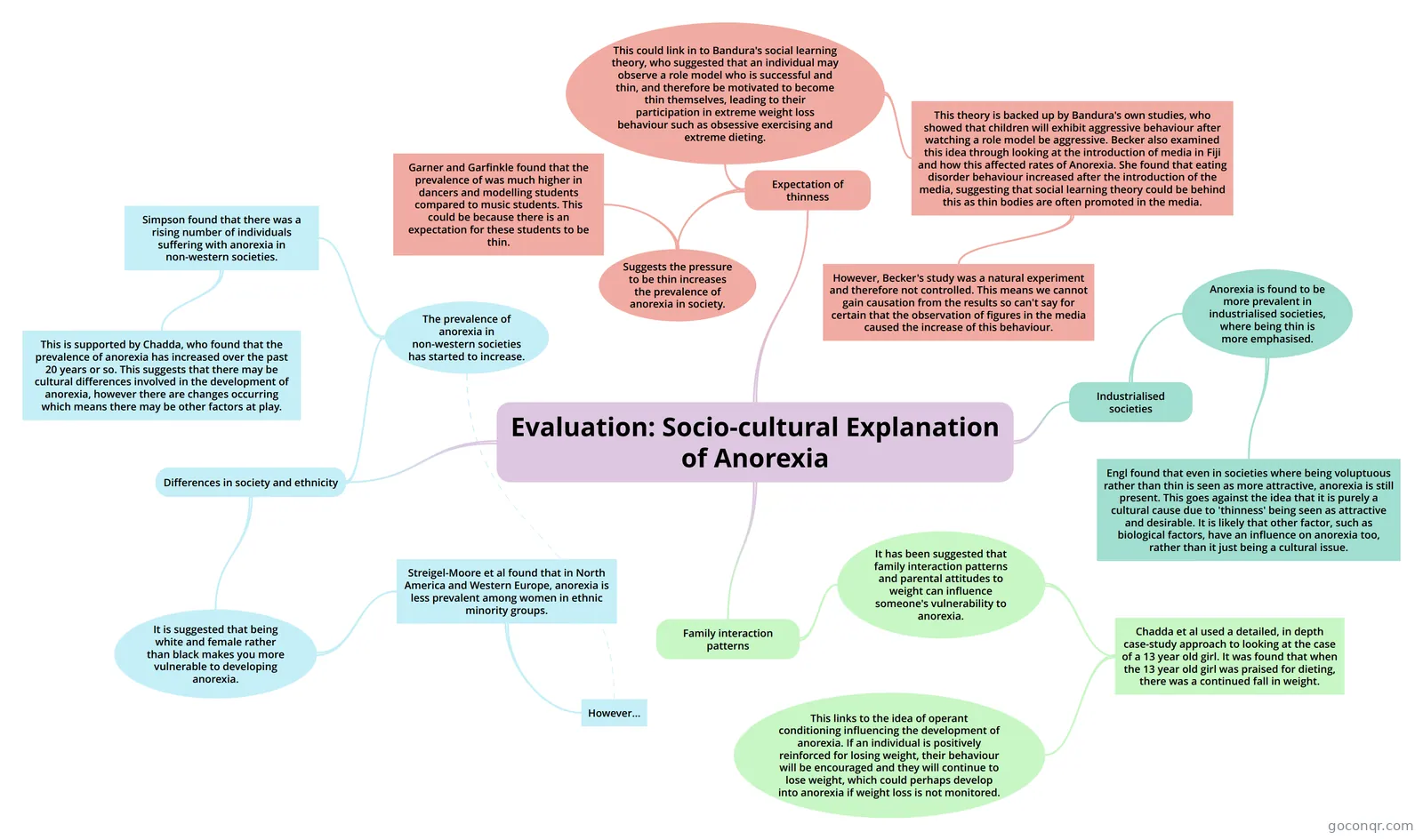
Mind map: Socio-cultural explanation of anorexia
Map content
Evaluation: Socio-cultural Explanation of Anorexia
Expectation of thinness
- Suggests the pressure to be thin increases the prevalence of anorexia in society.
- Garner and Garfinkle found that the prevalence of was much higher in dancers and modelling students compared to music students. This could be because there is an expectation for these students to be thin.
- This could link in to Bandura's social learning theory, who suggested that an individual may observe a role model who is successful and thin, and therefore be motivated to become thin themselves, leading to their participation in extreme weight loss behaviour such as obsessive exercising and extreme dieting.
- This theory is backed up by Bandura's own studies, who showed that children will exhibit aggressive behaviour after watching a role model be aggressive. Becker also examined this idea through looking at the introduction of media in Fiji and how this affected rates of Anorexia. She found that eating disorder behaviour increased after the introduction of the media, suggesting that social learning theory could be behind this as thin bodies are often promoted in the media.
- However, Becker's study was a natural experiment and therefore not controlled. This means we cannot gain causation from the results so can't say for certain that the observation of figures in the media caused the increase of this behaviour.
- This theory is backed up by Bandura's own studies, who showed that children will exhibit aggressive behaviour after watching a role model be aggressive. Becker also examined this idea through looking at the introduction of media in Fiji and how this affected rates of Anorexia. She found that eating disorder behaviour increased after the introduction of the media, suggesting that social learning theory could be behind this as thin bodies are often promoted in the media.
- Suggests the pressure to be thin increases the prevalence of anorexia in society.
Differences in society and ethnicity
- The prevalence of anorexia in non-western societies has started to increase.
- Simpson found that there was a rising number of individuals suffering with anorexia in non-western societies.
- This is supported by Chadda, who found that the prevalence of anorexia has increased over the past 20 years or so. This suggests that there may be cultural differences involved in the development of anorexia, however there are changes occurring which means there may be other factors at play.
- Simpson found that there was a rising number of individuals suffering with anorexia in non-western societies.
- It is suggested that being white and female rather than black makes you more vulnerable to developing anorexia.
- Streigel-Moore et al found that in North America and Western Europe, anorexia is less prevalent among women in ethnic minority groups.
- However...
- Streigel-Moore et al found that in North America and Western Europe, anorexia is less prevalent among women in ethnic minority groups.
- The prevalence of anorexia in non-western societies has started to increase.
Industrialised societies
- Anorexia is found to be more prevalent in industrialised societies, where being thin is more emphasised.
- Engl found that even in societies where being voluptuous rather than thin is seen as more attractive, anorexia is still present. This goes against the idea that it is purely a cultural cause due to 'thinness' being seen as attractive and desirable. It is likely that other factor, such as biological factors, have an influence on anorexia too, rather than it just being a cultural issue.
- Anorexia is found to be more prevalent in industrialised societies, where being thin is more emphasised.
Family interaction patterns
- It has been suggested that family interaction patterns and parental attitudes to weight can influence someone's vulnerability to anorexia.
- Chadda et al used a detailed, in depth case-study approach to looking at the case of a 13 year old girl. It was found that when the 13 year old girl was praised for dieting, there was a continued fall in weight.
- This links to the idea of operant conditioning influencing the development of anorexia. If an individual is positively reinforced for losing weight, their behaviour will be encouraged and they will continue to lose weight, which could perhaps develop into anorexia if weight loss is not monitored.
- Chadda et al used a detailed, in depth case-study approach to looking at the case of a 13 year old girl. It was found that when the 13 year old girl was praised for dieting, there was a continued fall in weight.
- It has been suggested that family interaction patterns and parental attitudes to weight can influence someone's vulnerability to anorexia.
Information
- Description
- A level Psychology (Clinical Psychology) Mind Map on Evaluation: Socio-cultural Explanation of Anorexia, created by Katie Greensted on 04/06/2019.
- Created by
- Katie Greensted
- Views
- 101
- Tags
- Rating