
Mind map
Norway
Mind map: Norway
Map content
Norway
https://journals.sagepub.com/doi/full/10.1177/2332858418756598
https://www.newsinenglish.no/2019/08/20/norway-to-try-more-flexible-school-start/
- https://www.newsinenglish.no/2019/08/20/norway-to-try-more-flexible-school-start/
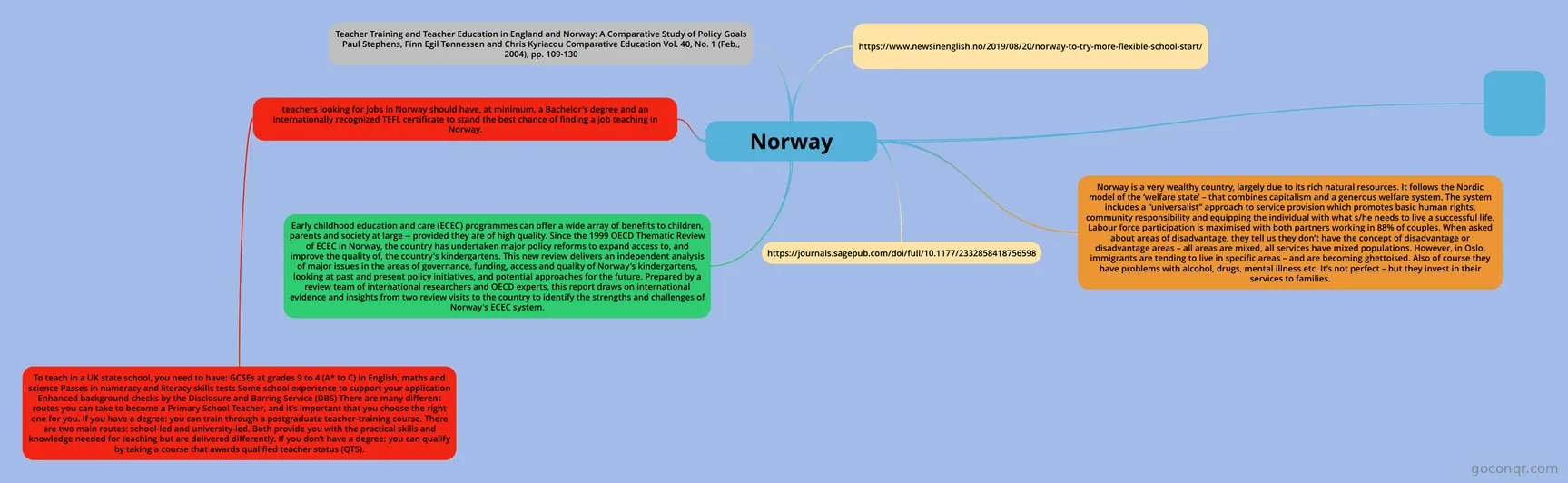
Norway is a very wealthy country, largely due to its rich natural resources. It follows the Nordic model of the ‘welfare state’ – that combines capitalism and a generous welfare system. The system includes a “universalist” approach to service provision which promotes basic human rights, community responsibility and equipping the individual with what s/he needs to live a successful life. Labour force participation is maximised with both partners working in 88% of couples. When asked about areas of disadvantage, they tell us they don’t have the concept of disadvantage or disadvantage areas – all areas are mixed, all services have mixed populations. However, in Oslo, immigrants are tending to live in specific areas – and are becoming ghettoised. Also of course they have problems with alcohol, drugs, mental illness etc. It’s not perfect – but they invest in their services to families.
Early childhood education and care (ECEC) programmes can offer a wide array of benefits to children, parents and society at large -- provided they are of high quality. Since the 1999 OECD Thematic Review of ECEC in Norway, the country has undertaken major policy reforms to expand access to, and improve the quality of, the country's kindergartens. This new review delivers an independent analysis of major issues in the areas of governance, funding, access and quality of Norway's kindergartens, looking at past and present policy initiatives, and potential approaches for the future. Prepared by a review team of international researchers and OECD experts, this report draws on international evidence and insights from two review visits to the country to identify the strengths and challenges of Norway's ECEC system.
Teacher Training and Teacher Education in England and Norway: A Comparative Study of Policy Goals Paul Stephens, Finn Egil Tønnessen and Chris Kyriacou Comparative Education Vol. 40, No. 1 (Feb., 2004), pp. 109-130
teachers looking for jobs in Norway should have, at minimum, a Bachelor's degree and an internationally recognized TEFL certificate to stand the best chance of finding a job teaching in Norway.
- To teach in a UK state school, you need to have: GCSEs at grades 9 to 4 (A* to C) in English, maths and science Passes in numeracy and literacy skills tests Some school experience to support your application Enhanced background checks by the Disclosure and Barring Service (DBS) There are many different routes you can take to become a Primary School Teacher, and it’s important that you choose the right one for you. If you have a degree: you can train through a postgraduate teacher-training course. There are two main routes: school-led and university-led. Both provide you with the practical skills and knowledge needed for teaching but are delivered differently. If you don’t have a degree: you can qualify by taking a course that awards qualified teacher status (QTS).
Information
- Description
- CACHE Level 3 Childcare Mind Map on Norway, created by sean thorpe on 01/10/2019.
- Created by
- sean thorpe
- Views
- 2
- History
-
- Created by Tina Cook · Oct 1, 2019
- Copied by sean thorpe · Oct 1, 2019
- Rating