
Mind map
Climate Change
Map content
Climate Change
Climate Change in the Past
- Climate - The average temperature and precipitation recorded in a place over 30 years.
- Climate Change - refers to how the average climate across the world varies over time
- Air Pressure
- Land and sea heat up differently
- On land, dark surfaces (e.g. soil, forest absorb sunlight, which is converted to heat
- Land heats quickly in summer, but only at the surface, so it cools quickly in winter
- When it heats, it also heats the air above, so air expands, become lighter and rises. This forms areas of low pressure over large landmasses in summer.
- The sea behaves differently. Some sunlight is reflected from the surface, while some is absorbed to 30m depth.
- It therefore takes the sea longer to heat, but also longer to cool. In summer air above the sea remains cooler and denser, forming areas of high pressure
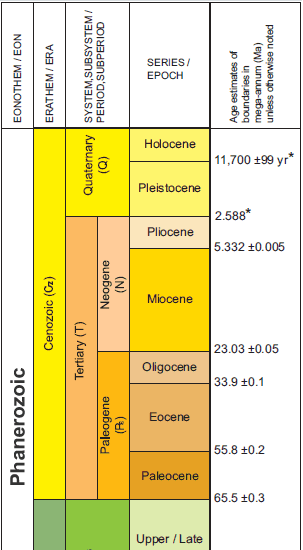
- The HOLOCENE is a warm period of time. These warm periods are called INTERGLACIAL periods.
- The PLEISTOCENE was a colder period of time. This started 1.8 million years ago and ended 10,000 years ago. This was when the Earth experienced the last ICE AGE. This was a GLACIAL period.
- Analytical Methods
- Pollen Analysis
- Produced by all plants, was extracted from sediment cores in peat bogs + lake beds
- Preserved in waterlogged sediments
- By analysis we can see how ecosystems have changed.
- - Not reliable, long pollen chains are rare, vegetation change could lag behind climate change
- Paintings and written accounts
- Photos/paintings could be good evidence
- Grape harvest data and written accounts like the Greenhouse saga.
- Unreliable, did not set out to record the climate, usually local and difficult to generalise, and some people could lie
- Retreating Glaciers
- Valley glaciers
- Grow + shrink to the climate
- Little Ice Age
- Maximum extent in 1850
- Reliable measurements extend back to 1880, before this, records are patchy and rely more on proxy records
- Pollen Analysis
Natural Causes of Climate Change
- Orbital Theory/Milankovitch Cycles
- Eccentricity
- Sometimes Earth's orbit is circular, meaning it is warmer as it is generally closer to the Sun. Other times it is oval/egg shaped, meaning at the extreme ends it is cooler, as it is generally further away from the Sun.
- It takes 100,000 years for the Earth's orbit to change from being more circular to more elliptical and back again.
- Obliquity
- It takes 41,000 years for the Earth's orbit to tilt, straighten up and tilt back again. More vertical means cooler, 2 degrees more tilt towards the Sun means warmer.
- Precession
- It takes 26,000 years for the Earth's axis to wobble, straighten up and wobble again. More wobble means warmer, less wobble means cooler.
- When all 3 cycles combine, this can form an ice age or can end an ice age.
- Eccentricity
- Sunspots
- Sunspots are black areas on the surface of the Sun. Sometimes there are more sunspots on the Sun than others. The sunspots mean that the Sun is more active than usual.
- During the little Ice Age there was a lack of sunspots on the Sun. However during the Medieval Warm period there was an increase of the number of sunspots.
- Sunspots can change the Earth's Climate by 1-2 degrees Celcius
- During the little Ice Age there was a lack of sunspots on the Sun. However during the Medieval Warm period there was an increase of the number of sunspots.
- Sunspots are black areas on the surface of the Sun. Sometimes there are more sunspots on the Sun than others. The sunspots mean that the Sun is more active than usual.
- Volcanic Eruptions
- Volcanic ash and dust is erupted into the atmosphere. This acts like a shield preventing sunlight from coming into the Earth's atmosphere and hitting the surface.
- Mount Pinatubo in the Phillipines erupted in 1991 releasing 17 million tonnes of sulfur dioxide into the atmosphere.
- The release of the sulfur dioxide was enough to reduce the global sunlight by 10% and therefore lowered the global temperature by 0.5 degrees Celcius
- Volcanic ash and dust is erupted into the atmosphere. This acts like a shield preventing sunlight from coming into the Earth's atmosphere and hitting the surface.
- Asteroid Collisions
- Relatively same as Volcanic Eruptions
- When asteroids collide with Earth, they throw dust and ash into the atmosphere. This acts as a shield to prevent sunlight from entering the Earth's atmosphere.
- In 1908 a 100m diameter asteroid exploded in the air 5km above Tunguska, Russia. The blast flattned 80 million trees, but was not large enough to alter the atmosphere.
- It is predicted that climate altering asteroids will hit once every 500,000 years and the effects on the climate could last for 5-10 years.
- Orbital Theory/Milankovitch Cycles
The Greenhouse Effect
- The Greenhouse effect is a natural process that keeps the planet warm and sustains life, by trapping the Sun's rays on Earth
- The Enhanced Greenhouse Effect
- Humans have been emitting greenhouse gases into the air since the Industrial Revollution when the burning of coal was discovered to provide a lot of needed energy for the growing population at the time
- This resulted in a boom of development for Britain; people were living longer and healthier lives as conditions got better for more people having access to clean water, heating and other amenities
- At the time, it was not known of the damaging effects tshi was having on the Earth's atmosphere and resulting average temperature
- Ever since, humans have extracted coal, oil and natural gas (methane) from the Earth's crust, slowly using all the resources up. At today's numbers (2015 data), gas will run out in 50 years, oil in 100 years and coal in 200 years
- This is slightly worrying because gas and oil are the cleaner forms of these fossil fuels and release fewer greenhouse gases into the atmosphere than coal
- Greenhouse gases are not limited to carbon dioxide, but also include compounds such as sulfur dioxide, methane and nitrous oxide
- Anthropogenic Causes of Global Warming
- Increased Cattle Farming
- Fluoroinated Gases/Chlorofluorocarbons
- Deforestation
- Fertilisers
Impacts of Climate Change
- Warning Signs
- Physical: Increasing temperature, rising sea levels, ice caps melting
- Biological: animals dying, environment changes, effects on economic/social activity
- Shrinking Glaciers
- Glaciers are melting and losing mass, retreating and causing unnecessary mishaps for people living near them
- Glacial lakes are unstable and prone to flooding and damaging local civilisations, flooding because devris walls are not very strong
- Massive water shortages e.g. India, threatens agriculture (livelihoods)
- Ecosystem Disruption
- Species can't adapt as fast as the climate is changing
- Ecological disruption threatens agriculture causing food shortages and theatening livelihoods
- Health Impacts
- More humid conditions means more mosquitos so higher risk of maliaria. Heat stress for elderly - can't adapt
- 30% of children under 5 killed by malnutrition, made worse by drought linked to global warming and food shortages.
- 50,000 deaths caused by weather-related issues. Contaminated water is also a problem
- Rising Sea Levels
- Ice melting increases sea levels. Estimated 2m rise by 2100
- Land for agriculture and habitation lost, so less farmland and creates climate refugees (e.g. Bangladesh) + salt contamination of farmland (e.g. Egypt, Nile Delta)
- Cultural Losses
- Climate change is destroying historical sites around the world
- Losing historical sites that can't ever be brought back (e.g. Venice at risk of flooding)
- Warning Signs
Climate Change Mitigation and Adaptation
- Mitigation
- Alternative Energy Production
- Energy sources that do not deplete and can be replaced within a human lifetime
- Doesn't produce greenhouse gas emissions or air pollutants
- Solar Panels (UK) e.g. UK biggest solar farm - 48 megawatts of energy, enough to power 15,000 homes for a year
- Low efficiency, expensive to set up, and high intermittancy
- Carbon Capture and Storage (CCS)
- Technology used to capture carbon dioxide produced from fossil fuels in electricity generation and industrial processes
- Once captured, carbon gas is compressed and transported to a pipeline and an injection well. Then it's injected as a liquid into the ground to be stored in suitable geoglogical reservoirs.
- Climeworks, Switzerland - Iceland
- Expensive, unclear if the carbon will stat locked away underground and it doesn't promote renewable energy.
- Planting Trees (Aforestation)
- Trees absorb carbon dioxide to grow and release oxygen as waste.
- Carbon Credit - 1cc per tonne of carbon dioxide absorbed by trees
- They also release moisture. This has a cooling effect by producing more clouds, reducing incoming solar radiation.
- Plantation forests can absorb carbon dioxide faster than a natural forest and for up to 50 years
- 3 million tonnes of carbon dioxide equivalent captured by forests in California
- Space for plantations
- International Agreements
- Agreements that make countries cut their emissions. They set targets to reduce carbon dioxide emissions
- Countries will take steps to reduce emissions
- Aim to keep warming "well below" 2 degrees Celcius. £65 bn given to poorer countries to invest in climate change mitigation
- Agreements are not enforceable + USA pulled out
- Alternative Energy Production
- Adaptation
- Adaptation responds to the impacts of climate change and tries to make populations less vulnerable. Adaptation stretegies are local rather than global, to respond to localised impacts.
- Managing Water Supply
- Himalayas - Stupas put in place to provide a supply of ice close to the village to use in summer months. they spray water out in winter months which freeze into ice which can then melt and supplies village with water.
- Reducing the risk from rising sea levels
- Flood barriers can be built, like the Thames barrier.
- Doesn't disrupt shipping
- Barrier only meant to last until 2030
- Might not last until 2030 because being pulled up so often
- More frequent extreme weather events e.g. tidal surges
- Maldives
- Highest point is 2.4m high
- By 2040 it's estimated that the island is uninhabitable and 2070 completely submerged
- 80% of land is above 1m sea level
- Risk of flood from storm surges
- Sea walls try to hold waters back
- General coastal defences
- Reduce erosion
- Reduce storm damage
- Oceans rising by 9mm per year
- General coastal defences
- Built new island
- Using dredged sand from a lagoon
- Used to be 1m below sea level
- Very bad for the environment
- Using dredged sand from a lagoon
- Flood barriers can be built, like the Thames barrier.
- Potato Park in Peru
- Challenges
- Drought and pests increasing, in mountainous regions
- Mitigation
- Creating a stepped farming landscape to grow the right variety of potatoes at the right temperature/altitude
- Aim is to preserve traditional culture
- Teaching people from around the world how to farm these varieties of potatoes
- Challenges
- Mitigation
Images and files in the map
Information
- Description
- Mind Map on Climate Change, created by Nathan Simon on 01/10/2019.
- Created by
- Nathan Simon
- Views
- 0
- Rating