
Mind map
Research methods
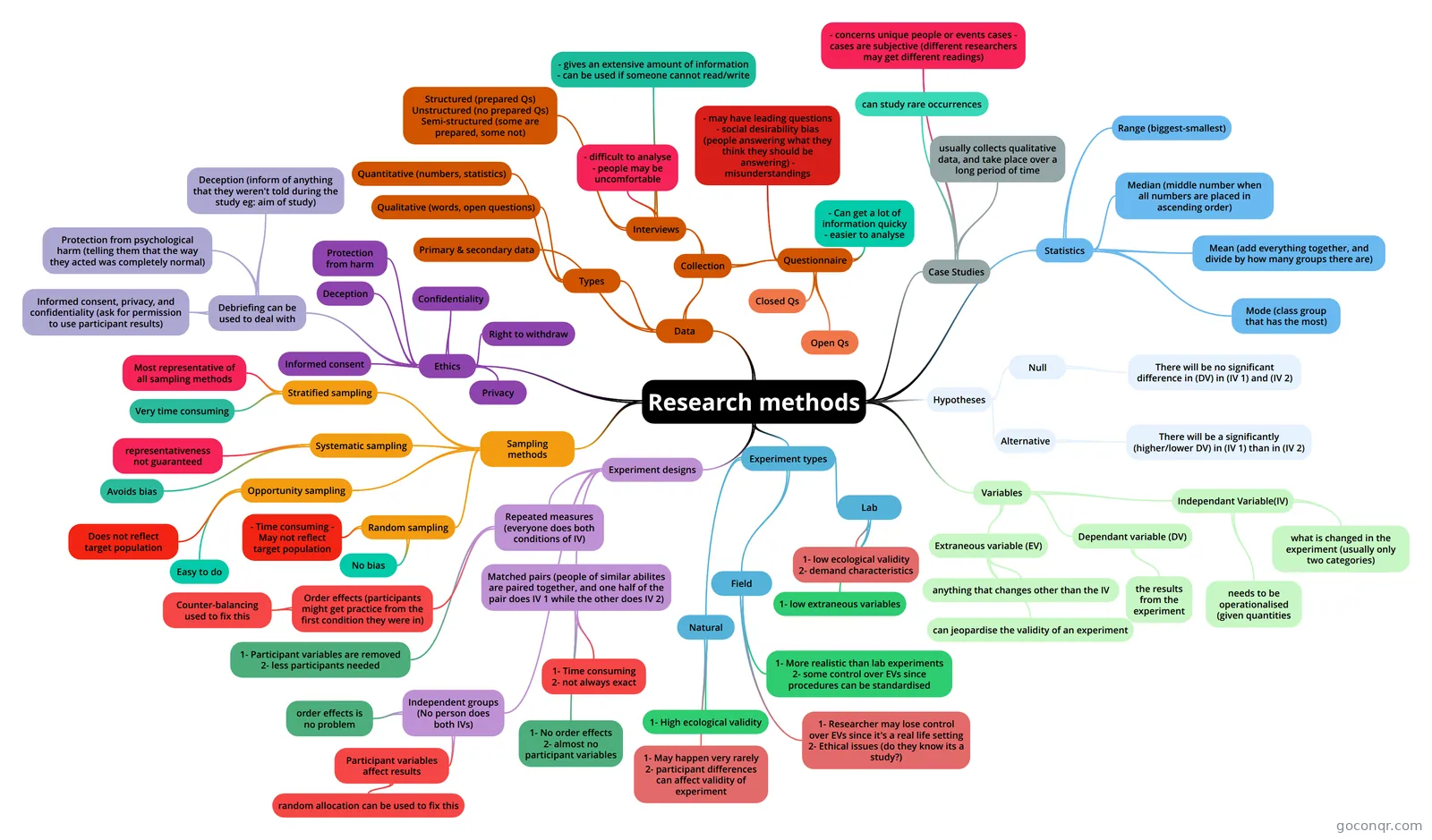
Mind map: Research methods
Map content
Research methods
Hypotheses
- Null
- There will be no significant difference in (DV) in (IV 1) and (IV 2)
- Alternative
- There will be a significantly (higher/lower DV) in (IV 1) than in (IV 2)
- Null
Experiment types
- Natural
- 1- May happen very rarely 2- participant differences can affect validity of experiment
- 1- High ecological validity
- Field
- 1- Researcher may lose control over EVs since it's a real life setting 2- Ethical issues (do they know its a study?)
- 1- More realistic than lab experiments 2- some control over EVs since procedures can be standardised
- Lab
- 1- low ecological validity 2- demand characteristics
- 1- low extraneous variables
- Natural
Variables
- Extraneous variable (EV)
- anything that changes other than the IV
- can jeopardise the validity of an experiment
- Dependant variable (DV)
- the results from the experiment
- Independant Variable(IV)
- what is changed in the experiment (usually only two categories)
- needs to be operationalised (given quantities
- Extraneous variable (EV)
Experiment designs
- Independent groups (No person does both IVs)
- order effects is no problem
- Participant variables affect results
- random allocation can be used to fix this
- Repeated measures (everyone does both conditions of IV)
- Order effects (participants might get practice from the first condition they were in)
- Counter-balancing used to fix this
- 1- Participant variables are removed 2- less participants needed
- Order effects (participants might get practice from the first condition they were in)
- Matched pairs (people of similar abilites are paired together, and one half of the pair does IV 1 while the other does IV 2)
- 1- Time consuming 2- not always exact
- 1- No order effects 2- almost no participant variables
- Independent groups (No person does both IVs)
Sampling methods
- Random sampling
- - Time consuming - May not reflect target population
- No bias
- Opportunity sampling
- Does not reflect target population
- Easy to do
- Systematic sampling
- representativeness not guaranteed
- Avoids bias
- Stratified sampling
- Most representative of all sampling methods
- Very time consuming
- Random sampling
Ethics
- Informed consent
- Deception
- Protection from harm
- Privacy
- Confidentiality
- Right to withdraw
- Debriefing can be used to deal with
- Informed consent, privacy, and confidentiality (ask for permission to use participant results)
- Deception (inform of anything that they weren't told during the study eg: aim of study)
- Protection from psychological harm (telling them that the way they acted was completely normal)
Data
- Types
- Qualitative (words, open questions)
- Quantitative (numbers, statistics)
- Collection
- Interviews
- Structured (prepared Qs) Unstructured (no prepared Qs) Semi-structured (some are prepared, some not)
- - difficult to analyse - people may be uncomfortable
- - gives an extensive amount of information - can be used if someone cannot read/write
- Questionnaire
- Open Qs
- Closed Qs
- - may have leading questions - social desirability bias (people answering what they think they should be answering) - misunderstandings
- - Can get a lot of information quicky - easier to analyse
- Interviews
- Primary & secondary data
- Types
Case Studies
- usually collects qualitative data, and take place over a long period of time
- can study rare occurrences
- - concerns unique people or events cases - cases are subjective (different researchers may get different readings)
Statistics
- Range (biggest-smallest)
- Median (middle number when all numbers are placed in ascending order)
- Mean (add everything together, and divide by how many groups there are)
- Mode (class group that has the most)