
Mind map
Chapter 1
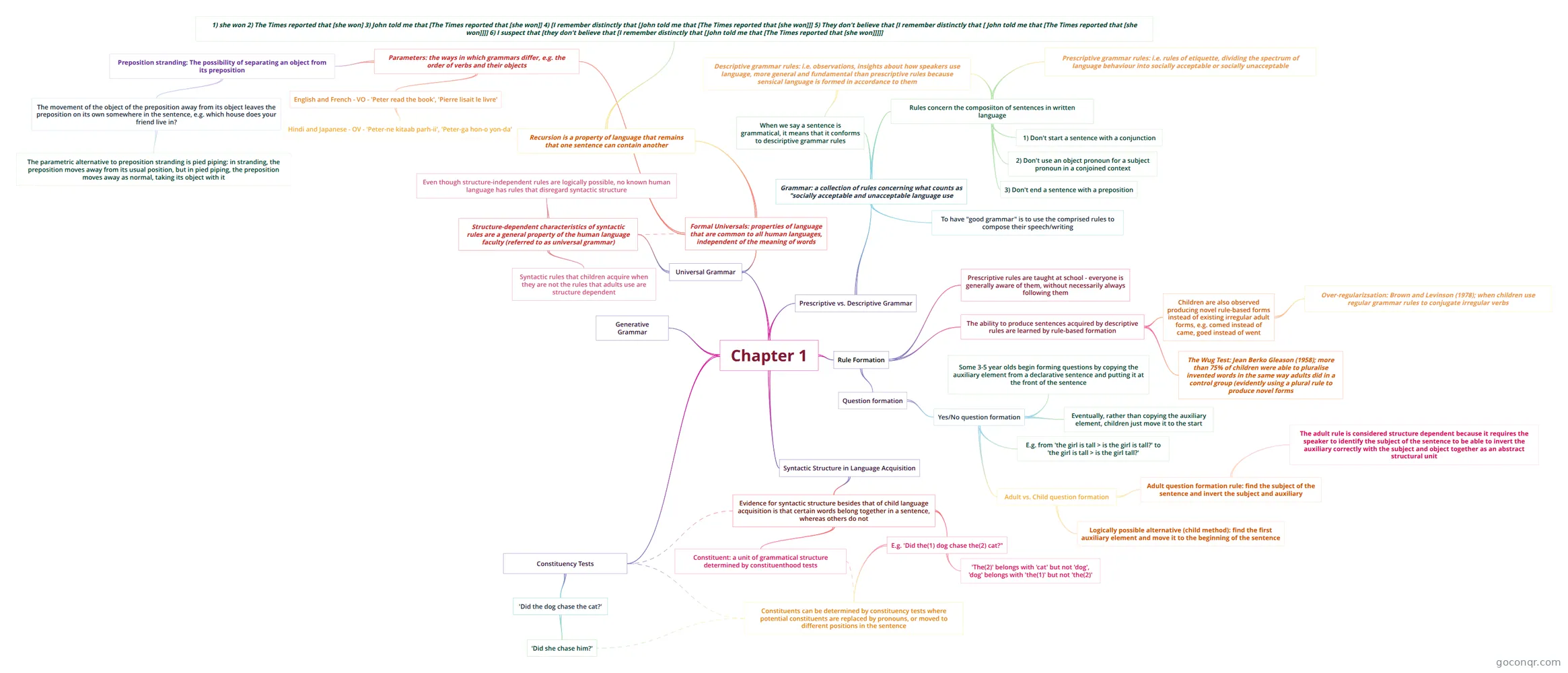
Mind map: Chapter 1 generative grammar
Map content
Chapter 1
Prescriptive vs. Descriptive Grammar
- Grammar: a collection of rules concerning what counts as "socially acceptable and unacceptable language use
- Rules concern the composiiton of sentences in written language
- 1) Don't start a sentence with a conjunction
- 2) Don't use an object pronoun for a subject pronoun in a conjoined context
- 3) Don't end a sentence with a preposition
- Prescriptive grammar rules: i.e. rules of etiquette, dividing the spectrum of language behaviour into socially acceptable or socially unacceptable
- Descriptive grammar rules: i.e. observations, insights about how speakers use language, more general and fundamental than prescriptive rules because sensical language is formed in accordance to them
- To have "good grammar" is to use the comprised rules to compose their speech/writing
- When we say a sentence is grammatical, it means that it conforms to desciriptive grammar rules
- Rules concern the composiiton of sentences in written language
- Grammar: a collection of rules concerning what counts as "socially acceptable and unacceptable language use
Rule Formation
- Prescriptive rules are taught at school - everyone is generally aware of them, without necessarily always following them
- The ability to produce sentences acquired by descriptive rules are learned by rule-based formation
- The Wug Test: Jean Berko Gleason (1958); more than 75% of children were able to pluralise invented words in the same way adults did in a control group (evidently using a plural rule to produce novel forms
- Children are also observed producing novel rule-based forms instead of existing irregular adult forms, e.g. comed instead of came, goed instead of went
- Over-regularizsation: Brown and Levinson (1978); when children use regular grammar rules to conjugate irregular verbs
- Question formation
- Yes/No question formation
- Some 3-5 year olds begin forming questions by copying the auxiliary element from a declarative sentence and putting it at the front of the sentence
- Eventually, rather than copying the auxiliary element, children just move it to the start
- E.g. from 'the girl is tall > is the girl is tall?' to 'the girl is tall > is the girl tall?'
- Adult vs. Child question formation
- Adult question formation rule: find the subject of the sentence and invert the subject and auxiliary
- The adult rule is considered structure dependent because it requires the speaker to identify the subject of the sentence to be able to invert the auxiliary correctly with the subject and object together as an abstract structural unit
- Logically possible alternative (child method): find the first auxiliary element and move it to the beginning of the sentence
- Adult question formation rule: find the subject of the sentence and invert the subject and auxiliary
- Yes/No question formation
Syntactic Structure in Language Acquisition
- Evidence for syntactic structure besides that of child language acquisition is that certain words belong together in a sentence, whereas others do not
- Constituent: a unit of grammatical structure determined by constituenthood tests
- E.g. 'Did the(1) dog chase the(2) cat?"
- 'The(2)' belongs with 'cat' but not 'dog', 'dog' belongs with 'the(1)' but not 'the(2)'
- Constituents can be determined by constituency tests where potential constituents are replaced by pronouns, or moved to different positions in the sentence
- Evidence for syntactic structure besides that of child language acquisition is that certain words belong together in a sentence, whereas others do not
Generative Grammar
Universal Grammar
- Formal Universals: properties of language that are common to all human languages, independent of the meaning of words
- Recursion is a property of language that remains that one sentence can contain another
- 1) she won 2) The Times reported that [she won] 3) John told me that [The Times reported that [she won]] 4) [I remember distinctly that [John told me that [The Times reported that [she won]]] 5) They don't believe that [I remember distinctly that [ John told me that [The Times reported that [she won]]]] 6) I suspect that [they don't believe that [I remember distinctly that [John told me that [The Times reported that [she won]]]]]
- Parameters: the ways in which grammars differ, e.g. the order of verbs and their objects
- English and French - VO - 'Peter read the book', 'Pierre lisait le livre'
- Hindi and Japanese - OV - 'Peter-ne kitaab parh-ii', 'Peter-ga hon-o yon-da'
- Preposition stranding: The possibility of separating an object from its preposition
- The movement of the object of the preposition away from its object leaves the preposition on its own somewhere in the sentence, e.g. which house does your friend live in?
- The parametric alternative to preposition stranding is pied piping: in stranding, the preposition moves away from its usual position, but in pied piping, the preposition moves away as normal, taking its object with it
- The movement of the object of the preposition away from its object leaves the preposition on its own somewhere in the sentence, e.g. which house does your friend live in?
- English and French - VO - 'Peter read the book', 'Pierre lisait le livre'
- Recursion is a property of language that remains that one sentence can contain another
- Structure-dependent characteristics of syntactic rules are a general property of the human language faculty (referred to as universal grammar)
- Syntactic rules that children acquire when they are not the rules that adults use are structure dependent
- Even though structure-independent rules are logically possible, no known human language has rules that disregard syntactic structure
- Formal Universals: properties of language that are common to all human languages, independent of the meaning of words
Constituency Tests
- 'Did the dog chase the cat?'
- Words that belong together can sometimes be replaced by placeholder elements, such as pronouns.
- 'Did she chase him?'
- In this example, 'the dog' is replaced by 'she' and 'the cat' is replaced by she. The resulting sentence is grammatical, meaning that 'the dog' and 'the cat' are constituents. We can prove this by repeating the substitution test, this time replacing 'Did the dog' with 'she' and 'the cat' (as before) with 'him'. This produces the following sentence: *She chase him? Which doesn't pose as a question anymore - highlighting that 'did' does not exist in the constituent 'the dog'.
- 'Did the dog chase the cat?'
Information
- Description
- Prescriptive vs. Descriptive Grammar Rule Formation and Syntactic Structure in Language Acquisition Evidence for Syntactic Structure Universal Grammar Generative Grammar
- Created by
- KatieC x
- Views
- 9
- Rating