
Mind map
Eye Witness Testimony
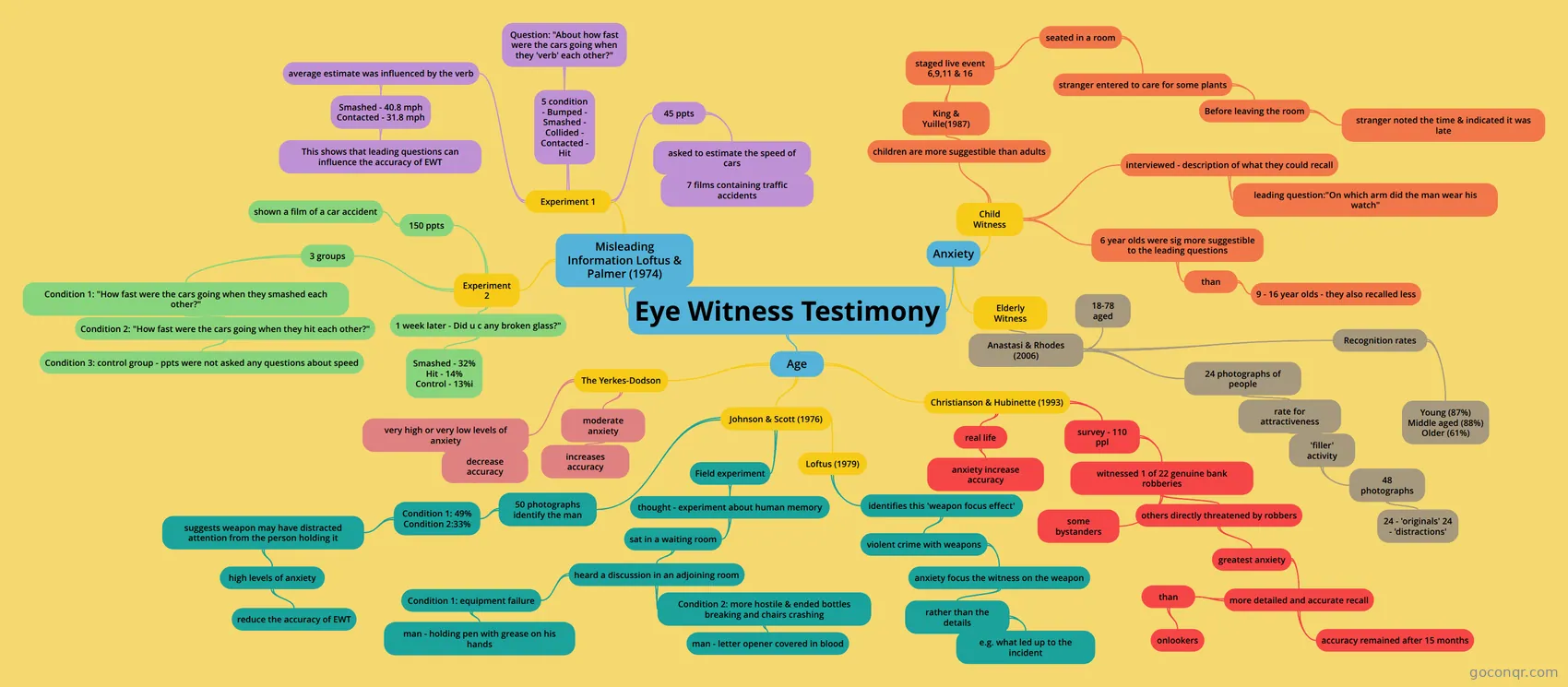
Mind map: Eye witness testimony
Map content
Eye Witness Testimony
Misleading Information Loftus & Palmer (1974)
- Experiment 1
- 45 ppts
- asked to estimate the speed of cars
- 7 films containing traffic accidents
- asked to estimate the speed of cars
- Question: "About how fast were the cars going when they 'verb' each other?"
- 5 condition - Bumped - Smashed - Collided - Contacted - Hit
- average estimate was influenced by the verb
- Smashed - 40.8 mph Contacted - 31.8 mph
- This shows that leading questions can influence the accuracy of EWT
- Smashed - 40.8 mph Contacted - 31.8 mph
- 45 ppts
- Experiment 2
- 150 ppts
- shown a film of a car accident
- 3 groups
- Condition 1: "How fast were the cars going when they smashed each other?"
- Condition 2: "How fast were the cars going when they hit each other?"
- Condition 3: control group - ppts were not asked any questions about speed
- Condition 2: "How fast were the cars going when they hit each other?"
- Condition 1: "How fast were the cars going when they smashed each other?"
- 1 week later - Did u c any broken glass?"
- Smashed - 32% Hit - 14% Control - 13%i
- 150 ppts
- Experiment 1
Anxiety
- Child Witness
- children are more suggestible than adults
- King & Yuille(1987)
- staged live event 6,9,11 & 16
- seated in a room
- stranger entered to care for some plants
- Before leaving the room
- stranger noted the time & indicated it was late
- Before leaving the room
- stranger entered to care for some plants
- seated in a room
- staged live event 6,9,11 & 16
- King & Yuille(1987)
- 6 year olds were sig more suggestible to the leading questions
- than
- 9 - 16 year olds - they also recalled less
- than
- interviewed - description of what they could recall
- leading question:"On which arm did the man wear his watch"
- children are more suggestible than adults
- Elderly Witness
- Anastasi & Rhodes (2006)
- 18-78 aged
- 24 photographs of people
- rate for attractiveness
- 'filler' activity
- 48 photographs
- 24 - 'originals' 24 - 'distractions'
- 48 photographs
- 'filler' activity
- rate for attractiveness
- Recognition rates
- Young (87%) Middle aged (88%) Older (61%)
- Anastasi & Rhodes (2006)
- Child Witness
Age
- The Yerkes-Dodson
- moderate anxiety
- increases accuracy
- very high or very low levels of anxiety
- decrease accuracy
- moderate anxiety
- Johnson & Scott (1976)
- Loftus (1979)
- identifies this 'weapon focus effect'
- violent crime with weapons
- anxiety focus the witness on the weapon
- rather than the details
- e.g. what led up to the incident
- rather than the details
- anxiety focus the witness on the weapon
- violent crime with weapons
- identifies this 'weapon focus effect'
- Field experiment
- thought - experiment about human memory
- sat in a waiting room
- heard a discussion in an adjoining room
- Condition 1: equipment failure
- man - holding pen with grease on his hands
- Condition 2: more hostile & ended bottles breaking and chairs crashing
- man - letter opener covered in blood
- Condition 1: equipment failure
- heard a discussion in an adjoining room
- sat in a waiting room
- thought - experiment about human memory
- 50 photographs identify the man
- Condition 1: 49% Condition 2:33%
- suggests weapon may have distracted attention from the person holding it
- high levels of anxiety
- reduce the accuracy of EWT
- high levels of anxiety
- suggests weapon may have distracted attention from the person holding it
- Condition 1: 49% Condition 2:33%
- Loftus (1979)
- Christianson & Hubinette (1993)
- real life
- anxiety increase accuracy
- survey - 110 ppl
- witnessed 1 of 22 genuine bank robberies
- some bystanders
- others directly threatened by robbers
- greatest anxiety
- more detailed and accurate recall
- than
- onlookers
- accuracy remained after 15 months
- than
- more detailed and accurate recall
- greatest anxiety
- witnessed 1 of 22 genuine bank robberies
- real life
- The Yerkes-Dodson
Information
- Description
- Mind Map on Eye Witness Testimony, created by glaxyjoseph18 on 31/03/2015.
- Created by
- glaxyjoseph18
- Views
- 0
- Rating