
Mind map
Enzymes
Map content
Enzymes
enzymes are biological catalysts
- they speed up chemical reactions
- enzyme action can be extracellular (outside cells) or intracellular (within cells)
- enzymes are globular proteins with a specific tertiary structure. their active site is determined by this tertiary structure.
- for enzymes to work, the substrate has to fit into the active site (its shape has to be complementary) otherwise the reaction will not be catalysed.
enzymes reduce activation energy
- this means reactions can occur usually at lower temperatures than with an enzyme. it also speeds up the rate of reaction.
- when a substrate binds to an enzymes active site, an enzyme-substrate complex is formed. its the formation of the enzyme-substrate complex that lowers the activation energy for two reasons.
- if two substrate molecules need to be joined, attaching to the enzyme holds them close together, reducing the repulsion between the molecules so they can bond more easily.
- if the enzyme is catalysing a breakdown reaction, fitting into the active site puts strain on the bonds in the substrate. this strain means the substrate breaks up more easily.
action of enzymes
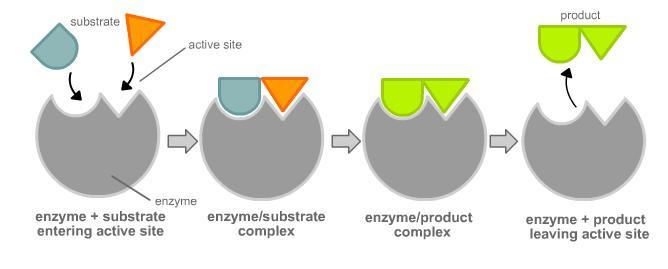
- the lock and key model
- the substrate 'key' fits into the active site 'lock' and is held in one place so the reaction can go ahead.
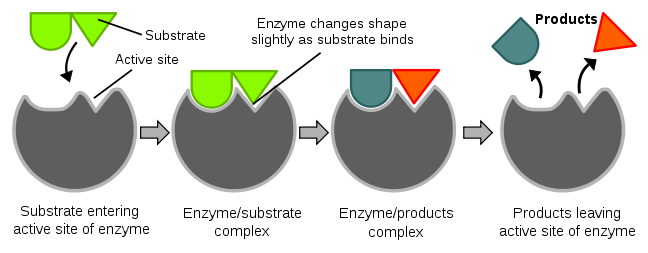
- it is now believed, that changes in the shape of the enzyme occur as the substrate binds to the active site. this is called the induced fit hypothesis.
- the induced fit hypothesis
- as the substrate molecules collides with an enzyme's active site, the enzyme molecule changes shape slightly making the active site fit more closely around the substrate. the substrate fits into place and is held because the oppositely charged groups on the substrate and the active site are found near to eachother. this is the enzyme-substrate complex. the change in shape puts strain on the substrate molecule which destrabalises it so the reaction occurs more easily. this produces a product and is now referred to as an enzyme-product complex. the products formed are a different shape from the substrate so the products no longer fit into the active site and so move away.
- the lock and key model
factors affecting enzyme activity
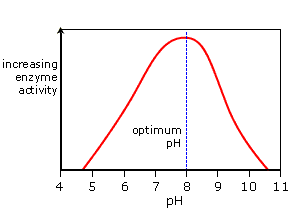
- pH affects enzyme activity
- above and below the optimum pH for an enzyme, the H+ and OH- ions can mess up the ionic bonds and hydrogen bonds that hold the enzyme's tertiary structure together. this makes the active site change shape and the enzyme is denatured.
- different enzymes have different optimums. most human enzymes work best at pH 7 with the exception of Pepsin which is at pH 2 as it is found in the stomach.
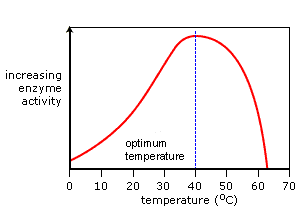
- temperature affects enzyme activity
- a rise in temperature produces more kinetic energy so the enzyme's molecules vibrate more increasing the chance of collision and increasing the rate of reaction.
- if the temperature goes too high, the increased movement of molecules breaks some of the bonds holding the enzyme in the specific shape. this means the active site changes shape and the substrate can no longer fit so the enzyme has denatured.
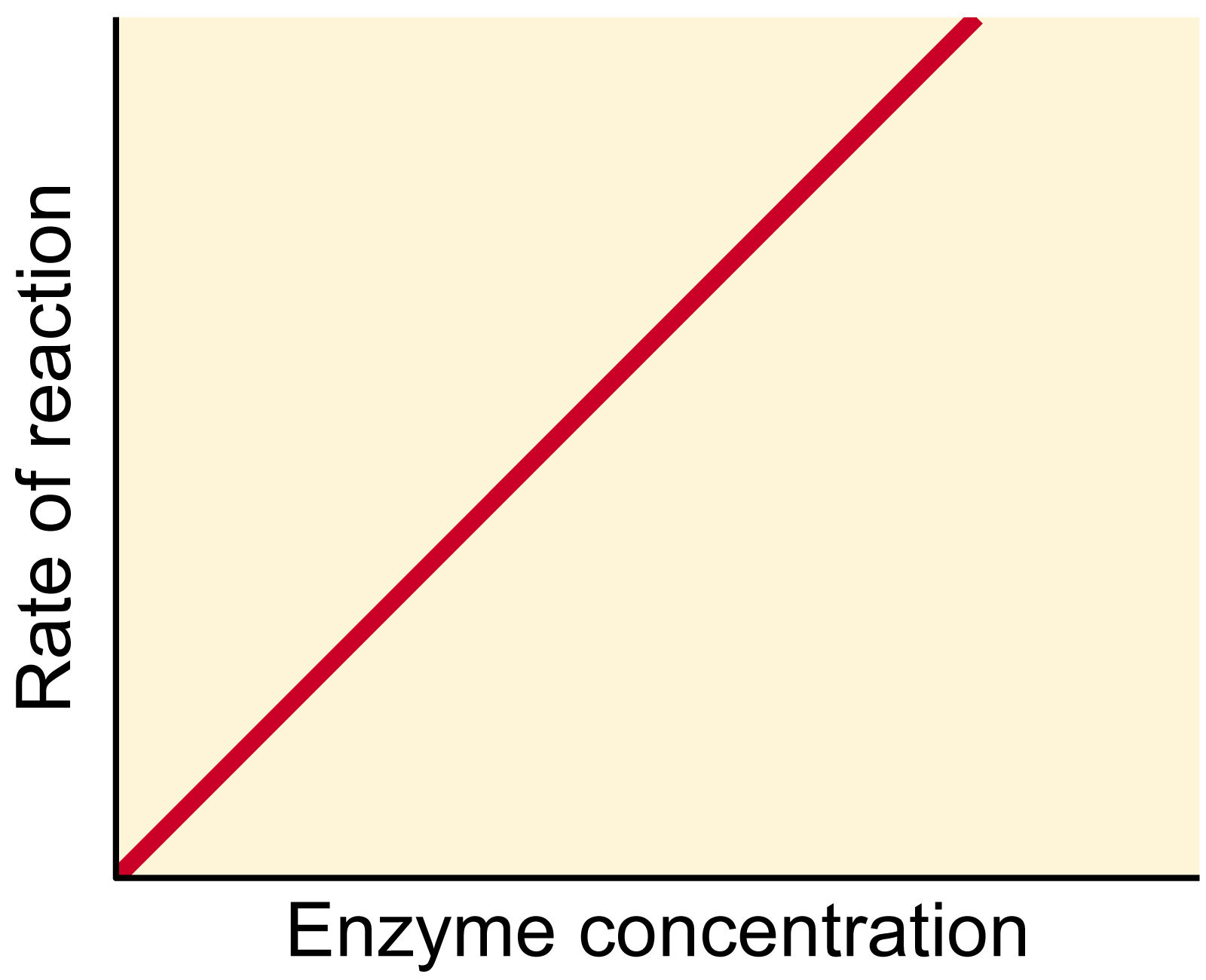
- enzyme concentration affects the rate of reaction
- the more enzyme molecules there are in a solution, the more likely a substrate molecule is to collide with one of them and form an enzyme-substrate complex. so increasing the concentration of enzyme increases the rate of reation.
- however, if the substrate is limited, there comes a point where there is more than enough enzyme molecules so adding more enzyme has no further effect.
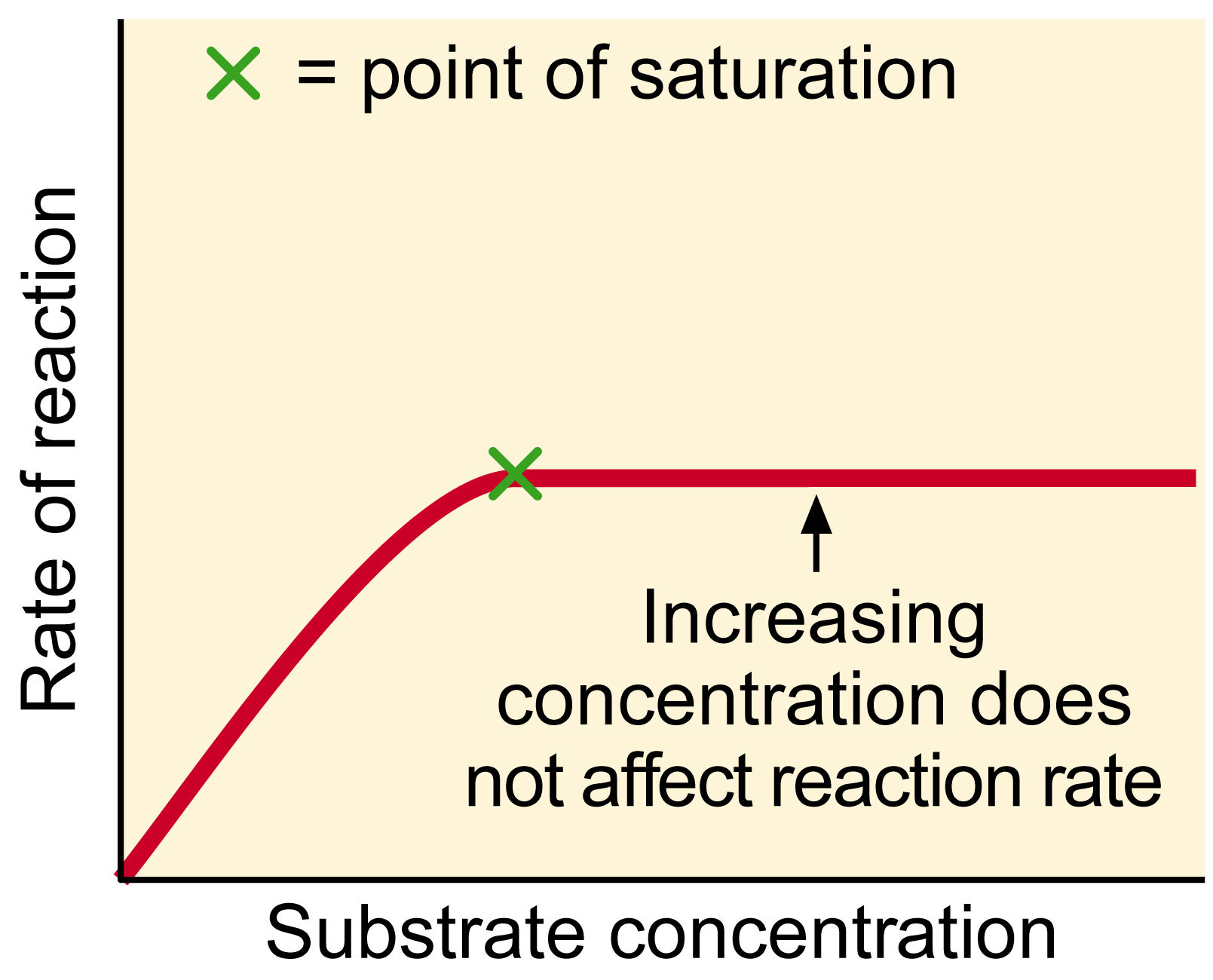
- substrate concentration affects the rate of reaction
- more substrate means more chance of collision with an enzyme so the rate of reaction is increased.
- this is until a point of saturation is reached where all the enzyme's active sites are full and adding more substrate makes no difference.
- pH affects enzyme activity
cofactors and coenzymes
- some enzymes will only work if there is another non-protein substance bound to them. these non protein substances are called cofactors.
- some cofactors are inorganic molecules. they work by helping the substrate and enzyme to bind together. they don't directly participate in the reaction so aren't used up or changed in any way. (manganese ions = cofactors in hydrolase)
- some cofactors are organic molecules, these are called coenzymes. they participate in the reaction and are changed by it. they often act as carriers, moving chemical groups between different enzyms. they're continually recycled.
- some enzymes will only work if there is another non-protein substance bound to them. these non protein substances are called cofactors.
inhibitors
- competitive inhibition
- competitive inhibitor molecules have a similar shape to the substrate molecules. they compete with the substrate to bind to the active site but no reaction takes place. instead, they block the active site so the substrate cannot bind. how much the enzyme is inhibited depends on the relative concentrations of the inhibitor and substrate. if theres a high concentration of inhibitor, nearly all the active sites will be taken up by inhibitor. usually not permanent- they bind for a while and then leave. they are reversible as removal of the inhibitor leaves the enzyme molecules unaffected.
- non-competitive inhibition
- non-competitive inhibitor molecules bind to the enzyme away from the active site in the allosteric site. this causes the active site to change shape so the substrate can no longer fit. they do not compete with the substrate as they are a completely different shape increasing the substrate concentration wont make any difference. usually permanent. the inhibition is irreversible, any enzyme molecule bound by inhibitor molecules are effectively denatured.
- drugs and poisons
- cyanide = a non-competitive inhibitor of cytochrome c oxidase, an enzyme that catalyses respiration reactions. (poison)
- antibiotics (penicillin) = inhibits the enzyme transpeptidase, which catalyses the formation of proteins in bacterial cell walls. this weakens the cell wall and prevents the bacterium from regulating its osmotic pressure. as a result, the cell bursts and the bacterium is killed.
- competitive inhibition
Images and files in the map
Information
- Description
- Biology Mind Map on Enzymes, created by Tom Jefferies on 17/04/2015.
- Created by
- Tom Jefferies · Apr 2015
- Updated
- Feb 19, 2016
- Views
- 5
- Rating