
Mind map
IMMUNITY: VACCINATION
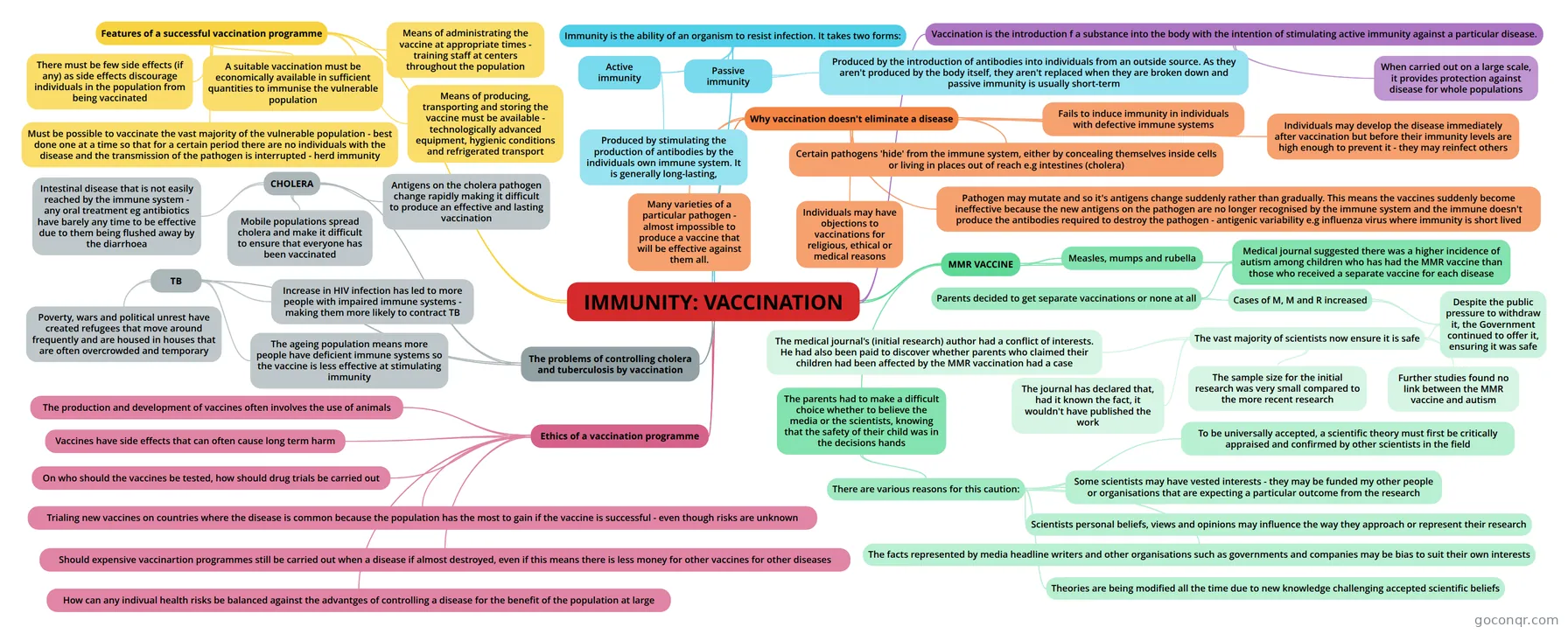
Mind map: immunity and vaccination
Map content
IMMUNITY: VACCINATION
Immunity is the ability of an organism to resist infection. It takes two forms:
- Passive immunity
- Produced by the introduction of antibodies into individuals from an outside source. As they aren't produced by the body itself, they aren't replaced when they are broken down and passive immunity is usually short-term
- Active immunity
- Produced by stimulating the production of antibodies by the individuals own immune system. It is generally long-lasting,
- Passive immunity
Vaccination is the introduction f a substance into the body with the intention of stimulating active immunity against a particular disease.
- When carried out on a large scale, it provides protection against disease for whole populations
Features of a successful vaccination programme
- A suitable vaccination must be economically available in sufficient quantities to immunise the vulnerable population
- There must be few side effects (if any) as side effects discourage individuals in the population from being vaccinated
- Means of producing, transporting and storing the vaccine must be available - technologically advanced equipment, hygienic conditions and refrigerated transport
- Means of administrating the vaccine at appropriate times - training staff at centers throughout the population
- Must be possible to vaccinate the vast majority of the vulnerable population - best done one at a time so that for a certain period there are no individuals with the disease and the transmission of the pathogen is interrupted - herd immunity
Why vaccination doesn't eliminate a disease
- Fails to induce immunity in individuals with defective immune systems
- Individuals may develop the disease immediately after vaccination but before their immunity levels are high enough to prevent it - they may reinfect others
- Pathogen may mutate and so it's antigens change suddenly rather than gradually. This means the vaccines suddenly become ineffective because the new antigens on the pathogen are no longer recognised by the immune system and the immune doesn't produce the antibodies required to destroy the pathogen - antigenic variability e.g influenza virus where immunity is short lived
- Many varieties of a particular pathogen - almost impossible to produce a vaccine that will be effective against them all.
- Certain pathogens 'hide' from the immune system, either by concealing themselves inside cells or living in places out of reach e.g intestines (cholera)
- Individuals may have objections to vaccinations for religious, ethical or medical reasons
The problems of controlling cholera and tuberculosis by vaccination
- CHOLERA
- Intestinal disease that is not easily reached by the immune system - any oral treatment eg antibiotics have barely any time to be effective due to them being flushed away by the diarrhoea
- Antigens on the cholera pathogen change rapidly making it difficult to produce an effective and lasting vaccination
- Mobile populations spread cholera and make it difficult to ensure that everyone has been vaccinated
- TB
- Increase in HIV infection has led to more people with impaired immune systems - making them more likely to contract TB
- Poverty, wars and political unrest have created refugees that move around frequently and are housed in houses that are often overcrowded and temporary
- The ageing population means more people have deficient immune systems so the vaccine is less effective at stimulating immunity
- CHOLERA
MMR VACCINE
- Measles, mumps and rubella
- Medical journal suggested there was a higher incidence of autism among children who has had the MMR vaccine than those who received a separate vaccine for each disease
- Parents decided to get separate vaccinations or none at all
- Cases of M, M and R increased
- Despite the public pressure to withdraw it, the Government continued to offer it, ensuring it was safe
- The vast majority of scientists now ensure it is safe
- The medical journal's (initial research) author had a conflict of interests. He had also been paid to discover whether parents who claimed their children had been affected by the MMR vaccination had a case
- Further studies found no link between the MMR vaccine and autism
- The sample size for the initial research was very small compared to the more recent research
- The journal has declared that, had it known the fact, it wouldn't have published the work
- The vast majority of scientists now ensure it is safe
- Despite the public pressure to withdraw it, the Government continued to offer it, ensuring it was safe
- Cases of M, M and R increased
- Parents decided to get separate vaccinations or none at all
- The parents had to make a difficult choice whether to believe the media or the scientists, knowing that the safety of their child was in the decisions hands
- There are various reasons for this caution:
- To be universally accepted, a scientific theory must first be critically appraised and confirmed by other scientists in the field
- Some scientists may have vested interests - they may be funded my other people or organisations that are expecting a particular outcome from the research
- Scientists personal beliefs, views and opinions may influence the way they approach or represent their research
- The facts represented by media headline writers and other organisations such as governments and companies may be bias to suit their own interests
- Theories are being modified all the time due to new knowledge challenging accepted scientific beliefs
- There are various reasons for this caution:
Ethics of a vaccination programme
- The production and development of vaccines often involves the use of animals
- Vaccines have side effects that can often cause long term harm
- On who should the vaccines be tested, how should drug trials be carried out
- Trialing new vaccines on countries where the disease is common because the population has the most to gain if the vaccine is successful - even though risks are unknown
- Should expensive vaccinartion programmes still be carried out when a disease if almost destroyed, even if this means there is less money for other vaccines for other diseases
- How can any indivual health risks be balanced against the advantges of controlling a disease for the benefit of the population at large
Information
- Description
- A Level AS Biology Mind Map on IMMUNITY: VACCINATION, created by Ashiana Fraser on 29/04/2015.
- Created by
- Ashiana Fraser
- Views
- 3
- Rating