
Mind map
EVOLUTION
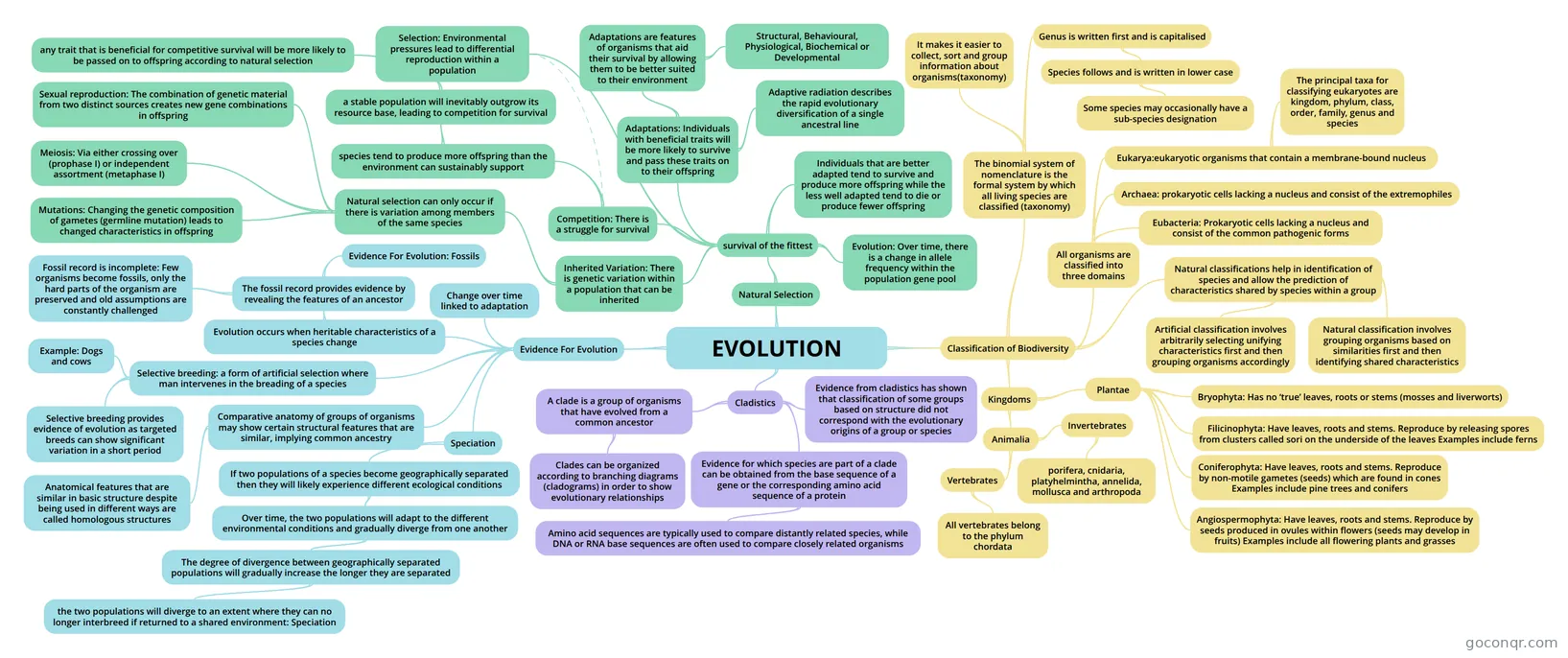
Mind map: Evolution
Map content
EVOLUTION
Evidence For Evolution
- Evolution occurs when heritable characteristics of a species change
- The fossil record provides evidence by revealing the features of an ancestor
- Evidence For Evolution: Fossils
- Fossil record is incomplete: Few organisms become fossils, only the hard parts of the organism are preserved and old assumptions are constantly challenged
- The fossil record provides evidence by revealing the features of an ancestor
- Change over time linked to adaptation
- Selective breeding: a form of artificial selection where man intervenes in the breading of a species
- Example: Dogs and cows
- Selective breeding provides evidence of evolution as targeted breeds can show significant variation in a short period
- Comparative anatomy of groups of organisms may show certain structural features that are similar, implying common ancestry
- Anatomical features that are similar in basic structure despite being used in different ways are called homologous structures
- Speciation
- If two populations of a species become geographically separated then they will likely experience different ecological conditions
- Over time, the two populations will adapt to the different environmental conditions and gradually diverge from one another
- The degree of divergence between geographically separated populations will gradually increase the longer they are separated
- the two populations will diverge to an extent where they can no longer interbreed if returned to a shared environment: Speciation
- The degree of divergence between geographically separated populations will gradually increase the longer they are separated
- Over time, the two populations will adapt to the different environmental conditions and gradually diverge from one another
- If two populations of a species become geographically separated then they will likely experience different ecological conditions
- Evolution occurs when heritable characteristics of a species change
Natural Selection
- survival of the fittest
- Inherited Variation: There is genetic variation within a population that can be inherited
- Natural selection can only occur if there is variation among members of the same species
- Mutations: Changing the genetic composition of gametes (germline mutation) leads to changed characteristics in offspring
- Meiosis: Via either crossing over (prophase I) or independent assortment (metaphase I)
- Sexual reproduction: The combination of genetic material from two distinct sources creates new gene combinations in offspring
- Natural selection can only occur if there is variation among members of the same species
- Competition: There is a struggle for survival
- species tend to produce more offspring than the environment can sustainably support
- a stable population will inevitably outgrow its resource base, leading to competition for survival
- any trait that is beneficial for competitive survival will be more likely to be passed on to offspring according to natural selection
- a stable population will inevitably outgrow its resource base, leading to competition for survival
- species tend to produce more offspring than the environment can sustainably support
- Selection: Environmental pressures lead to differential reproduction within a population
- Adaptations: Individuals with beneficial traits will be more likely to survive and pass these traits on to their offspring
- Adaptations are features of organisms that aid their survival by allowing them to be better suited to their environment
- Structural, Behavioural, Physiological, Biochemical or Developmental
- Adaptive radiation describes the rapid evolutionary diversification of a single ancestral line
- Adaptations are features of organisms that aid their survival by allowing them to be better suited to their environment
- Evolution: Over time, there is a change in allele frequency within the population gene pool
- Individuals that are better adapted tend to survive and produce more offspring while the less well adapted tend to die or produce fewer offspring
- Inherited Variation: There is genetic variation within a population that can be inherited
- survival of the fittest
Classification of Biodiversity
- The binomial system of nomenclature is the formal system by which all living species are classified (taxonomy)
- It makes it easier to collect, sort and group information about organisms(taxonomy)
- Genus is written first and is capitalised
- Species follows and is written in lower case
- Some species may occasionally have a sub-species designation
- Species follows and is written in lower case
- All organisms are classified into three domains
- Eukarya:eukaryotic organisms that contain a membrane-bound nucleus
- The principal taxa for classifying eukaryotes are kingdom, phylum, class, order, family, genus and species
- Archaea: prokaryotic cells lacking a nucleus and consist of the extremophiles
- Eubacteria: Prokaryotic cells lacking a nucleus and consist of the common pathogenic forms
- Eukarya:eukaryotic organisms that contain a membrane-bound nucleus
- Natural classifications help in identification of species and allow the prediction of characteristics shared by species within a group
- Artificial classification involves arbitrarily selecting unifying characteristics first and then grouping organisms accordingly
- Natural classification involves grouping organisms based on similarities first and then identifying shared characteristics
- Kingdoms
- Plantae
- Bryophyta: Has no ‘true’ leaves, roots or stems (mosses and liverworts)
- Filicinophyta: Have leaves, roots and stems. Reproduce by releasing spores from clusters called sori on the underside of the leaves Examples include ferns
- Coniferophyta: Have leaves, roots and stems. Reproduce by non-motile gametes (seeds) which are found in cones Examples include pine trees and conifers
- Angiospermophyta: Have leaves, roots and stems. Reproduce by seeds produced in ovules within flowers (seeds may develop in fruits) Examples include all flowering plants and grasses
- Animalia
- Invertebrates
- porifera, cnidaria, platyhelmintha, annelida, mollusca and arthropoda
- Vertebrates
- All vertebrates belong to the phylum chordata
- Invertebrates
- Plantae
- The binomial system of nomenclature is the formal system by which all living species are classified (taxonomy)
Cladistics
- A clade is a group of organisms that have evolved from a common ancestor
- Clades can be organized according to branching diagrams (cladograms) in order to show evolutionary relationships
- Evidence for which species are part of a clade can be obtained from the base sequence of a gene or the corresponding amino acid sequence of a protein
- Amino acid sequences are typically used to compare distantly related species, while DNA or RNA base sequences are often used to compare closely related organisms
- Evidence from cladistics has shown that classification of some groups based on structure did not correspond with the evolutionary origins of a group or species
- A clade is a group of organisms that have evolved from a common ancestor
Information
- Description
- Mind Map on EVOLUTION, created by maria jose mora perez on 03/01/2021.
- Created by
- maria jose mora perez
- Views
- 0
- Rating
More on Evidence for Evolution