
Mind map
Biology
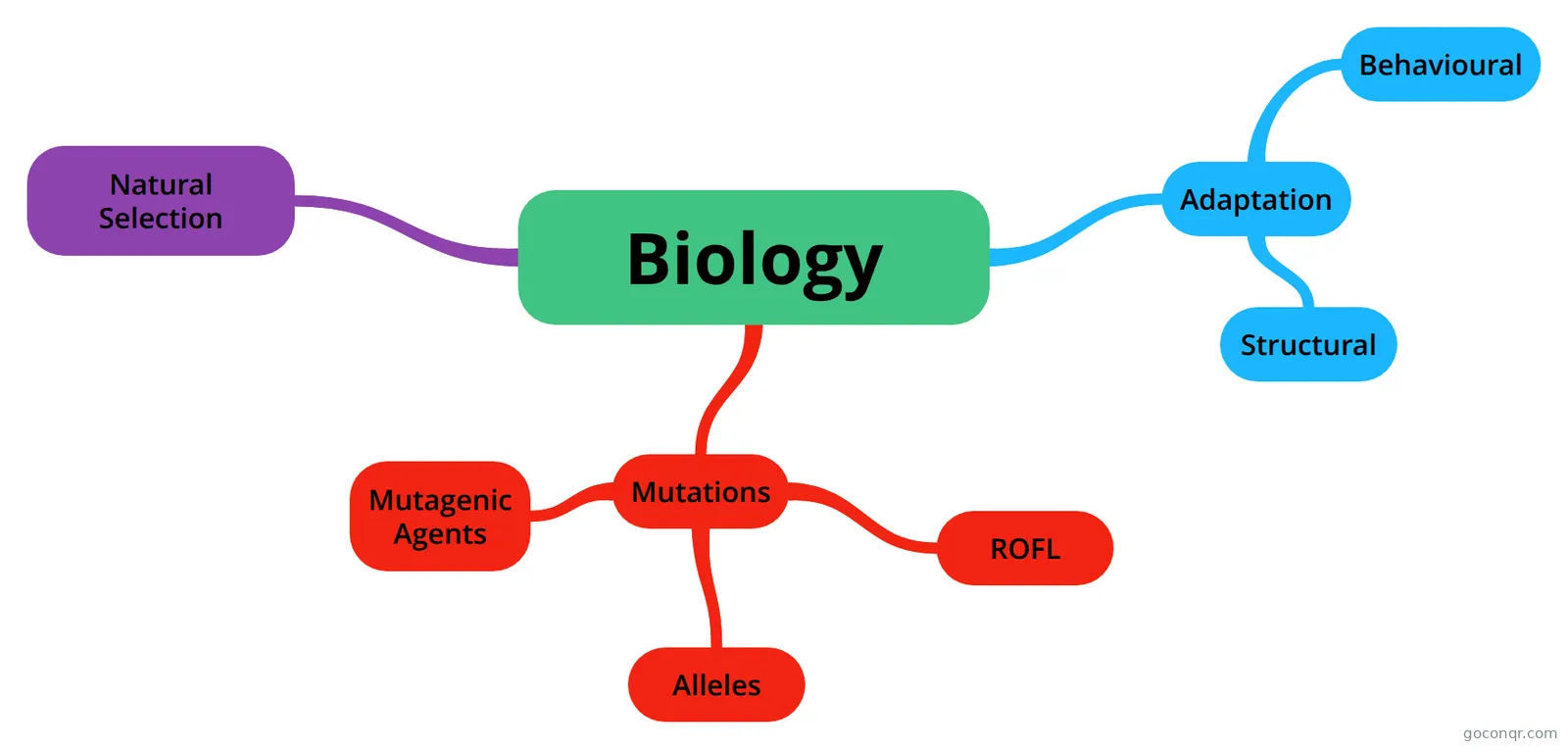
Mind map: Biology
Map content
Biology
- Adaptation Natural selection Evolution of a species
Mutations
- Mutations are a change in the structure or quantity of an organisms genetic material. Mutations can be: - Neutral - Advantageous - Disadvantageous
- Mutagenic Agents
- Mutagenic Agents are substances that speed up the rate of mutations. These can be: Radiation e.g. X-rays and Gamma rays Chemicals e.g. Colchine and Mustard gas.
- ROFL
- Mutations are spontaneous, random events and occur rarely. R - andom O - ccurence L - ow F - requency
- Alleles
- Genes exist in different forms called Alleles. Mutations are the only source of new alleles and therefore new variation amongst a population. This is important because it may confer an advantage to an organism and provide new alleles upon which natural selection can act resulting in evolutionary change
Adaptation
- An adaptation is an inherited characteristic that makes an organism suited to its environment.
- Structural
- Adaptations may be structural. e.g. Dessert mammal Kangaroo Rat is a little mammal in the dessert where there isn't much water and days are hot and nights are cold. Structural changes that allow it to survive are things such as: - No sweat glands so it doesn't sweat. (this is so it doesn't lose any body fluid) - Dry mouth and nasal passage. (this is so it doesn't waste water as saliva)
- Behavioural
- Kangaroo Rats have behavioural adaptations also: - Active at night (This is so it does not need to go out in the heat and is also less likely to be eaten) - Remains in burrow during the day (This is so it's energy is not wasted in the scorching heat)
Natural Selection
- Natural Selection is the process by which those individuals who are best adapted to the environment survive, reproduce and pass their genes on to their offspring
Information
- Description
- Biology (Life on Earth) Adaptations, Natural selection and Evolution of a species
- Created by
- JDB
- Views
- 7
- Rating