
Mind map
*C8 Language Processing part 1
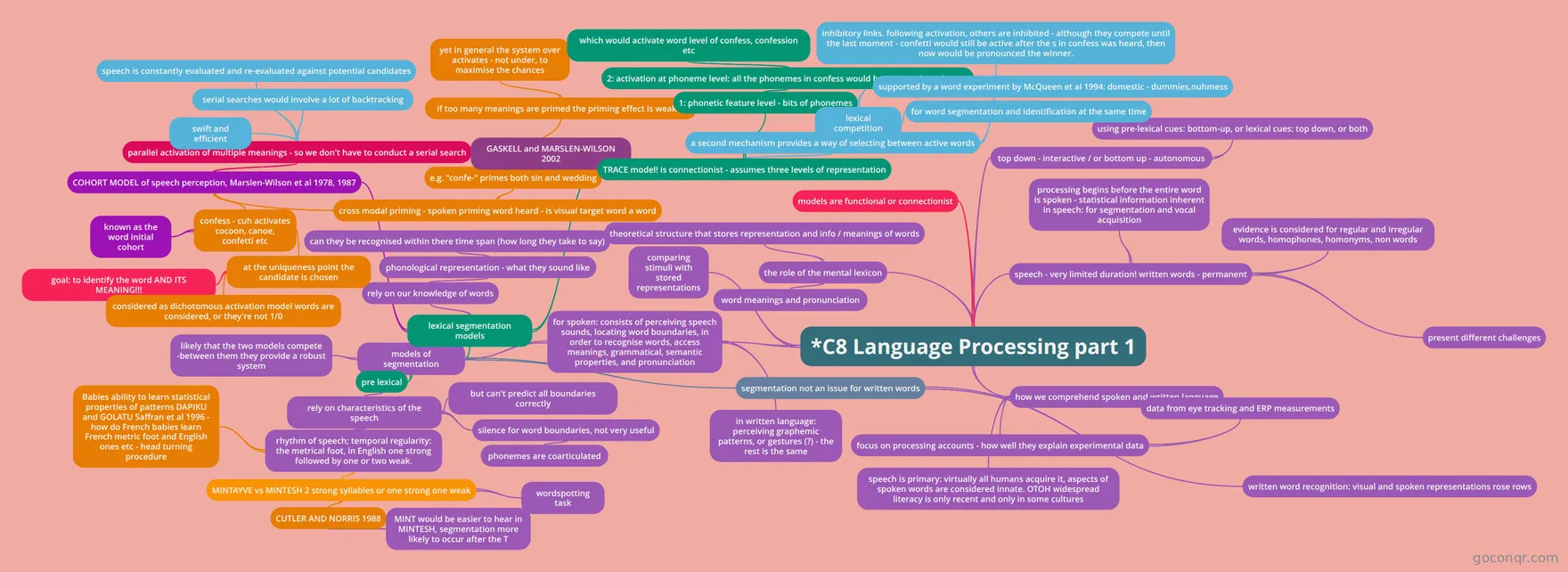
Mind map: language processing
Map content
*C8 Language Processing part 1
how we comprehend spoken and written language
- focus on processing accounts - how well they explain experimental data
- data from eye tracking and ERP measurements
- speech is primary: virtually all humans acquire it, aspects of spoken words are considered innate. OTOH widespread literacy is only recent and only in some cultures
- focus on processing accounts - how well they explain experimental data
models are functional or connectionist
the role of the mental lexicon
- theoretical structure that stores representation and info / meanings of words
- word meanings and pronunciation
top down - interactive / or bottom up - autonomous
- using pre-lexical cues: bottom-up, or lexical cues: top down, or both
for spoken: consists of perceiving speech sounds, locating word boundaries, in order to recognise words, access meanings, grammatical, semantic properties, and pronunciation
- in written language: perceiving graphemic patterns, or gestures (?) - the rest is the same
- models of segmentation
- segmentation not an issue for written words
- written word recognition: visual and spoken representations rose rows
- pre lexical
- rely on characteristics of the speech
- silence for word boundaries, not very useful
- phonemes are coarticulated
- rhythm of speech; temporal regularity: the metrical foot, in English one strong followed by one or two weak.
- MINTAYVE vs MINTESH 2 strong syllables or one strong one weak
- CUTLER AND NORRIS 1988
- MINT would be easier to hear in MINTESH, segmentation more likely to occur after the T
- wordspotting task
- CUTLER AND NORRIS 1988
- Babies ability to learn statistical properties of patterns DAPIKU and GOLATU Saffran et al 1996 - how do French babies learn French metric foot and English ones etc - head turning procedure
- MINTAYVE vs MINTESH 2 strong syllables or one strong one weak
- but can't predict all boundaries correctly
- silence for word boundaries, not very useful
- rely on characteristics of the speech
- lexical segmentation models
- rely on our knowledge of words
- phonological representation - what they sound like
- can they be recognised within there time span (how long they take to say)
- phonological representation - what they sound like
- COHORT MODEL of speech perception, Marslen-Wilson et al 1978, 1987
- confess - cuh activates cocoon, canoe, confetti etc
- at the uniqueness point the candidate is chosen
- goal: to identify the word AND ITS MEANING!!!
- considered as dichotomous activation model words are considered, or they're not 1/0
- known as the word initial cohort
- at the uniqueness point the candidate is chosen
- cross modal priming - spoken priming word heard - is visual target word a word
- e.g. "confe-" primes both sin and wedding
- GASKELL and MARSLEN-WILSON 2002
- e.g. "confe-" primes both sin and wedding
- parallel activation of multiple meanings - so we don't have to conduct a serial search
- if too many meanings are primed the priming effect is weaker
- yet in general the system over activates - not under, to maximise the chances
- swift and efficient
- serial searches would involve a lot of backtracking
- speech is constantly evaluated and re-evaluated against potential candidates
- if too many meanings are primed the priming effect is weaker
- confess - cuh activates cocoon, canoe, confetti etc
- TRACE model! is connectionist - assumes three levels of representation
- 1: phonetic feature level - bits of phonemes
- 2: activation at phoneme level: all the phonemes in confess would be activated one by one
- which would activate word level of confess, confession etc
- 2: activation at phoneme level: all the phonemes in confess would be activated one by one
- a second mechanism provides a way of selecting between active words
- inhibitory links. following activation, others are inhibited - although they compete until the last moment - confetti would still be active after the s in confess was heard, then now would be pronounced the winner.
- lexical competition
- supported by a word experiment by McQueen et al 1994: domestic - dummies,nuhmess
- for word segmentation and identification at the same time
- 1: phonetic feature level - bits of phonemes
- rely on our knowledge of words
- likely that the two models compete -between them they provide a robust system
- segmentation not an issue for written words
comparing stimuli with stored representations
speech - very limited duration! written words - permanent
- present different challenges
- evidence is considered for regular and irregular words, homophones, homonyms, non words
- processing begins before the entire word is spoken - statistical information inherent in speech: for segmentation and vocal acquisition
Information
- Description
- level 5 Cognitive Psychology Mind Map on *C8 Language Processing part 1, created by Eli Y on 19/09/2015.
- Created by
- Eli Y
- Views
- 0
- Rating
More on Speech Perception and Language Comprehension