
Mind map
GCSE AQA BIOLOGY HUMAN SYSTEMS.
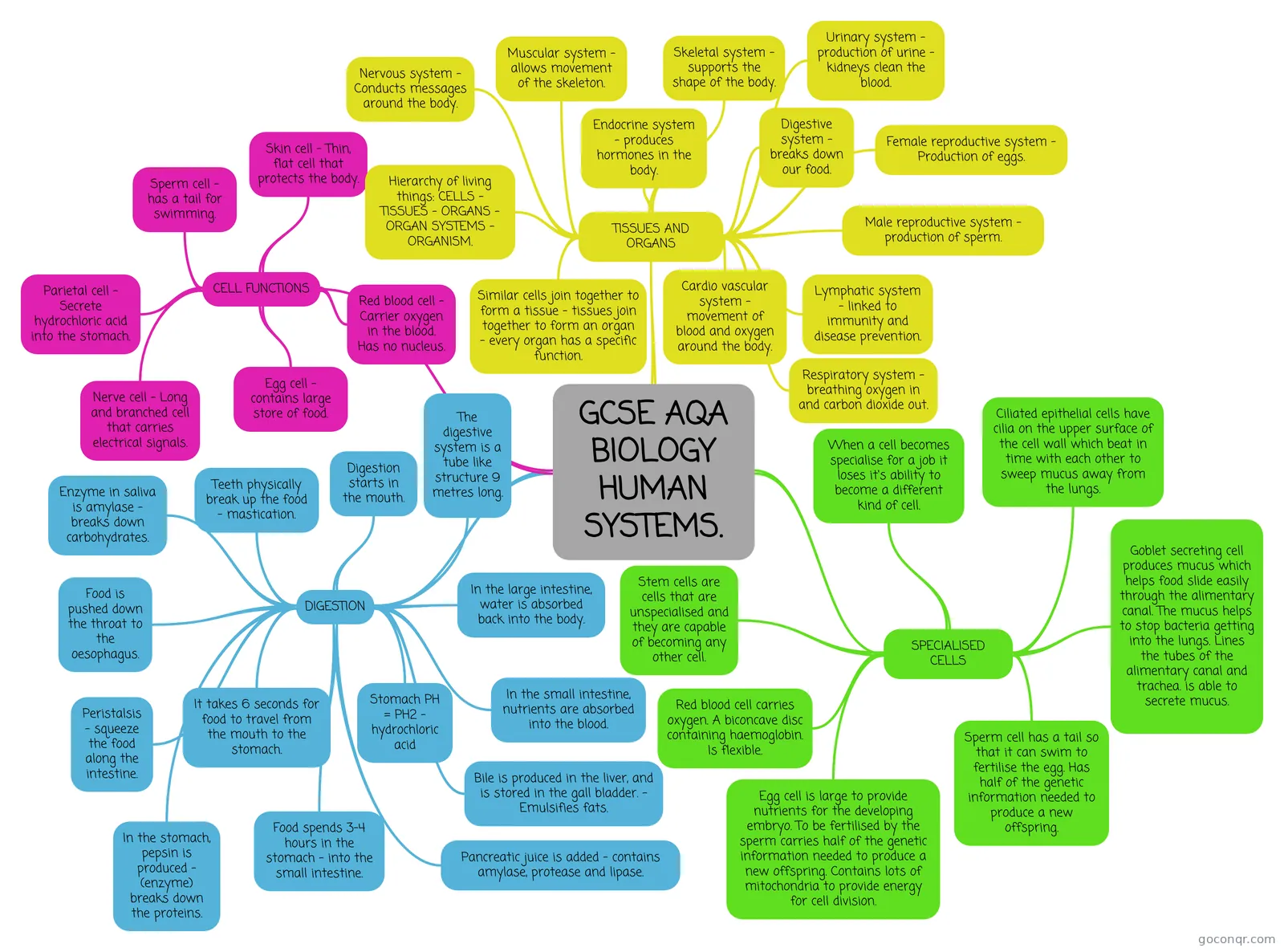
Mind map: GCSE AQA Biology human systems
Map content
GCSE AQA BIOLOGY HUMAN SYSTEMS.
CELL FUNCTIONS
- Sperm cell - has a tail for swimming.
- Parietal cell - Secrete hydrochloric acid into the stomach.
- Red blood cell - Carrier oxygen in the blood. Has no nucleus.
- Nerve cell - Long and branched cell that carries electrical signals.
- Skin cell - Thin, flat cell that protects the body.
- Egg cell - contains large store of food.
TISSUES AND ORGANS
- Similar cells join together to form a tissue - tissues join together to form an organ - every organ has a specific function.
- Hierarchy of living things: CELLS - TISSUES - ORGANS - ORGAN SYSTEMS - ORGANISM.
- Muscular system - allows movement of the skeleton.
- Skeletal system - supports the shape of the body.
- Nervous system - Conducts messages around the body.
- Endocrine system - produces hormones in the body.
- Cardio vascular system - movement of blood and oxygen around the body.
- Lymphatic system - linked to immunity and disease prevention.
- Respiratory system - breathing oxygen in and carbon dioxide out.
- Digestive system - breaks down our food.
- Urinary system - production of urine - kidneys clean the blood.
- Female reproductive system - Production of eggs.
- Male reproductive system - production of sperm.
DIGESTION
- The digestive system is a tube like structure 9 metres long.
- Digestion starts in the mouth.
- Teeth physically break up the food - mastication.
- Enzyme in saliva is amylase - breaks down carbohydrates.
- Food is pushed down the throat to the oesophagus.
- Peristalsis - squeeze the food along the intestine.
- It takes 6 seconds for food to travel from the mouth to the stomach.
- In the stomach, pepsin is produced - (enzyme) breaks down the proteins.
- Stomach PH = PH2 - hydrochloric acid
- Food spends 3-4 hours in the stomach - into the small intestine.
- Pancreatic juice is added - contains amylase, protease and lipase.
- Bile is produced in the liver, and is stored in the gall bladder. - Emulsifies fats.
- In the small intestine, nutrients are absorbed into the blood.
- In the large intestine, water is absorbed back into the body.
SPECIALISED CELLS
- When a cell becomes specialise for a job it loses it's ability to become a different kind of cell.
- Stem cells are cells that are unspecialised and they are capable of becoming any other cell.
- Red blood cell carries oxygen. A biconcave disc containing haemoglobin. Is flexible.
- Egg cell is large to provide nutrients for the developing embryo. To be fertilised by the sperm carries half of the genetic information needed to produce a new offspring. Contains lots of mitochondria to provide energy for cell division.
- Sperm cell has a tail so that it can swim to fertilise the egg. Has half of the genetic information needed to produce a new offspring.
- Ciliated epithelial cells have cilia on the upper surface of the cell wall which beat in time with each other to sweep mucus away from the lungs.
- Goblet secreting cell produces mucus which helps food slide easily through the alimentary canal. The mucus helps to stop bacteria getting into the lungs. Lines the tubes of the alimentary canal and trachea. is able to secrete mucus.
Information
- Description
- Mind Map on GCSE AQA BIOLOGY HUMAN SYSTEMS., created by Kate Ordidge on 01/11/2015.
- Created by
- Kate Ordidge
- Views
- 3
- Rating