
Mind map
Biological Membranes
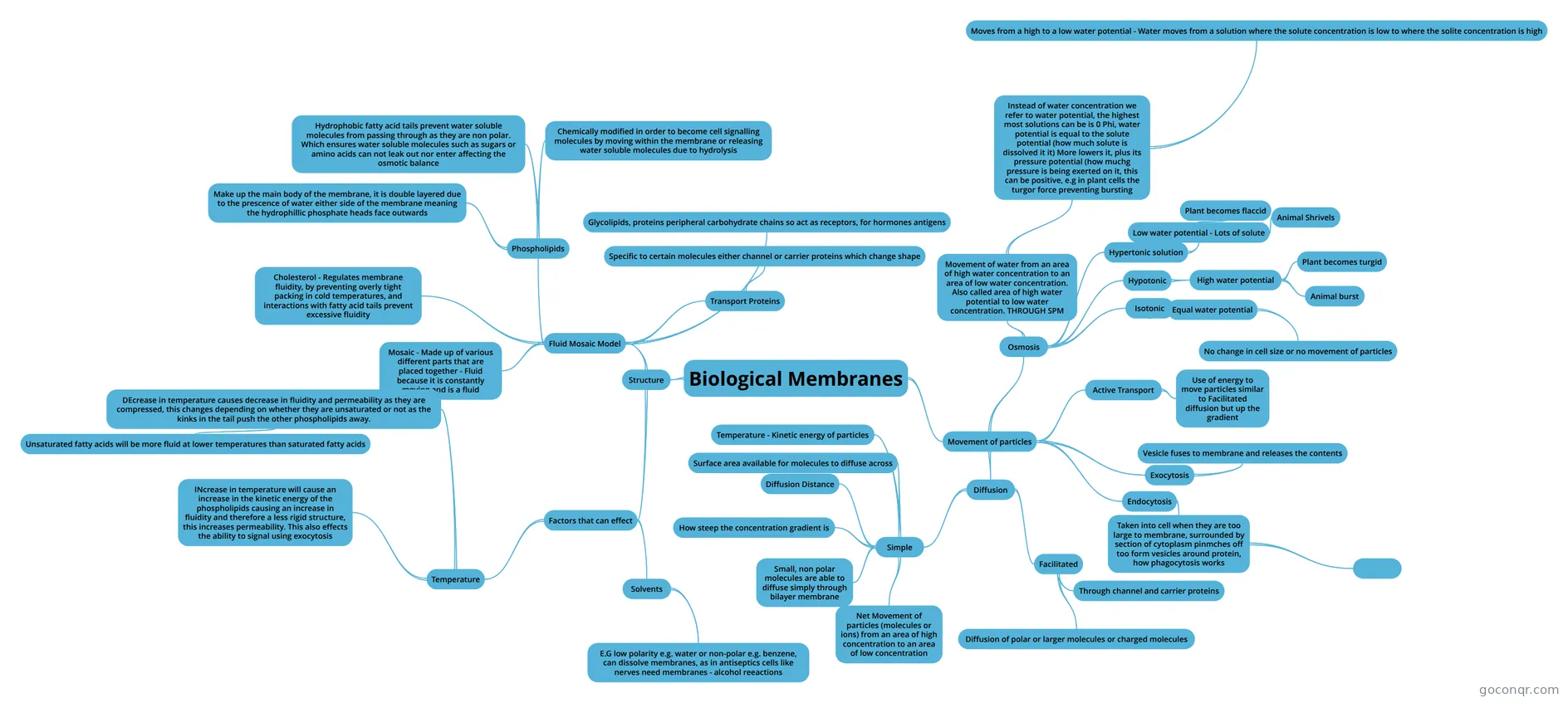
Mind map: Biological membranes
Map content
Biological Membranes
Structure
- Fluid Mosaic Model
- Mosaic - Made up of various different parts that are placed together - Fluid because it is constantly moving and is a fluid
- Cholesterol - Regulates membrane fluidity, by preventing overly tight packing in cold temperatures, and interactions with fatty acid tails prevent excessive fluidity
- Phospholipids
- Make up the main body of the membrane, it is double layered due to the prescence of water either side of the membrane meaning the hydrophillic phosphate heads face outwards
- Hydrophobic fatty acid tails prevent water soluble molecules from passing through as they are non polar. Which ensures water soluble molecules such as sugars or amino acids can not leak out nor enter affecting the osmotic balance
- Chemically modified in order to become cell signalling molecules by moving within the membrane or releasing water soluble molecules due to hydrolysis
- Glycolipids, proteins peripheral carbohydrate chains so act as receptors, for hormones antigens
- Transport Proteins
- Specific to certain molecules either channel or carrier proteins which change shape
- Factors that can effect
- Temperature
- INcrease in temperature will cause an increase in the kinetic energy of the phospholipids causing an increase in fluidity and therefore a less rigid structure, this increases permeability. This also effects the ability to signal using exocytosis
- DEcrease in temperature causes decrease in fluidity and permeability as they are compressed, this changes depending on whether they are unsaturated or not as the kinks in the tail push the other phospholipids away.
- Unsaturated fatty acids will be more fluid at lower temperatures than saturated fatty acids
- Solvents
- E.G low polarity e.g. water or non-polar e.g. benzene, can dissolve membranes, as in antiseptics cells like nerves need membranes - alcohol reeactions
- Temperature
- Fluid Mosaic Model
Movement of particles
- Diffusion
- Simple
- Net Movement of particles (molecules or ions) from an area of high concentration to an area of low concentration
- Small, non polar molecules are able to diffuse simply through bilayer membrane
- How steep the concentration gradient is
- Diffusion Distance
- Surface area available for molecules to diffuse across
- Temperature - Kinetic energy of particles
- Facilitated
- Diffusion of polar or larger molecules or charged molecules
- Through channel and carrier proteins
- Simple
- Osmosis
- Movement of water from an area of high water concentration to an area of low water concentration. Also called area of high water potential to low water concentration. THROUGH SPM
- Instead of water concentration we refer to water potential, the highest most solutions can be is 0 Phi, water potential is equal to the solute potential (how much solute is dissolved it it) More lowers it, plus its pressure potential (how muchg pressure is being exerted on it, this can be positive, e.g in plant cells the turgor force preventing bursting
- Moves from a high to a low water potential - Water moves from a solution where the solute concentration is low to where the solite concentration is high
- Instead of water concentration we refer to water potential, the highest most solutions can be is 0 Phi, water potential is equal to the solute potential (how much solute is dissolved it it) More lowers it, plus its pressure potential (how muchg pressure is being exerted on it, this can be positive, e.g in plant cells the turgor force preventing bursting
- Isotonic
- Equal water potential
- No change in cell size or no movement of particles
- Equal water potential
- Hypertonic solution
- Low water potential - Lots of solute
- Plant becomes flaccid
- Animal Shrivels
- Low water potential - Lots of solute
- Hypotonic
- High water potential
- Plant becomes turgid
- Animal burst
- High water potential
- Movement of water from an area of high water concentration to an area of low water concentration. Also called area of high water potential to low water concentration. THROUGH SPM
- Active Transport
- Use of energy to move particles similar to Facilitated diffusion but up the gradient
- Endocytosis
- Taken into cell when they are too large to membrane, surrounded by section of cytoplasm pinmches off too form vesicles around protein, how phagocytosis works
- Taken into cell when they are too large to membrane, surrounded by section of cytoplasm pinmches off too form vesicles around protein, how phagocytosis works
- Exocytosis
- Vesicle fuses to membrane and releases the contents
- Diffusion
Information
- Description
- A level Biology Mind Map on Biological Membranes, created by Sam Buller on 07/10/2024.
- Created by
- Sam Buller
- Views
- 0
- Rating