
Mind map
Social Differentiation & Social Inequality (Chapter 1)
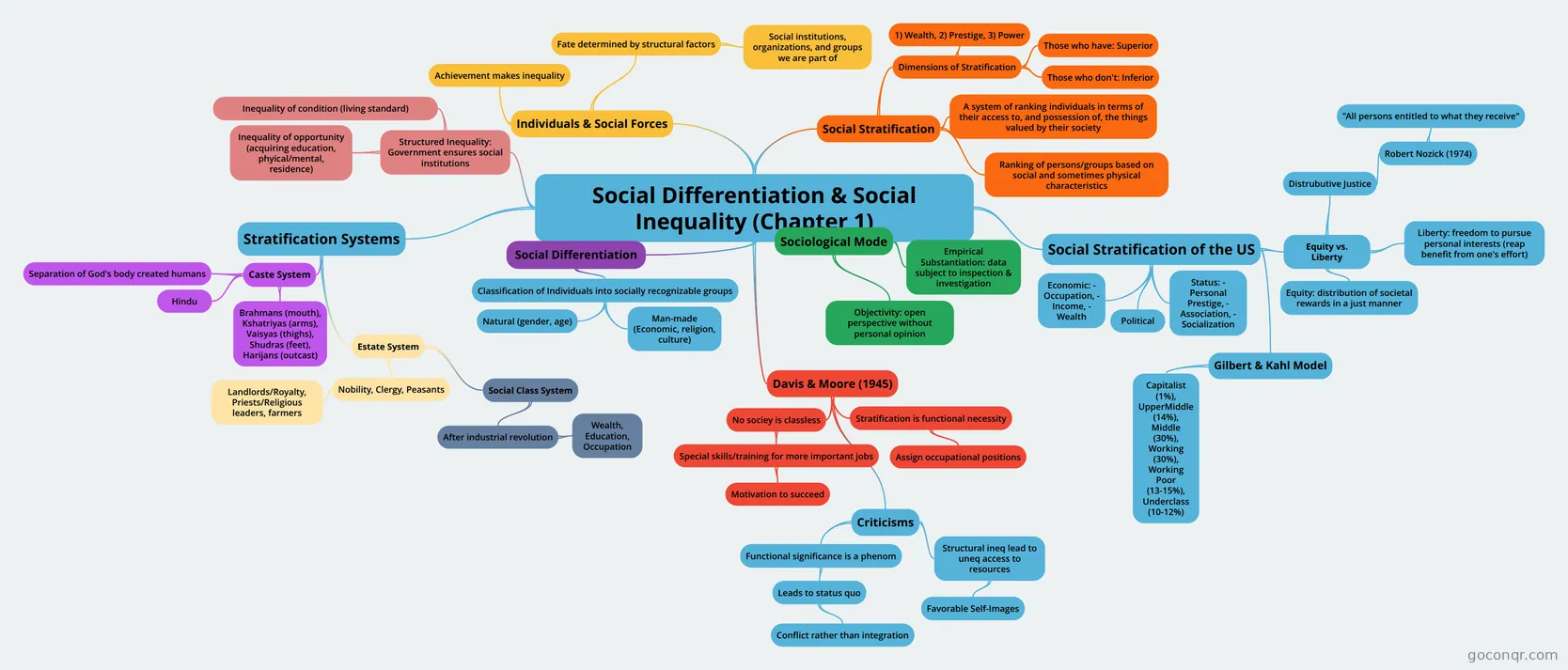
Mind map: social differentiation & social inequality
Map content
Social Differentiation & Social Inequality (Chapter 1)
Social Differentiation
- Classification of Individuals into socially recognizable groups
- Natural (gender, age)
- Man-made (Economic, religion, culture)
- Classification of Individuals into socially recognizable groups
Sociological Mode
- Objectivity: open perspective without personal opinion
- Empirical Substantiation: data subject to inspection & investigation
Individuals & Social Forces
- Achievement makes inequality
- Fate determined by structural factors
- Social institutions, organizations, and groups we are part of
Social Stratification
- A system of ranking individuals in terms of their access to, and possession of, the things valued by their society
- Ranking of persons/groups based on social and sometimes physical characteristics
- Dimensions of Stratification
- 1) Wealth, 2) Prestige, 3) Power
- Those who have: Superior
- Those who don't: Inferior
Structured Inequality: Government ensures social institutions
- Inequality of condition (living standard)
- Inequality of opportunity (acquiring education, phyical/mental, residence)
Stratification Systems
- Caste System
- Hindu
- Separation of God's body created humans
- Brahmans (mouth), Kshatriyas (arms), Vaisyas (thighs), Shudras (feet), Harijans (outcast)
- Estate System
- Nobility, Clergy, Peasants
- Landlords/Royalty, Priests/Religious leaders, farmers
- Social Class System
- After industrial revolution
- Wealth, Education, Occupation
- After industrial revolution
- Nobility, Clergy, Peasants
- Caste System
Social Stratification of the US
- Economic: - Occupation, - Income, - Wealth
- Status: - Personal Prestige, - Association, - Socialization
- Political
- Equity vs. Liberty
- Equity: distribution of societal rewards in a just manner
- Liberty: freedom to pursue personal interests (reap benefit from one's effort)
- Distrubutive Justice
- Robert Nozick (1974)
- "All persons entitled to what they receive"
- Robert Nozick (1974)
- Gilbert & Kahl Model
- Capitalist (1%), UpperMiddle (14%), Middle (30%), Working (30%), Working Poor (13-15%), Underclass (10-12%)
Davis & Moore (1945)
- No sociey is classless
- Special skills/training for more important jobs
- Motivation to succeed
- Special skills/training for more important jobs
- Stratification is functional necessity
- Assign occupational positions
- Criticisms
- Functional significance is a phenom
- Leads to status quo
- Conflict rather than integration
- Leads to status quo
- Structural ineq lead to uneq access to resources
- Favorable Self-Images
- Functional significance is a phenom
- No sociey is classless