
Mind map
Communication and homeostasis
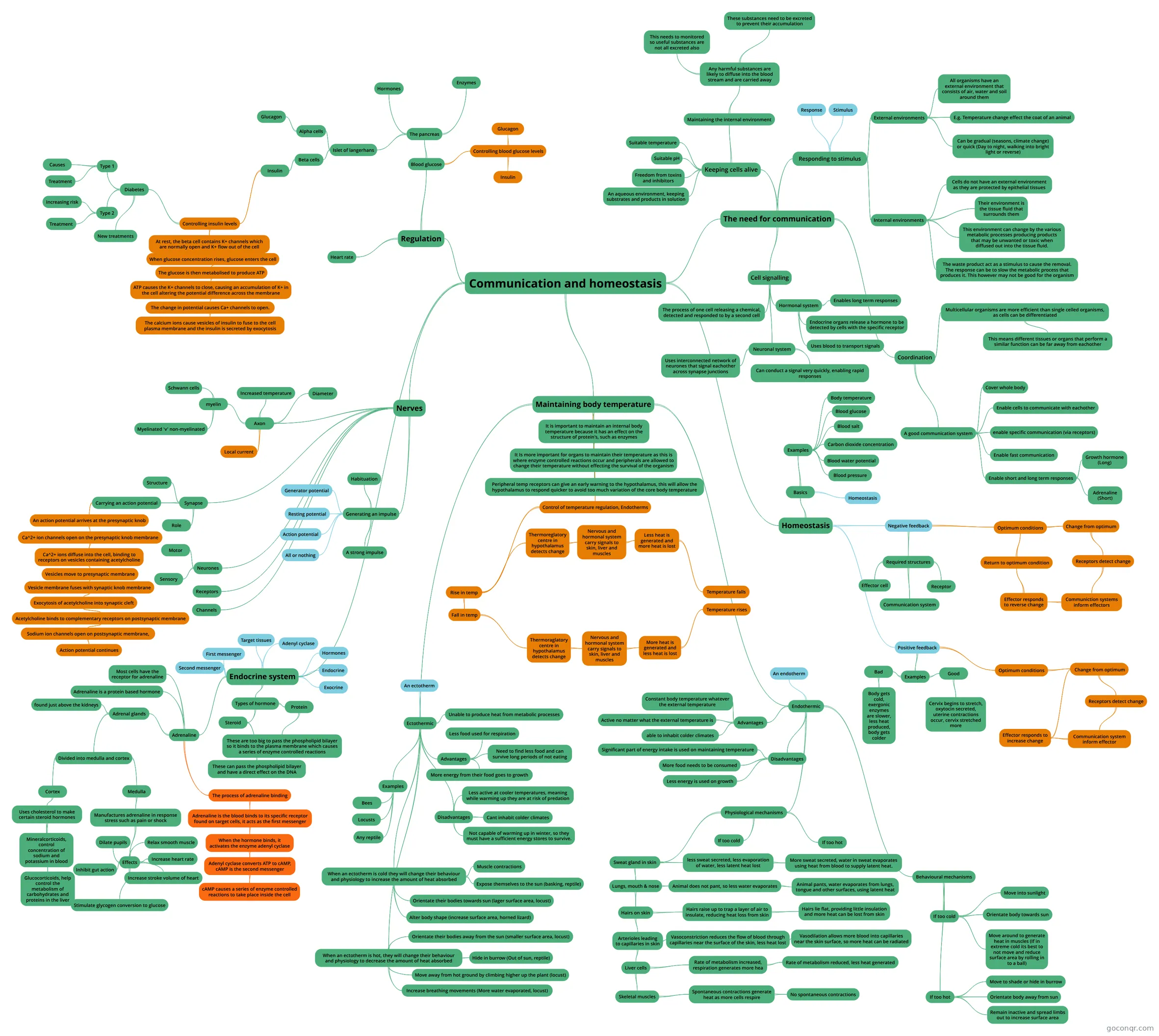
Mind map: Communication and homeostasis
Map content
Communication and homeostasis
The need for communication
- Keeping cells alive
- Maintaining the internal environment
- Any harmful substances are likely to diffuse into the blood stream and are carried away
- These substances need to be excreted to prevent their accumulation
- This needs to monitored so useful substances are not all excreted also
- Any harmful substances are likely to diffuse into the blood stream and are carried away
- Suitable temperature
- Suitable pH
- Freedom from toxins and inhibitors
- An aqueous environment, keeping substrates and products in solution
- Maintaining the internal environment
- Responding to stimulus
- External environments
- All organisms have an external environment that consists of air, water and soil around them
- E.g. Temperature change effect the coat of an animal
- Can be gradual (seasons, climate change) or quick (Day to night, walking into bright light or reverse)
- Internal environments
- Cells do not have an external environment as they are protected by epithelial tissues
- Their environment is the tissue fluid that surrounds them
- This environment can change by the various metabolic processes producing products that may be unwanted or toxic when diffused out into the tissue fluid.
- The waste product act as a stimulus to cause the removal. The response can be to slow the metabolic process that produces it. This however may not be good for the organism
- Response
- A change in behaviour or physiology as a result to a stimulus
- Stimulus
- A change in the environment that causes a response
- External environments
- Coordination
- Multicellular organisms are more efficient than single celled organisms, as cells can be differentiated
- This means different tissues or organs that perform a similar function can be far away from eachother
- A good communication system
- Cover whole body
- Enable cells to communicate with eachother
- enable specific communication (via receptors)
- Enable fast communication
- Enable short and long term responses
- Growth hormone (Long)
- Adrenaline (Short)
- Multicellular organisms are more efficient than single celled organisms, as cells can be differentiated
- Cell signalling
- Hormonal system
- Uses blood to transport signals
- Endocrine organs release a hormone to be detected by cells with the specific receptor
- Enables long term responses
- Neuronal system
- Uses interconnected network of neurones that signal eachother across synapse junctions
- Can conduct a signal very quickly, enabling rapid responses
- The process of one cell releasing a chemical, detected and responded to by a second cell
- Hormonal system
- Keeping cells alive
Homeostasis
- Positive feedback
- The process that increases a change detected by receptors. Can be harmful. Does not lead to homeostasis
- Optimum conditions
- Change from optimum
- Receptors detect change
- Communication system inform effector
- Effector responds to increase change
- Change from optimum
- Effector responds to increase change
- Communication system inform effector
- Receptors detect change
- Change from optimum
- Examples
- Good
- Cervix begins to stretch, oxytocin secreted, uterine contractions occur, cervix stretched more
- Bad
- Body gets cold, exergonic enzymes are slower, less heat produced, body gets colder
- Good
- Negative feedback
- The process that brings about a reversal of a change in conditions. Ensures optimum state is maintained. Internal environments are returned to its original conditions after the change. Leads to homeostasis.
- Optimum condition
- Change from optimum
- Receptors detect change
- Communiction systems inform effectors
- Effector responds to reverse change
- Return to optimum condition
- Optimum conditions
- Return to optimum condition
- Effector responds to reverse change
- Communiction systems inform effectors
- Receptors detect change
- Change from optimum
- Required structures
- Receptor
- Communication system
- Effector cell
- Basics
- Homeostasis
- The maintenance of the internal environment in a constant state despite external changes.
- Constant - Within a minor range
- Examples
- Body temperature
- Blood glucose
- Blood salt
- Blood water potential
- Blood pressure
- Carbon dioxide concentration
- Homeostasis
- Positive feedback
Maintaining body temperature
- Ectothermic
- An ectotherm
- An organism that relies on external heat sources to regulate its body temperature
- Unable to produce heat from metabolic processes
- Advantages
- Less food used for respiration
- Need to find less food and can survive long periods of not eating
- More energy from their food goes to growth
- Disadvantages
- Less active at cooler temperatures, meaning while warming up they are at risk of predation
- Not capable of warming up in winter, so they must have a sufficient energy stores to survive.
- Cant inhabit colder climates
- When an ectotherm is cold they will change their behaviour and physiology to increase the amount of heat absorbed
- Muscle contractions
- Expose themselves to the sun (basking, reptile)
- Orientate their bodies towards sun (lager surface area, locust)
- Alter body shape (increase surface area, horned lizard)
- Examples
- Any reptile
- Locusts
- Bees
- When an ectotherm is hot, they will change their behaviour and physiology to decrease the amount of heat absorbed
- Orientate their bodies away from the sun (smaller surface area, locust)
- Hide in burrow (Out of sun, reptile)
- Increase breathing movements (More water evaporated, locust)
- Move away from hot ground by climbing higher up the plant (locust)
- An ectotherm
- Endothermic
- An endotherm
- An organism that uses internal sources of heat, such as metabolism in the liver, to maintain body temperature. They are largely independent from external heat sources.
- Advantages
- Constant body temperature whatever the external temperature
- Active no matter what the external temperature is
- able to inhabit colder climates
- Disadvantages
- Significant part of energy intake is used on maintaining temperature
- More food needs to be consumed
- Less energy is used on growth
- Physiological mechanisms
- Sweat gland in skin
- Lungs, mouth & nose
- Hairs on skin
- Arterioles leading to capillaries in skin
- Liver cells
- Skeletal muscles
- Spontaneous contractions generate heat as more cells respire
- No spontaneous contractions
- Spontaneous contractions generate heat as more cells respire
- Rate of metabolism increased, respiration generates more hea
- Rate of metabolism reduced, less heat generated
- Skeletal muscles
- Vasoconstriction reduces the flow of blood through capillaries near the surface of the skin, less heat lost
- Vasodilation allows more blood into capillaries near the skin surface, so more heat can be radiated
- Liver cells
- Hairs raise up to trap a layer of air to insulate, reducing heat loss from skin
- Hairs lie flat, providing little insulation and more heat can be lost from skin
- Arterioles leading to capillaries in skin
- Animal does not pant, so less water evaporates
- Animal pants, water evaporates from lungs, tongue and other surfaces, using latent heat
- Hairs on skin
- less sweat secreted, less evaporation of water, less latent heat lost
- More sweat secreted, water in sweat evaporates using heat from blood to supply latent heat.
- Lungs, mouth & nose
- If too hot
- If too cold
- Sweat gland in skin
- Behavioural mechanisms
- If too cold
- Move into sunlight
- Orientate body towards sun
- Move around to generate heat in muscles (If in extreme cold its best to not move and reduce surface area by rolling in to a ball)
- If too hot
- Move to shade or hide in burrow
- Orientate body away from sun
- Remain inactive and spread limbs out to increase surface area
- If too cold
- An endotherm
- It is important to maintain an internal body temperature because it has an effect on the structure of protein's, such as enzymes
- It Is more important for organs to maintain their temperature as this is where enzyme controlled reactions occur and peripherals are allowed to change their temperature without effecting the survival of the organism
- Control of temperature regulation, Endotherms
- Rise in temp
- Thermoreglatory centre in hypothalamus detects change
- Nervous and hormonal system carry signals to skin, liver and muscles
- Less heat is generated and more heat is lost
- Temperature falls
- Less heat is generated and more heat is lost
- Nervous and hormonal system carry signals to skin, liver and muscles
- Fall in temp
- Thermoraglatory centre in hypothalamus detects change
- Nervous and hormonal system carry signals to skin, liver and muscles
- More heat is generated and less heat is lost
- Temperature rises
- More heat is generated and less heat is lost
- Nervous and hormonal system carry signals to skin, liver and muscles
- Thermoraglatory centre in hypothalamus detects change
- Thermoreglatory centre in hypothalamus detects change
- Rise in temp
- Peripheral temp receptors can give an early warning to the hypothalamus, this will allow the hypothalamus to respond quicker to avoid too much variation of the core body temperature
- Ectothermic
Nerves
- Generating an impulse
- Generator potential
- Action potential
- Resting potential
- All or nothing
- If the stimulus is not strong enough and does not reach the threshold potential and the depolarisation of the membrane is insufficient, an action potential is not generated.
- A strong impulse
- As an action potential is always the same intensity, a strong impulse causes more frequent action potentials and a high rate of action potentials means a strong stimulus
- Habituation
- E.g. for wearing clothes, theyre not constantly felt, this is because the Na+ channels remain open and a resting potential is not re-established
- Receptors
- Neurones
- These can be described as transducers as they convert one form of energy to another form of energy
- Sensory
- Deformation of the tip causes more Na+ to enter as gaps are made in the phospholipid bilayer
- Motor
- Channels
- Synapse
- Structure
- Role
- Allows neurones to communicate Ensure transmission is in one direction only Allows convergence Allows divergence Filter low level stimuli Prevents fatigue Allow low level stimuli being amplified Permits memory
- Carrying an action potential
- An action potential arrives at the presynaptic knob
- Ca^2+ ion channels open on the presynaptic knob membrane
- Ca^2+ ions diffuse into the cell, binding to receptors on vesicles containing acetylcholine
- Vesicles move to presynaptic membrane
- Vesicle membrane fuses with synaptic knob membrane
- Exocytosis of acetylcholine into synaptic cleft
- Acetylcholine binds to complementary receptors on postsynaptic membrane
- Sodium ion channels open on postsynaptic membrane,
- Action potential continues
- Sodium ion channels open on postsynaptic membrane,
- Acetylcholine binds to complementary receptors on postsynaptic membrane
- Exocytosis of acetylcholine into synaptic cleft
- Vesicle membrane fuses with synaptic knob membrane
- Vesicles move to presynaptic membrane
- Ca^2+ ions diffuse into the cell, binding to receptors on vesicles containing acetylcholine
- Ca^2+ ion channels open on the presynaptic knob membrane
- An action potential arrives at the presynaptic knob
- Axon
- myelin
- An insulating layer of fatty material which prevent sodium and potassium diffusing though. This means the local current of an action potential are elongated and sodium ions only enter at the gaps in the sheath, the nodes of ranvier. This is called saltatory conduction.
- Schwann cells
- Schwann cells wrap around axon, but leave gaps called nodes of Ranvier
- Myelinated 'v' non-myelinated
- Myelinated axons produce a greater transmission speed with same diameter. Un-myelinated need to have a larger diameter to produce similar speeds.
- Diameter
- Larger diameter axon produces faster transmission speed
- Increased temperature
- At higher temperatures, transmission is faster due to the increased kinetic energy allows sodium ions to diffuse into the axon faster causing depolarisation to happen faster
- If it gets too hot, transmission stops as the ion channels are denatured and no longer allow sodium ions to diffuse
- Local current
- If sodium ions enter the neurone at a point, this disrupts the resting potential created by the sodium potassium pumps. This creates local currents which cause sodium ion channels to open further along the membrane.
- When an action potential occurs, sodium ion channels open Sodium ions diffuse across the membrane from high to low concentration.The sodium ions cause a disruption in the balanced ionic concentrations created by the sodium potassium pumpsThe concentration of sodium ions rises at a single point, creating a concentration gradient inside the cellDiffusion down the concentration gradient causes the sodium ions to move sidewaysThe movement of sodium ions is called the local currentThe sodium ions that have moved will cause the next sodium ion channel to open to create another point of high concentration of sodium ions continuing the process.
- myelin
- Generating an impulse
Endocrine system
- Endocrine
- A gland that secretes hormones directly into the blood without ducts
- Exocrine
- A gland that secretes molecules into a duct that carries the molecules to where they are used
- Hormones
- Molecules that are released by an endocrine gland directly into the blood that act as messengers to specific cells with the complementary receptors
- Adrenaline
- Adrenaline is a protein based hormone
- The process of adrenaline binding
- Adrenaline is the blood binds to its specific receptor found on target cells, it acts as the first messenger
- When the hormone binds, it activates the enzyme adenyl cyclase
- Adenyl cyclase converts ATP to cAMP, cAMP is the second messenger
- cAMP causes a series of enzyme controlled reactions to take place inside the cell
- Adenyl cyclase converts ATP to cAMP, cAMP is the second messenger
- When the hormone binds, it activates the enzyme adenyl cyclase
- Adrenaline is the blood binds to its specific receptor found on target cells, it acts as the first messenger
- Adrenal glands
- found just above the kidneys
- Divided into medulla and cortex
- Cortex
- Uses cholesterol to make certain steroid hormones
- Mineralcorticoids, control concentration of sodium and potassium in blood
- Glucocorticoids, help control the metabolism of carbohydrates and proteins in the liver
- Uses cholesterol to make certain steroid hormones
- Medulla
- Manufactures adrenaline in response stress such as pain or shock
- Effects
- Relax smooth muscle
- Increase stroke volume of heart
- Increase heart rate
- Dilate pupils
- Inhibit gut action
- Stimulate glycogen conversion to glucose
- Effects
- Manufactures adrenaline in response stress such as pain or shock
- Cortex
- Most cells have the receptor for adrenaline
- Types of hormone
- Steroid
- These can pass the phospholipid bilayer and have a direct effect on the DNA
- Protein
- These are too big to pass the phospholipid bilayer so it binds to the plasma membrane which causes a series of enzyme controlled reactions
- Steroid
- Adenyl cyclase
- An enzyme associated with the receptor for many hormones found on the inside of the plasma membrane
- Target tissues
- Cells that possess the specific receptor that has a complementary shape to the hormone
- First messenger
- The hormone that transmits a signal all around the body
- Second messenger
- A molecule that transmits a signal inside the cell e.g. cAMP
- Endocrine
Regulation
- Blood glucose
- The pancreas
- Islet of langerhans
- Alpha cells
- Glucagon
- Beta cells
- Insulin
- Controlling insulin levels
- Diabetes
- A disease when the body can no longer control the blood glucose concentration. Hyperglyceamia after a glucose rich meal and hypoglyceamia after exercise.
- Type 1
- This when the body has an inability to produce enough effective insulin or be able to store excess glucose as glycogen.
- Causes
- Damaged beta cells from bodies own immune system attacking them Genetic Triggered by a virus
- Treatment
- Insulin injections which need to be the correct dose to ensure the glucose concentration remains stable
- Type 2
- This is when the body becomes less responsive to insulin, probably because their specific receptors to insulin on the surface of hepatocytes and muscle cells
- Increasing risk
- Age Genetic More common in males More common in Afro-Caribbean Obesity High intake of sugar Lack of physical activity High blood pressure Excessive alcohol intake
- Treatment
- Usually with a monitored diet, avoiding carbohydrates. May need insulin injections/other drugs which slow the absorption of glucose
- New treatments
- Instead of extracting insulin from pigs, genetically modified bacteria can produce human insulin, which means: Faster acting and more effective Less chance in becoming tolerant to it Less chance of rejection due to immune response Lower risk of infection Cheaper to manufacture than to extract it from pigs Less moral issues
- Using stem cells to replace the beta cells in patients with type 1 diabetes
- At rest, the beta cell contains K+ channels which are normally open and K+ flow out of the cell
- When glucose concentration rises, glucose enters the cell
- The glucose is then metabolised to produce ATP
- ATP causes the K+ channels to close, causing an accumulation of K+ in the cell altering the potential difference across the membrane
- The change in potential causes Ca+ channels to open.
- The calcium ions cause vesicles of insulin to fuse to the cell plasma membrane and the insulin is secreted by exocytosis
- The change in potential causes Ca+ channels to open.
- ATP causes the K+ channels to close, causing an accumulation of K+ in the cell altering the potential difference across the membrane
- The glucose is then metabolised to produce ATP
- When glucose concentration rises, glucose enters the cell
- Diabetes
- Controlling insulin levels
- Insulin
- Alpha cells
- Enzymes
- Hormones
- Islet of langerhans
- Controlling blood glucose levels
- Insulin
- Glucagon
- When blood glucose concentration decreases, this is released by alpha cells in the islets of langerhans in the pancreas It promotes conversion of glycogen to glucose, glycogenolysis in the liver and muscle effector cells Causes gluconeogenesis Increases the use of fatty acids in respiration Negative feedback reduces the secretion of glucagon Glucagon reduces insulin secretion
- The pancreas
- Heart rate
- Blood glucose
Information
- Description
- A-Level Biology (A2 topics) Mind Map on Communication and homeostasis, created by jacob gray on 10/01/2016.
- Created by
- jacob gray
- Views
- 2
- Rating