
Mind map
Week 6: Glycolysis
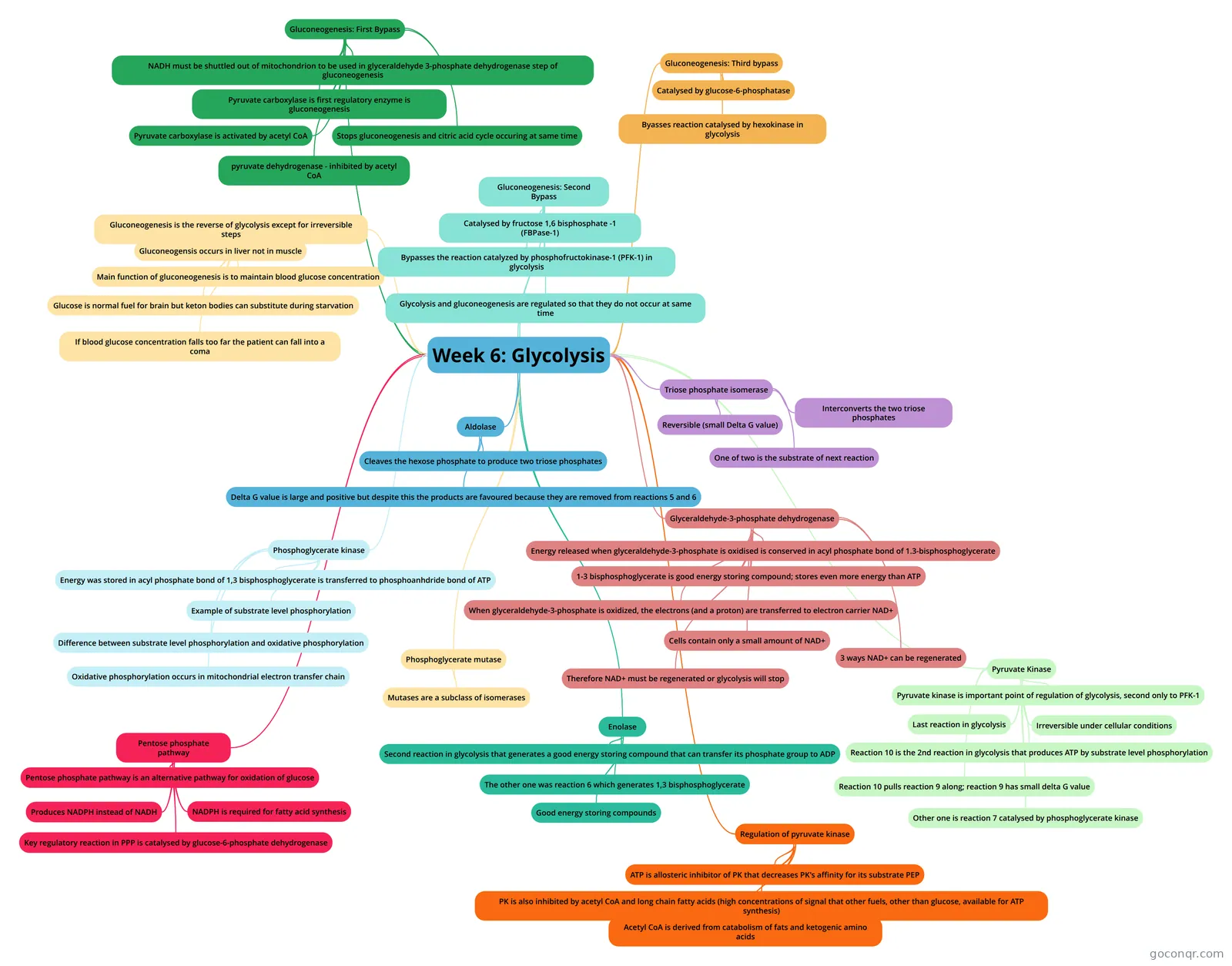
Mind map: Glycolysis
Map content
Week 6: Glycolysis
Aldolase
- Cleaves the hexose phosphate to produce two triose phosphates
- Delta G value is large and positive but despite this the products are favoured because they are removed from reactions 5 and 6
Triose phosphate isomerase
- Reversible (small Delta G value)
- Interconverts the two triose phosphates
- One of two is the substrate of next reaction
Glyceraldehyde-3-phosphate dehydrogenase
- Energy released when glyceraldehyde-3-phosphate is oxidised is conserved in acyl phosphate bond of 1.3-bisphosphoglycerate
- 1-3 bisphosphoglycerate is good energy storing compound; stores even more energy than ATP
- When glyceraldehyde-3-phosphate is oxidized, the electrons (and a proton) are transferred to electron carrier NAD+
- Cells contain only a small amount of NAD+
- Therefore NAD+ must be regenerated or glycolysis will stop
- 3 ways NAD+ can be regenerated
Phosphoglycerate kinase
- Energy was stored in acyl phosphate bond of 1,3 bisphosphoglycerate is transferred to phosphoanhdride bond of ATP
- Example of substrate level phosphorylation
- Difference between substrate level phosphorylation and oxidative phosphorylation
- Oxidative phosphorylation occurs in mitochondrial electron transfer chain
Phosphoglycerate mutase
- Mutases are a subclass of isomerases
Enolase
- Second reaction in glycolysis that generates a good energy storing compound that can transfer its phosphate group to ADP
- The other one was reaction 6 which generates 1,3 bisphosphoglycerate
- Good energy storing compounds
Pyruvate Kinase
- Last reaction in glycolysis
- Irreversible under cellular conditions
- Reaction 10 pulls reaction 9 along; reaction 9 has small delta G value
- Reaction 10 is the 2nd reaction in glycolysis that produces ATP by substrate level phosphorylation
- Other one is reaction 7 catalysed by phosphoglycerate kinase
- Pyruvate kinase is important point of regulation of glycolysis, second only to PFK-1
Regulation of pyruvate kinase
- ATP is allosteric inhibitor of PK that decreases PK's affinity for its substrate PEP
- PK is also inhibited by acetyl CoA and long chain fatty acids (high concentrations of signal that other fuels, other than glucose, available for ATP synthesis)
- Acetyl CoA is derived from catabolism of fats and ketogenic amino acids
Pentose phosphate pathway
- Pentose phosphate pathway is an alternative pathway for oxidation of glucose
- Produces NADPH instead of NADH
- NADPH is required for fatty acid synthesis
- Key regulatory reaction in PPP is catalysed by glucose-6-phosphate dehydrogenase
Gluconeogenesis is the reverse of glycolysis except for irreversible steps
- Gluconeogensis occurs in liver not in muscle
- Main function of gluconeogenesis is to maintain blood glucose concentration
- Glucose is normal fuel for brain but keton bodies can substitute during starvation
- If blood glucose concentration falls too far the patient can fall into a coma
Gluconeogenesis: First Bypass
- NADH must be shuttled out of mitochondrion to be used in glyceraldehyde 3-phosphate dehydrogenase step of gluconeogenesis
- Pyruvate carboxylase is first regulatory enzyme is gluconeogenesis
- Pyruvate carboxylase is activated by acetyl CoA
- pyruvate dehydrogenase - inhibited by acetyl CoA
- Stops gluconeogenesis and citric acid cycle occuring at same time
Gluconeogenesis: Second Bypass
- Catalysed by fructose 1,6 bisphosphate -1 (FBPase-1)
- Bypasses the reaction catalyzed by phosphofructokinase-1 (PFK-1) in glycolysis
- Glycolysis and gluconeogenesis are regulated so that they do not occur at same time
Gluconeogenesis: Third bypass
- Catalysed by glucose-6-phosphatase
- Byasses reaction catalysed by hexokinase in glycolysis
Information
- Description
- Universität Biochemistry Mind Map on Week 6: Glycolysis, created by Paras Chrysostomou on 04/04/2016.
- Created by
- Paras Chrysostomou
- Views
- 1
- Rating