
Mind map
Biology Chapter 23.1: Speciation
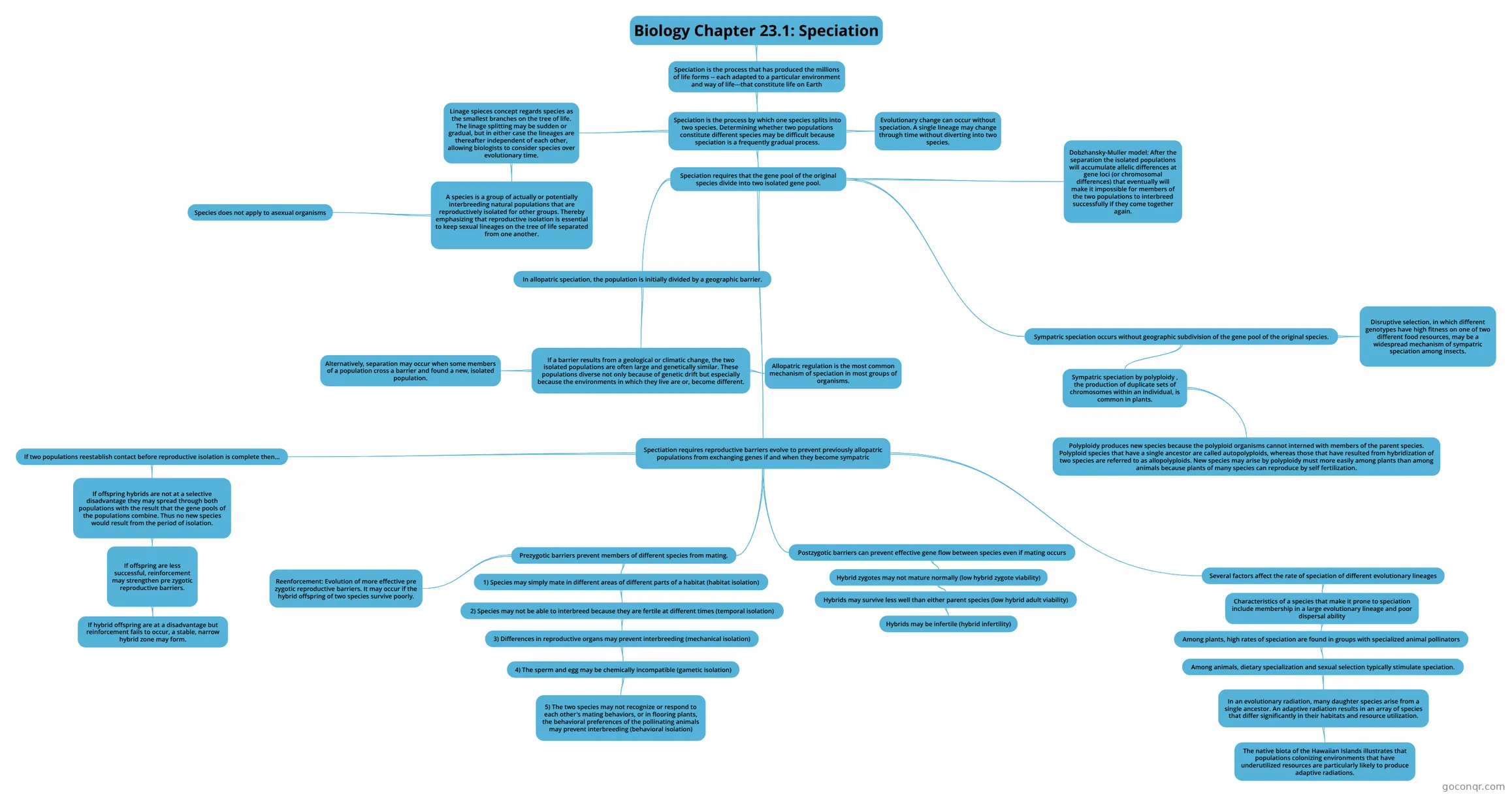
Mind map: speciation biology
Map content
Biology Chapter 23.1: Speciation
Speciation is the process that has produced the millions of life forms -- each adapted to a particular environment and way of life---that constitute life on Earth
- Speciation is the process by which one species splits into two species. Determining whether two populations constitute different species may be difficult because speciation is a frequently gradual process.
- Linage spieces concept regards species as the smallest branches on the tree of life. The linage splitting may be sudden or gradual, but in either case the lineages are thereafter independent of each other, allowing biologists to consider species over evolutionary time.
- A species is a group of actually or potentially interbreeding natural populations that are reproductively isolated for other groups. Thereby emphasizing that reproductive isolation is essential to keep sexual lineages on the tree of life separated from one another.
- Species does not apply to asexual organisms
- A species is a group of actually or potentially interbreeding natural populations that are reproductively isolated for other groups. Thereby emphasizing that reproductive isolation is essential to keep sexual lineages on the tree of life separated from one another.
- Evolutionary change can occur without speciation. A single lineage may change through time without diverting into two species.
- Speciation requires that the gene pool of the original species divide into two isolated gene pool.
- Dobzhansky-Muller model: After the separation the isolated populations will accumulate allelic differences at gene loci (or chromosomal differences) that eventually will make it impossible for members of the two populations to interbreed successfully if they come together again.
- In allopatric speciation, the population is initially divided by a geographic barrier.
- If a barrier results from a geological or climatic change, the two isolated populations are often large and genetically similar. These populations diverse not only because of genetic drift but especially because the environments in which they live are or, become different.
- Alternatively, separation may occur when some members of a population cross a barrier and found a new, isolated population.
- Allopatric regulation is the most common mechanism of speciation in most groups of organisms.
- If a barrier results from a geological or climatic change, the two isolated populations are often large and genetically similar. These populations diverse not only because of genetic drift but especially because the environments in which they live are or, become different.
- Sympatric speciation occurs without geographic subdivision of the gene pool of the original species.
- Disruptive selection, in which different genotypes have high fitness on one of two different food resources, may be a widespread mechanism of sympatric speciation among insects.
- Sympatric speciation by polyploidy , the production of duplicate sets of chromosomes within an individual, is common in plants.
- Polyploidy produces new species because the polyploid organisms cannot interned with members of the parent species. Polyploid species that have a single ancestor are called autopolyploids, whereas those that have resulted from hybridization of two species are referred to as allopolyploids. New species may arise by polyploidy must more easily among plants than among animals because plants of many species can reproduce by self fertilization.
- Spectiation requires reproductive barriers evolve to prevent previously allopatric populations from exchanging genes if and when they become sympatric
- Prezygotic barriers prevent members of different species from mating.
- 1) Species may simply mate in different areas of different parts of a habitat (habitat isolation)
- 2) Species may not be able to interbreed because they are fertile at different times (temporal isolation)
- 3) Differences in reproductive organs may prevent interbreeding (mechanical isolation)
- 4) The sperm and egg may be chemically incompatible (gametic isolation)
- 5) The two species may not recognize or respond to each other's mating behaviors, or in flooring plants, the behavioral preferences of the pollinating animals may prevent interbreeding (behavioral isolation)
- 4) The sperm and egg may be chemically incompatible (gametic isolation)
- 3) Differences in reproductive organs may prevent interbreeding (mechanical isolation)
- 2) Species may not be able to interbreed because they are fertile at different times (temporal isolation)
- Reenforcement: Evolution of more effective pre zygotic reproductive barriers. It may occur if the hybrid offspring of two species survive poorly.
- 1) Species may simply mate in different areas of different parts of a habitat (habitat isolation)
- Postzygotic barriers can prevent effective gene flow between species even if mating occurs
- Hybrid zygotes may not mature normally (low hybrid zygote viability)
- Hybrids may survive less well than either parent species (low hybrid adult viability)
- Hybrids may be infertile (hybrid infertility)
- Hybrids may survive less well than either parent species (low hybrid adult viability)
- Hybrid zygotes may not mature normally (low hybrid zygote viability)
- If two populations reestablish contact before reproductive isolation is complete then...
- If offspring hybrids are not at a selective disadvantage they may spread through both populations with the result that the gene pools of the populations combine. Thus no new species would result from the period of isolation.
- If offspring are less successful, reinforcement may strengthen pre zygotic reproductive barriers.
- If hybrid offspring are at a disadvantage but reinforcement fails to occur, a stable, narrow hybrid zone may form.
- If offspring are less successful, reinforcement may strengthen pre zygotic reproductive barriers.
- If offspring hybrids are not at a selective disadvantage they may spread through both populations with the result that the gene pools of the populations combine. Thus no new species would result from the period of isolation.
- Several factors affect the rate of speciation of different evolutionary lineages
- Characteristics of a species that make it prone to speciation include membership in a large evolutionary lineage and poor dispersal ability
- Among plants, high rates of speciation are found in groups with specialized animal pollinators
- Among animals, dietary specialization and sexual selection typically stimulate speciation.
- In an evolutionary radiation, many daughter species arise from a single ancestor. An adaptive radiation results in an array of species that differ significantly in their habitats and resource utilization.
- The native biota of the Hawaiian Islands illustrates that populations colonizing environments that have underutilized resources are particularly likely to produce adaptive radiations.
- In an evolutionary radiation, many daughter species arise from a single ancestor. An adaptive radiation results in an array of species that differ significantly in their habitats and resource utilization.
- Among animals, dietary specialization and sexual selection typically stimulate speciation.
- Among plants, high rates of speciation are found in groups with specialized animal pollinators
- Characteristics of a species that make it prone to speciation include membership in a large evolutionary lineage and poor dispersal ability
- Prezygotic barriers prevent members of different species from mating.
- Linage spieces concept regards species as the smallest branches on the tree of life. The linage splitting may be sudden or gradual, but in either case the lineages are thereafter independent of each other, allowing biologists to consider species over evolutionary time.
- Speciation is the process by which one species splits into two species. Determining whether two populations constitute different species may be difficult because speciation is a frequently gradual process.
Information
- Description
- Biology Mind Map on Biology Chapter 23.1: Speciation, created by Phoenix Nash on 05/12/2016.
- Created by
- Phoenix Nash
- Views
- 0
- Rating