
Mind map
IMMUNITY & IMMUNE EVASION
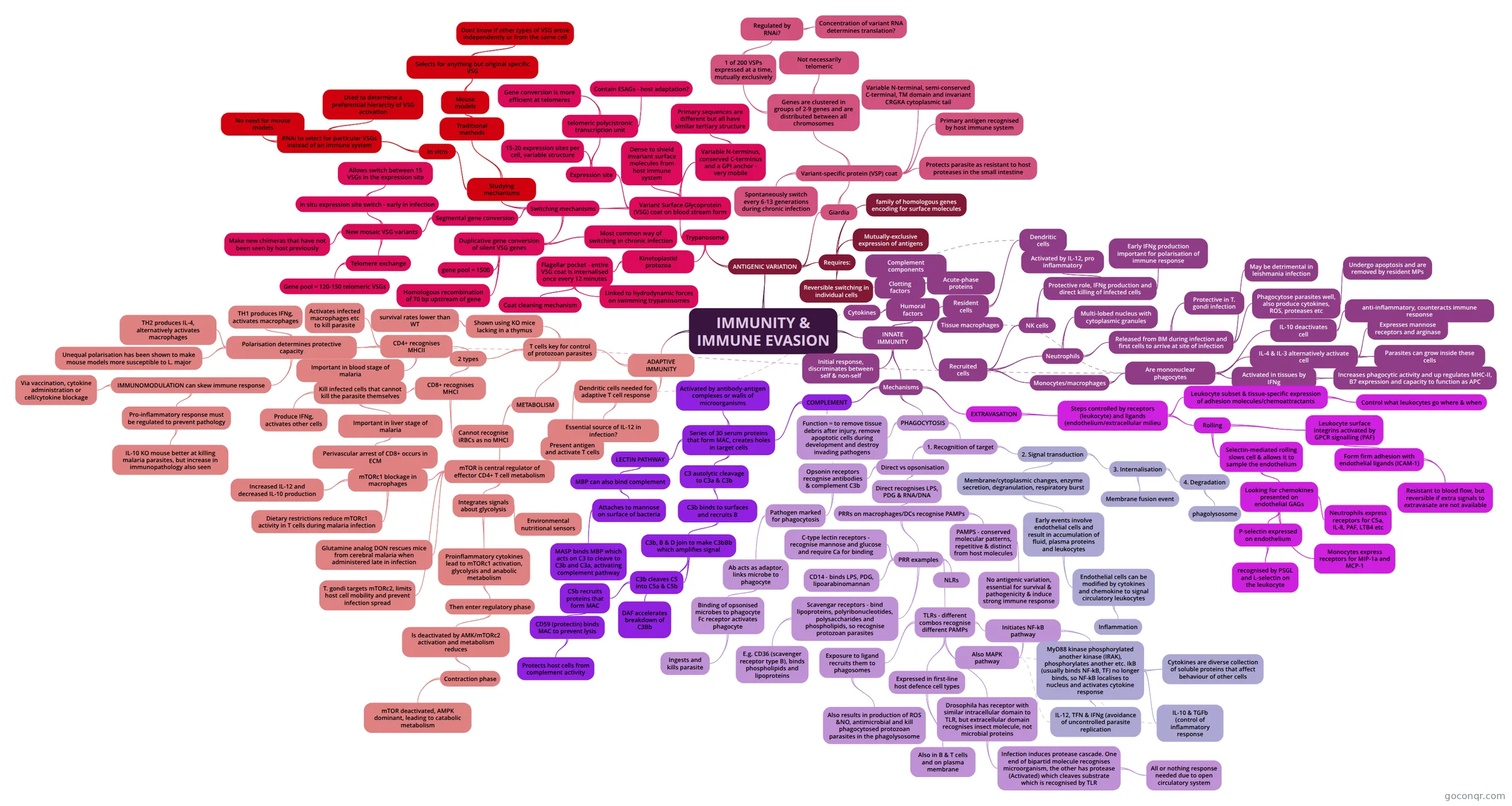
Mind map: immunity and immune evasion
Map content
IMMUNITY & IMMUNE EVASION
ANTIGENIC VARIATION
- Requires:
- family of homologous genes encoding for surface molecules
- A family of homologous genes encoding for an immunodominant antigenic ally different surface molecule, or a process needs to be present which generates diversity in this molecule
- Mutually-exclusive expression of antigens
- A mechanism that guarantees mutually-exclusive expression of only one antigen at a time
- Reversible switching in individual cells
- A mechanism for reversibly switching the expression of these molecules in individual cells
- family of homologous genes encoding for surface molecules
- Giardia
- Previous exposure to Giardia produces immunity to the disease and if re-infection occurs the symptoms tend to be less severe Differences in the surface labelling patterns were observed in cultured trophozoites and confirmed using specific monoclonal antibodies that only recognised some variants
- Variant-specific protein (VSP) coat
- Protects parasite as resistant to host proteases in the small intestine
- VSPs form a dense protective coat that covers the entire surface of the parasite
- Primary antigen recognised by host immune system
- This results in the production of cytotoxic antibodies that are involved in infection control
- Variable N-terminal, semi-conserved C-terminal, TM domain and invariant CRGKA cytoplasmic tail
- They are cysteine-rich proteins that have lots of CXX motifs and are often glycosylated
- Spontaneously switch every 6-13 generations during chronic infection
- No evidence that gene rearrangements are coupled with the switching. Does not appear to be triggered by an immune response as switching also occurred in vitro in the absence of an immune system
- Genes are clustered in groups of 2-9 genes and are distributed between all chromosomes
- No specific VSP promoters have been identified yet, but only 1 VSP is expressed at a time, despite there being 2 independent nuclei
- 1 of 200 VSPs expressed at a time, mutually exclusively
- Regulated by RNAi?
- Homologues to all parts of RNAi pathway have been found in Giardia genome. Dicer KO had expression of different VSPs onto surface One VSP is expressed, the others have antisense amplified by RdRP and are degraded by RNAi.
- Concentration of variant RNA determines translation?
- Regulated by RNAi?
- Not necessarily telomeric
- Protects parasite as resistant to host proteases in the small intestine
- Trypanosome
- American T. cruzi causes Chagas disease African T. brucei causes African Sleeping sickness
- Variant Surface Glycoprotein (VSG) coat on blood stream form
- Dense to shield invariant surface molecules from host immune system
- Variable N-terminus, conserved C-terminus and a GPI anchor - very mobile
- Primary sequences are different but all have similar tertiary structure
- Identified by sequence alignment Suggests there is a selection pressure to maintain shape, perhaps as during switch the different VSGs have to pack close together to maintain the dense protective structure
- Primary sequences are different but all have similar tertiary structure
- Expression site
- telomeric polycistronic transcription unit
- Always located at telomeres, transcribed at a v high rate by RNA polymerase I
- Contain ESAGs - host adaptation?
- ESAGs = expression site associated genes
- Gene conversion is more efficient at telomeres
- Recombinogenic regions of the genome, frequent recombination leads to generation of sequences diversity. VSG switching mechanisms probably positively influenced by telomeric location
- 15-20 expression sites per cell, variable structure
- telomeric polycistronic transcription unit
- Switching mechanisms
- T. brucei has 1500 VSG genes and pseudogenes (10% of genome)
- Segmental gene conversion
- New mosaic VSG variants
- Telomere exchange
- Exchange of 2 telomere ends
- Gene pool = 120-150 telomeric VSGs
- in situ expression site switch - early in infection
- Transcriptional silencing of one expression site and activation of another
- Allows switch between 15 VSGs in the expression site
- Make new chimeras that have not been seen by host previously
- Telomere exchange
- New mosaic VSG variants
- Duplicative gene conversion of silent VSG genes
- New gene is added to active expression site and old one is discarded, preventing loss of genetic material.
- Homologous recombination of 70 bp upstream of gene
- 3' end is also very similar between VSG genes
- Most common way of switching in chronic infection
- gene pool = 1500
- Studying mechanisms
- Traditional methods
- Mouse models
- Immunised against 1 VSG so it develops antibodies Inject lots of trypanosomes into it Immune system will target and kill all known VSGs, leaving only variants that can be isolated as clonal populations
- Selects for anything but original specific VSG
- Dont know if other types of VSG arose independently or from the same cell
- Mouse models
- In vitro
- RNAi to select for particular VSGs instead of an immune system
- No need for mouse models
- Used to determine a preferential hierarchy of VSG activation
- All different switch variants coming up were analysed using sequencing. Does seem to be a preference in what msgs the trypanosome switches between but not known what determines that Makes sense to limit the number of different variants exposed to the host, help make infections relatively homogenous
- RNAi to select for particular VSGs instead of an immune system
- Traditional methods
- Kinetoplastid protozoa
- Flagellar pocket - entire VSG coat is internalised once every 12 minutes
- T. bruce i has one of the highest rates of endocytosis measured Turnover is 3x faster than macrophages, 5-9x faster than in fibroblasts
- Coat cleaning mechanism
- VSG-antbody complexes are internalised and antibodies stripped off. VSG then returned to surface
- Linked to hydrodynamic forces on swimming trypanosomes
- Flagellar pocket - entire VSG coat is internalised once every 12 minutes
- Requires:
INNATE IMMUNITY
- Initial response, discriminates between self & non-self
- Resident cells
- Tissue macrophages
- Dendritic cells
- Recruited cells
- Neutrophils
- Mature from committed granulocyte-monocyte progenitor in BM for 6 days then released into vasculature to circulate for 6-12 hours before entering issues. 3 days later, undergo apoptosis and are removed by resident MPs.
- Multi-lobed nucleus with cytoplasmic granules
- Released from BM during infection and first cells to arrive at site of infection
- Phagocytose parasites well, also produce cytokines, ROS, proteases etc
- Undergo apoptosis and are removed by resident MPs
- May be detrimental in leishmania infection
- parasites inside neutrophils are viable and can cause infection
- Protective in T. gondi infection
- rapidly migrate to site of infection and react specifically to free parasites. Could be protective through release of extracellular NETS (protein and DNA complexes) that trap parasites, or production of defensins, MMPs (Matrix metalloproteases)
- Phagocytose parasites well, also produce cytokines, ROS, proteases etc
- Monocytes/macrophages
- Are mononuclear phagocytes
- Differentiate from granulocyte-monocyte progenitors to pro-monocytes in the BM and released into vasculature to fully mature and circulate. Then enter tissue and differentiate into tissue MPs, which have a 4-25 day lifespan. Number of MPs at infection site increases due to monocyte infiltration, NOT MP proliferation.
- Activated in tissues by IFNg
- Increases phagocytic activity and up regulates MHC-II, B7 expression and capacity to function as APC
- Good parasite killers
- Increases phagocytic activity and up regulates MHC-II, B7 expression and capacity to function as APC
- IL-10 deactivates cell
- anti-inflammatory, counteracts immune response
- IL-4 & IL-3 alternatively activate cell
- Expresses mannose receptors and arginase
- Used by the cell when exposed to a pro inflammatory environment to synthesise iNOS to kill the parasite Can also enter arginase pathway to produce urea
- Parasites can grow inside these cells
- e.g. leishmania, as no good at killing parasites, so results in lots of parasites living inside the cells.
- Expresses mannose receptors and arginase
- Are mononuclear phagocytes
- NK cells
- Important in malaria infection as inhibit parasite maturation in hepatocytes and produce IFNg following exposure to pRBCs and depletion of NK cells affects parasite control
- Protective role, IFNg production and direct killing of infected cells
- Early IFNg production important for polarisation of immune response
- Activated by IL-12, pro inflammatory
- Neutrophils
- Humoral factors
- Complement components
- Acute-phase proteins
- Clotting factors
- Cytokines
- Mechanisms
- PHAGOCYTOSIS
- First described by Elie Metchnikoff The process by which cells internalise other cells, cell fragments, protein aggregates and foreign bodies.
- Function = to remove tissue debris after injury, remove apoptotic cells during development and destroy invading pathogens
- 1. Recognition of target
- 2. Signal transduction
- Membrane/cytoplasmic changes, enzyme secretion, degranulation, respiratory burst
- Early events involve endothelial cells and result in accumulation of fluid, plasma proteins and leukocytes
- Endothelial cells can be modified by cytokines and chemokine to signal circulatory leukocytes
- Inflammation
- They change surface receptors and recruit other cells, leading to inflammation
- Inflammation
- Endothelial cells can be modified by cytokines and chemokine to signal circulatory leukocytes
- Early events involve endothelial cells and result in accumulation of fluid, plasma proteins and leukocytes
- 3. Internalisation
- Membrane fusion event
- 4. Degradation
- phagolysosome
- Membrane/cytoplasmic changes, enzyme secretion, degranulation, respiratory burst
- Direct vs opsonisation
- Opsonin receptors recognise antibodies & complement C3b
- Pathogen marked for phagocytosis
- Ab acts as adaptor, links microbe to phagocyte
- Binding of opsonised microbes to phagocyte Fc receptor activates phagocyte
- Ingests and kills parasite
- Binding of opsonised microbes to phagocyte Fc receptor activates phagocyte
- Ab acts as adaptor, links microbe to phagocyte
- Pathogen marked for phagocytosis
- Direct recognises LPS, PDG & RNA/DNA
- LPS = lipopolysaccharides Common to gram negative PDG = peptidoglycan Common to gram positive RNA/DNA that should not be in the fluid, indicate possible tissue damage/virus
- PRRs on macrophages/DCs recognise PAMPs
- PRRs = pattern-recognition receptors PAMPs = pathogen-associated molecular patterns
- PRR examples
- CD14 - binds LPS, PDG, lipoarabinomannan
- GPI-linked receptor on monocytes and in plasma Ligation activates cell to express antibacterial peptides and cytokines
- Scavengar receptors - bind lipoproteins, polyribonucleotides, polysaccharides and phospholipids, so recognise protozoan parasites
- Trimeric membrane proteins that contain collagenous domains on MP and DCs
- E.g. CD36 (scavenger receptor type B), binds phospholipids and lipoproteins
- C-type lectin receptors - recognise mannose and glucose and require Ca for binding
- Type 1 membrane proteins with 8-10 lectin-binding domains
- TLRs - different combos recognise different PAMPs
- 1&2 = bacterial parasites 2&6 = gram positive bacteria/fungi 4&4 = gram negative bacteria 5&5 = flagellated bacteria 3 (internal) = viral dsRNA 9 (internal) = bacterial DNA elements
- Expressed in first-line host defence cell types
- Macrophages, neutrophils, epithelial cells in gut, lungs etc, dermal endothelial cells and DCs.
- Also in B & T cells and on plasma membrane
- Exposure to ligand recruits them to phagosomes
- Enables killing of intracellular parasites living in the cell
- Also results in production of ROS &NO, antimicrobial and kill phagocytosed protozoan parasites in the phagolysosome
- Drosophila has receptor with similar intracellular domain to TLR, but extracellular domain recognises insect molecule, not microbial proteins
- Infection induces protease cascade. One end of bipartid molecule recognises microorganism, the other has protease (Activated) which cleaves substrate which is recognised by TLR
- All or nothing response needed due to open circulatory system
- Cascade means that for 1 event hundred to molecules can be activated.
- All or nothing response needed due to open circulatory system
- Infection induces protease cascade. One end of bipartid molecule recognises microorganism, the other has protease (Activated) which cleaves substrate which is recognised by TLR
- Initiates NF-kB pathway
- KO TLR signalling cascades was found to have a big impact on immune response in mouse models, with survival rates falling
- MyD88 kinase phosphorylated another kinase (IRAK), phosphorylates another etc. IkB (usually binds NF-kB, TF) no longer binds, so NF-kB localises to nucleus and activates cytokine response
- Cytokines are diverse collection of soluble proteins that affect behaviour of other cells
- Balance of cytokines/chemokines affects outcome of the response
- IL-12, TFN & IFNg (avoidance of uncontrolled parasite replication
- IL-10 & TGFb (control of inflammatory response
- Cytokines are diverse collection of soluble proteins that affect behaviour of other cells
- Also MAPK pathway
- NLRs
- Nod like receptors
- CD14 - binds LPS, PDG, lipoarabinomannan
- PAMPS - conserved molecular patterns, repetitive & distinct from host molecules
- No antigenic variation, essential for survival & pathogenicity & induce strong immune response
- Opsonin receptors recognise antibodies & complement C3b
- 2. Signal transduction
- COMPLEMENT
- Series of 30 serum proteins that form MAC, creates holes in target cells
- Complement protein are produced in the liver by macrophages/firboblasts and are found in plasma or bound to cell membranes
- Activated by antibody-antigen complexes or walls of microorganisms
- C3 autolytic cleavage to C3a & C3b
- C3b binds to surfaces and recruits B
- C3b, B & D join to make C3bBb which amplifies signal
- C3b cleaves C5 into C5a & C5b
- C5b recruits proteins that form MAC
- CD59 (protectin) binds MAC to prevent lysis
- Protects host cells from complement activity
- CD59 (protectin) binds MAC to prevent lysis
- C5b recruits proteins that form MAC
- DAF accelerates breakdown of C3Bb
- DAF = Decay-accelerating factor on surface of mammalian cells
- C3b cleaves C5 into C5a & C5b
- C3b, B & D join to make C3bBb which amplifies signal
- C3b binds to surfaces and recruits B
- LECTIN PATHWAY
- MBP can also bind complement
- MBP = mannose binding protein
- Attaches to mannose on surface of bacteria
- MASP binds MBP which acts on C3 to cleave to C3b and C3a, activating complement pathway
- MASP = mammon-activated serine protease
- MASP binds MBP which acts on C3 to cleave to C3b and C3a, activating complement pathway
- MBP can also bind complement
- Series of 30 serum proteins that form MAC, creates holes in target cells
- EXTRAVASATION
- Leukocytes enter tissues by rolling, activation-dependent firm adhesion, diapedesis/extravasation and chemotaxis
- Steps controlled by receptors (leukocyte) and ligands (endothelium/extracellular milieu
- Leukocyte subset & tissue-specific expression of adhesion molecules/chemoattractants
- Control what leukocytes go where & when
- Rolling
- Selectin-mediated rolling slows cell & allows it to sample the endothelium
- Looking for chemokines presented on endothelial GAGs
- GAGs = endothelial glycocalyx
- P-selectin expressed on endothelium
- 1 of 3 Ca-dependent carb-binding proteins involved in interactions with B/T leukocytes and endothelium
- recognised by PSGL and L-selectin on the leukocyte
- Neutrophils express receptors for C5a, IL-8, PAF, LTB4 etc
- Monocytes express receptors for MIP-1a and MCP-1
- Looking for chemokines presented on endothelial GAGs
- Leukocyte surface integrins activated by GPCR signalling (PAF)
- Integrins are heterodimeric cell-adhesion molecules that bind immunoglobulin superfamily cell adhesion molecules (ICAMs) 14 a chains and 8 b chains, so 22 combinations with overlapping specificities
- Form firm adhesion with endothelial ligands (ICAM-1)
- Resistant to blood flow, but reversible if extra signals to extravasate are not available
- Selectin-mediated rolling slows cell & allows it to sample the endothelium
- Leukocyte subset & tissue-specific expression of adhesion molecules/chemoattractants
- PHAGOCYTOSIS
ADAPTIVE IMMUNITY
- T cells key for control of protozoan parasites
- Shown using KO mice lacking in a thymus
- Due to deletion of FOXN1 gene, so had no T cells
- survival rates lower than WT
- Number of parasites continued to rise until they died, rather than drop off like they did in WT
- 2 types
- CD4+ recognises MHCII
- Important in blood stage of malaria
- Blood stage, depleting CD8+ T cells had no effect on the parasite burden, but depleting CD4+ T Cells caused increased parasitaemia
- Activates infected macrophages etc to kill parasite
- Polarisation determines protective capacity
- TH1 produces IFNg, activates macrophages
- TH2 produces IL-4, alternatively activates macrophages
- Unequal polarisation has been shown to make mouse models more susceptible to L. major
- IMMUNOMODULATION can skew immune response
- Can augment anti-pathogen responses promoting pathogen clearance and can inhibit pathogenic responses
- Via vaccination, cytokine administration or cell/cytokine blockage
- Pro-inflammatory response must be regulated to prevent pathology
- IL-10 KO mouse better at killing malaria parasites, but increase in immunopathology also seen
- Increased parasitemia seen in WT but not IL-10 KO when infected with plasmodium. KO has greater inflammatory response Increase in immunopathology shown by liver stains suggested that IL-10 KO damages host organs
- IL-10 KO mouse better at killing malaria parasites, but increase in immunopathology also seen
- Important in blood stage of malaria
- CD8+ recognises MHCI
- Kill infected cells that cannot kill the parasite themselves
- Important in liver stage of malaria
- T cell clones generated to particular molecule of malaria sporozoite Transfer of clones provided protection to challenge of infection
- Perivascular arrest of CD8+ occurs in ECM
- ECM= Experimental Cerebral Malaria. CD8+ T cells accumulate in perivascular space of mouse brains infected with P. bergei. Perivascular T cells showed arrested behaviour, specifically during ECM infectoinonly. Formed long-term cognate interactions with myeloid cells
- Produce IFNg, activates other cells
- Important in liver stage of malaria
- Cannot recognise iRBCs as no MHCI
- Kill infected cells that cannot kill the parasite themselves
- CD4+ recognises MHCII
- METABOLISM
- mTOR is central regulator of effector CD4+ T cell metabolism
- Integrates signals about glycolysis
- From immunological clues (TCR, co stimulatory receptor and cytokine receptor signalling) and environmental nutritional sensors
- Environmental nutritional sensors
- e.g. glucose and amino acid transporters to increase glycolysis where appropriate
- Proinflammatory cytokines lead to mTORc1 activation, glycolysis and anabolic metabolism
- Then enter regulatory phase
- ls deactivated by AMK/mTORc2 activation and metabolism reduces
- Contraction phase
- mTOR deactivated, AMPK dominant, leading to catabolic metabolism
- Contraction phase
- ls deactivated by AMK/mTORc2 activation and metabolism reduces
- Then enter regulatory phase
- mTORc1 blockage in macrophages
- Increased IL-12 and decreased IL-10 production
- during infection by L. donovani and L. major
- Dietary restrictions reduce mTORc1 activity in T cells during malaria infection
- Increased IL-12 and decreased IL-10 production
- T. gondi targets mTORc2, limits host cell mobility and prevent infection spread
- Glutamine analog DON rescues mice from cerebral malaria when administered late in infection
- Integrates signals about glycolysis
- mTOR is central regulator of effector CD4+ T cell metabolism
- Shown using KO mice lacking in a thymus
- Dendritic cells needed for adaptive T cell response
- shown by developing mice that would, on injection of Diptheria toxin, have specifically depleted DCs. Resulted in ablation of malaria specific T cell response, showing that DCs are needed to mount T cell immune response
- Present antigen and activate T cells
- Essential source of IL-12 in infection?
- Activates NK & T cells Depletion in DCs has been shown to do more than just impair antigen processing and presentation
- T cells key for control of protozoan parasites
Information
- Description
- Biochemistry (ATPVB) Mind Map on IMMUNITY & IMMUNE EVASION, created by Alice Paterson on 24/12/2016.
- Created by
- Alice Paterson
- Views
- 0
- Rating