
Mind map
Plant responses, p440 - 459
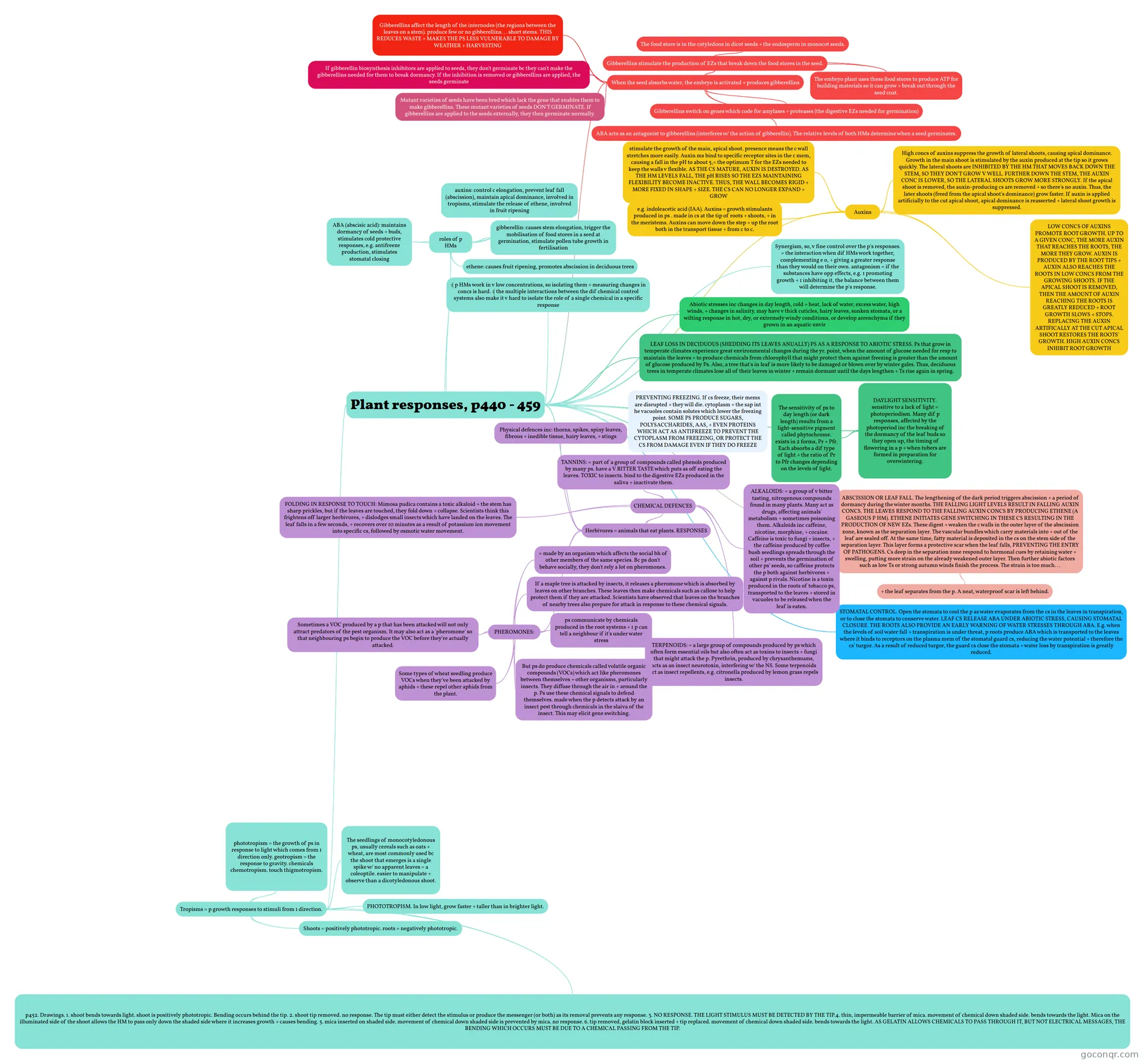
Mind map: Plant responses
Map content
Plant responses, p440 - 459
roles of p HMs
- auxins: control c elongation, prevent leaf fall (abscission), maintain apical dominance, involved in tropisms, stimulate the release of ethene, involved in fruit ripening
- gibberellin: causes stem elongation, trigger the mobilisation of food stores in a seed at germination, stimulate pollen tube growth in fertilisation
- ethene: causes fruit ripening, promotes abscission in deciduous trees
- ABA (abscisic acid): maintains dormancy of seeds + buds, stimulates cold protective responses, e.g. antifreeze production, stimulates stomatal closing
:( p HMs work in v low concentrations, so isolating them + measuring changes in concs is hard. :( the multiple interactions between the dif chemical control systems also make it v hard to isolate the role of a single chemical in a specific response
When the seed absorbs water, the embryo is activated + produces gibberellins
- Gibberellins stimulate the production of EZs that break down the food stores in the seed.
- The food store is in the cotyledons in dicot seeds + the endosperm in monocot seeds.
- The embryo plant uses these food stores to produce ATP for building materials so it can grow + break out through the seed coat.
- Gibberellins switch on genes which code for amylases + proteases (the digestive EZs needed for germination)
- ABA acts as an antagonist to gibberellins (interferes w/ the action of gibberellin). The relative levels of both HMs determine when a seed germinates.
- Mutant varieties of seeds have been bred which lack the gene that enables them to make gibberellins. These mutant varieties of seeds DON'T GERMINATE. If gibberellins are applied to the seeds externally, they then germinate normally.
- If gibberellin biosynthesis inhibitors are applied to seeds, they don't germinate bc they can't make the gibberellins needed for them to break dormancy. If the inhibition is removed or gibberellins are applied, the seeds germinate
- Gibberellins affect the length of the internodes (the regions between the leaves on a stem). produce few or no gibberellins... short stems. THIS REDUCES WASTE + MAKES THE PS LESS VULNERABLE TO DAMAGE BY WEATHER + HARVESTING
- Gibberellins stimulate the production of EZs that break down the food stores in the seed.
Auxins
- e.g. indoleacetic acid (IAA). Auxins = growth stimulants produced in ps . made in cs at the tip of roots + shoots, + in the meristems. Auxins can move down the step + up the root both in the transport tissue + from c to c.
- stimulate the growth of the main, apical shoot. presence means the c wall stretches more easily. Auxin ms bind to specific receptor sites in the c mem, causing a fall in the pH to about 5,= the optimum T for the EZs needed to keep the walls v flexible. AS THE CS MATURE, AUXIN IS DESTROYED. AS THE HM LEVELS FALL, THE pH RISES SO THE EZS MAINTAINING FLEXIBILITY BECOME INACTIVE. THUS, THE WALL BECOMES RIGID + MORE FIXED IN SHAPE + SIZE. THE CS CAN NO LONGER EXPAND + GROW
- High concs of auxins suppress the growth of lateral shoots, causing apical dominance. Growth in the main shoot is stimulated by the auxin produced at the tip so it grows quickly. The lateral shoots are INHIBITED BY THE HM THAT MOVES BACK DOWN THE STEM, SO THEY DON'T GROW V WELL. FURTHER DOWN THE STEM, THE AUXIN CONC IS LOWER, SO THE LATERAL SHOOTS GROW MORE STRONGLY. If the apical shoot is removed, the auxin-producing cs are removed + so there's no auxin. Thus, the later shoots (freed from the apical shoot's dominance) grow faster. If auxin is applied artificially to the cut apical shoot, apical dominance is reasserted + lateral shoot growth is suppressed.
- LOW CONCS OF AUXINS PROMOTE ROOT GROWTH. UP TO A GIVEN CONC, THE MORE AUXIN THAT REACHES THE ROOTS, THE MORE THEY GROW. AUXIN IS PRODUCED BY THE ROOT TIPS + AUXIN ALSO REACHES THE ROOTS IN LOW CONCS FROM THE GROWING SHOOTS. IF THE APICAL SHOOT IS REMOVED, THEN THE AMOUNT OF AUXIN REACHING THE ROOTS IS GREATLY REDUCED + ROOT GROWTH SLOWS + STOPS. REPLACING THE AUXIN ARTIFICALLY AT THE CUT APICAL SHOOT RESTORES THE ROOTS' GROWTH. HIGH AUXIN CONCS INHIBIT ROOT GROWTH
Synergism, so, v fine control over the p's responses. = the interaction when dif HMs work together, complementing e o, + giving a greater response than they would on their own. antagonism = if the substances have opp effects, e.g. 1 promoting growth + 1 inhibiting it, the balance between them will determine the p's response.
Abiotic stresses inc changes in day length, cold + heat, lack of water, excess water, high winds, + changes in salinity. may have v thick cuticles, hairy leaves, sunken stomata, or a wilting response in hot, dry, or extremely windy conditions, or develop aerenchyma if they grown in an aquatic envir
LEAF LOSS IN DECIDUOUS (SHEDDING ITS LEAVES ANUALLY) PS AS A RESPONSE TO ABIOTIC STRESS. Ps that grow in temperate climates experience great environmental changes during the yr. point, when the amount of glucose needed for resp to maintain the leaves + to produce chemicals from chlorophyll that might protect them against freezing is greater than the amount of glucose produced by Ps. Also, a tree that's in leaf is more likely to be damaged or blown over by winter gales. Thus, deciduous trees in temperate climates lose all of their leaves in winter + remain dormant until the days lengthen + Ts rise again in spring.
DAYLIGHT SENSITIVITY. sensitive to a lack of light = photoperiodism. Many dif p responses, affected by the photoperiod inc the breaking of the dormancy of the leaf buds so they open up, the timing of flowering in a p + when tubers are formed in preparation for overwintering.
- The sensitivity of ps to day length (or dark length) results from a light-sensitive pigment called phytochrome. exists in 2 forms, Pr + Pfr. Each absorbs a dif type of light + the ratio of Pr to Pfr changes depending on the levels of light.
ABSCISSION OR LEAF FALL. The lengthening of the dark period triggers abscission + a period of dormancy during the winter months. THE FALLING LIGHT LEVELS RESULT IN FALLING AUXIN CONCS. THE LEAVES RESPOND TO THE FALLING AUXIN CONCS BY PRODUCING ETHENE (A GASEOUS P HM). ETHENE INITIATES GENE SWITCHING IN THESE CS RESULTING IN THE PRODUCTION OF NEW EZs. These digest + weaken the c walls in the outer layer of the abscission zone, known as the separation layer. The vascular bundles which carry materials into + out of the leaf are sealed off. At the same time, fatty material is deposited in the cs on the stem side of the separation layer. This layer forms a protective scar when the leaf falls, PREVENTING THE ENTRY OF PATHOGENS. Cs deep in the separation zone respond to hormonal cues by retaining water + swelling, putting more strain on the already weakened outer layer. Then further abiotic factors such as low Ts or strong autumn winds finish the process. The strain is too much...
- Ethene intiates gene switching in these cs resulting in the production of new EZs.
- + the leaf separates from the p. A neat, waterproof scar is left behind.
PREVENTING FREEZING. If cs freeze, their mems are disrupted + they will die. cytoplasm + the sap int he vacuoles contain solutes which lower the freezing point. SOME PS PRODUCE SUGARS, POLYSACCHARIDES, AAS, + EVEN PROTEINS WHICH ACT AS ANTIFREEZE TO PREVENT THE CYTOPLASM FROM FREEZING, OR PROTECT THE CS FROM DAMAGE EVEN IF THEY DO FREEZE
STOMATAL CONTROL. Open the stomata to cool the p as water evaporates from the cs in the leaves in transpiration, or to close the stomata to conserve water. LEAF CS RELEASE ABA UNDER ABIOTIC STRESS, CAUSING STOMATAL CLOSURE. THE ROOTS ALSO PROVIDE AN EARLY WARNING OF WATER STRESSES THROUGH ABA. E.g. when the levels of soil water fall + transpiration is under threat, p roots produce ABA which is transported to the leaves where it binds to receptors on the plasma mem of the stomatal guard cs, reducing the water potential + therefore the cs' turgor. As a result of reduced turgor, the guard cs close the stomata + water loss by transpiration is greatly reduced.
Herbivores = animals that eat plants. RESPONSES
- Physical defences inc: thorns, spikes, spiny leaves, fibrous + inedible tissue, hairy leaves, + stings
- CHEMICAL DEFENCES
- TANNINS: = part of a group of compounds called phenols produced by many ps. have a V BITTER TASTE which puts as off eating the leaves. TOXIC to insects. bind to the digestive EZs produced in the saliva + inactivate them.
- ALKALOIDS: = a group of v bitter tasting, nitrogenous compounds found in many plants. Many act as drugs, affecting animals' metabolism + sometimes poisoning them. Alkaloids inc caffeine, nicotine, morphine, + cocaine. Caffeine is toxic to fungi + insects, + the caffeine produced by coffee bush seedlings spreads through the soil + prevents the germination of other ps' seeds, so caffeine protects the p both against herbivores + against p rivals. Nicotine is a toxin produced in the roots of tobacco ps, transported to the leaves + stored in vacuoles to be released when the leaf is eaten.
- TERPENOIDS: = a large group of compounds produced by ps which often form essential oils but also often act as toxins to insects + fungi that might attack the p. Pyrethrin, produced by chrysanthemums, acts as an insect neurotoxin, interfering w/ the NS. Some terpenoids act as insect repellents, e.g. citronella produced by lemon grass repels insects.
- FOLDING IN RESPONSE TO TOUCH: Mimosa pudica contains a toxic alkaloid + the stem has sharp prickles, but if the leaves are touched, they fold down + collapse. Scientists think this frightens off larger herbivores, + dislodges small insects which have landed on the leaves. The leaf falls in a few seconds, + recovers over 10 minutes as a result of potassium ion movement into specific cs, followed by osmotic water movement.
- PHEROMONES:
- = made by an organism which affects the social bh of other members of the same species. Bc ps don't behave socially, they don't rely a lot on pheromones.
- If a maple tree is attacked by insects, it releases a pheromone which is absorbed by leaves on other branches. These leaves then make chemicals such as callose to help protect them if they are attacked. Scientists have observed that leaves on the branches of nearby trees also prepare for attack in response to these chemical signals.
- ps communicate by chemicals produced in the root systems + 1 p can tell a neighbour if it's under water stress
- But ps do produce chemicals called volatile organic compounds (VOCs) which act like pheromones between themselves + other organisms, particularly insects. They diffuse through the air in + around the p. Ps use these chemical signals to defend themselves. made when the p detects attack by an insect pest through chemicals in the slaiva of the insect. This may elicit gene switching.
- Some types of wheat seedling produce VOCs when they've been attacked by aphids + these repel other aphids from the plant.
- Sometimes a VOC produced by a p that has been attacked will not only attract predators of the pest organism. It may also act as a 'pheromone' so that neighbouring ps begin to produce the VOC before they're actually attacked.
Tropisms = p growth responses to stimuli from 1 direction.
- phototropism = the growth of ps in response to light which comes from 1 direction only. geotropism = the response to gravity. chemicals chemotropism. touch thigmotropism.
- The seedlings of monocotyledonous ps, usually cereals such as oats + wheat, are most commonly used bc the shoot that emerges is a single spike w/ no apparent leaves = a coleoptile. easier to manipulate + observe than a dicotyledonous shoot.
- PHOTOTROPISM. In low light, grow faster + taller than in brighter light.
- Shoots = positively phototropic. roots = negatively phototropic.
- p452. Drawings. 1. shoot bends towards light. shoot is positively phototropic. Bending occurs behind the tip. 2. shoot tip removed. no response. The tip must either detect the stimulus or produce the messenger (or both) as its removal prevents any response. 3. NO RESPONSE. THE LIGHT STIMULUS MUST BE DETECTED BY THE TIP.4. thin, impermeable barrier of mica. movement of chemical down shaded side. bends towards the light. Mica on the illuminated side of the shoot allows the HM to pass only down the shaded side where it increases growth + causes bending. 5. mica inserted on shaded side. movement of chemical down shaded side is prevented by mica. no response. 6. tip removed, gelatin block inserted + tip replaced. movement of chemical down shaded side. bends towards the light. AS GELATIN ALLOWS CHEMICALS TO PASS THROUGH IT, BUT NOT ELECTRICAL MESSAGES, THE BENDING WHICH OCCURS MUST BE DUE TO A CHEMICAL PASSING FROM THE TIP.
Information
- Description
- 1hr14min 09:05
- Created by
- Maria Angela Samonte
- Views
- 14
- Rating
More on Plant growth and responses