
Mind map
Eye Witness Testimony
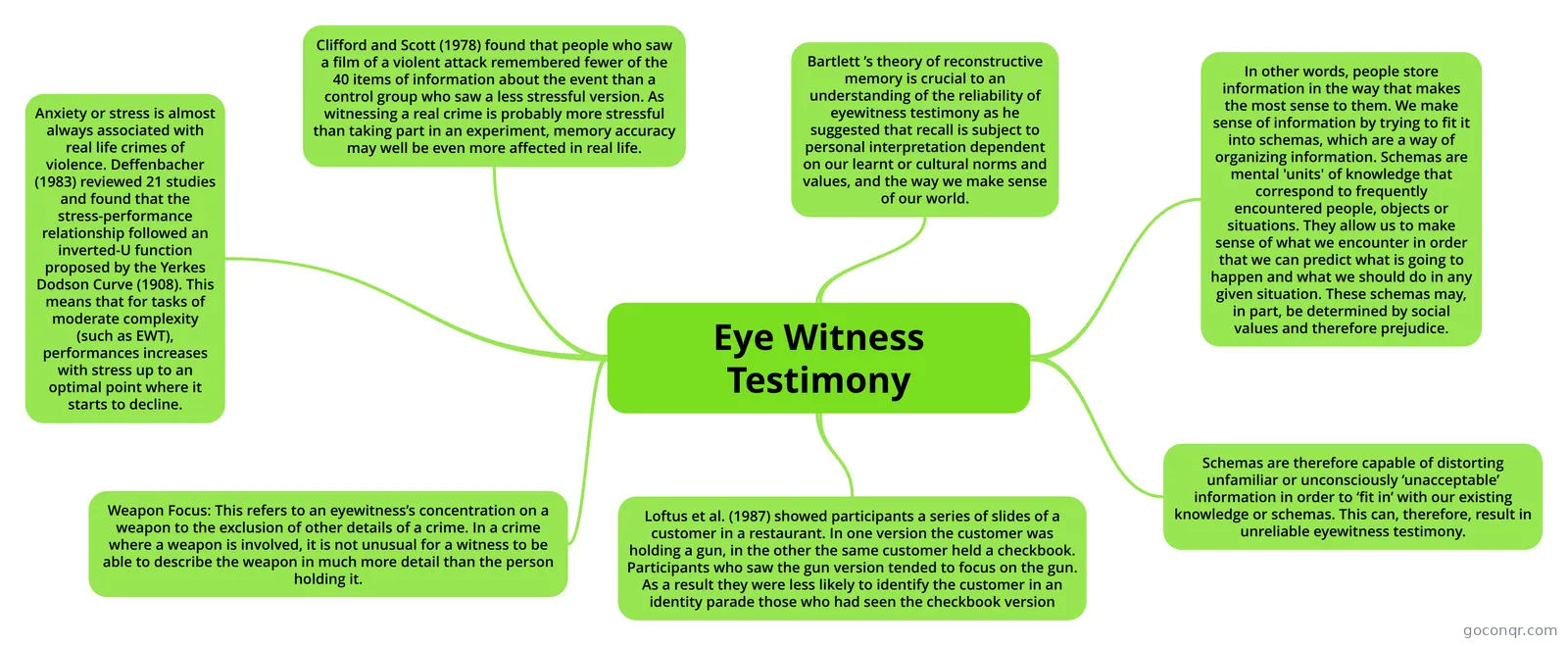
Mind map: Eye witness testimony
Map content
Eye Witness Testimony
Anxiety or stress is almost always associated with real life crimes of violence. Deffenbacher (1983) reviewed 21 studies and found that the stress-performance relationship followed an inverted-U function proposed by the Yerkes Dodson Curve (1908). This means that for tasks of moderate complexity (such as EWT), performances increases with stress up to an optimal point where it starts to decline.
Clifford and Scott (1978) found that people who saw a film of a violent attack remembered fewer of the 40 items of information about the event than a control group who saw a less stressful version. As witnessing a real crime is probably more stressful than taking part in an experiment, memory accuracy may well be even more affected in real life.
Bartlett ’s theory of reconstructive memory is crucial to an understanding of the reliability of eyewitness testimony as he suggested that recall is subject to personal interpretation dependent on our learnt or cultural norms and values, and the way we make sense of our world.
In other words, people store information in the way that makes the most sense to them. We make sense of information by trying to fit it into schemas, which are a way of organizing information. Schemas are mental 'units' of knowledge that correspond to frequently encountered people, objects or situations. They allow us to make sense of what we encounter in order that we can predict what is going to happen and what we should do in any given situation. These schemas may, in part, be determined by social values and therefore prejudice.
Schemas are therefore capable of distorting unfamiliar or unconsciously ‘unacceptable’ information in order to ‘fit in’ with our existing knowledge or schemas. This can, therefore, result in unreliable eyewitness testimony.
Weapon Focus: This refers to an eyewitness’s concentration on a weapon to the exclusion of other details of a crime. In a crime where a weapon is involved, it is not unusual for a witness to be able to describe the weapon in much more detail than the person holding it.
Loftus et al. (1987) showed participants a series of slides of a customer in a restaurant. In one version the customer was holding a gun, in the other the same customer held a checkbook. Participants who saw the gun version tended to focus on the gun. As a result they were less likely to identify the customer in an identity parade those who had seen the checkbook version
Information
- Description
- Mind Map on Eye Witness Testimony, created by joti Zandu on 10/04/2014.
- Created by
- joti Zandu
- Views
- 6
- Rating