
Mind map
Has the position of children improved?
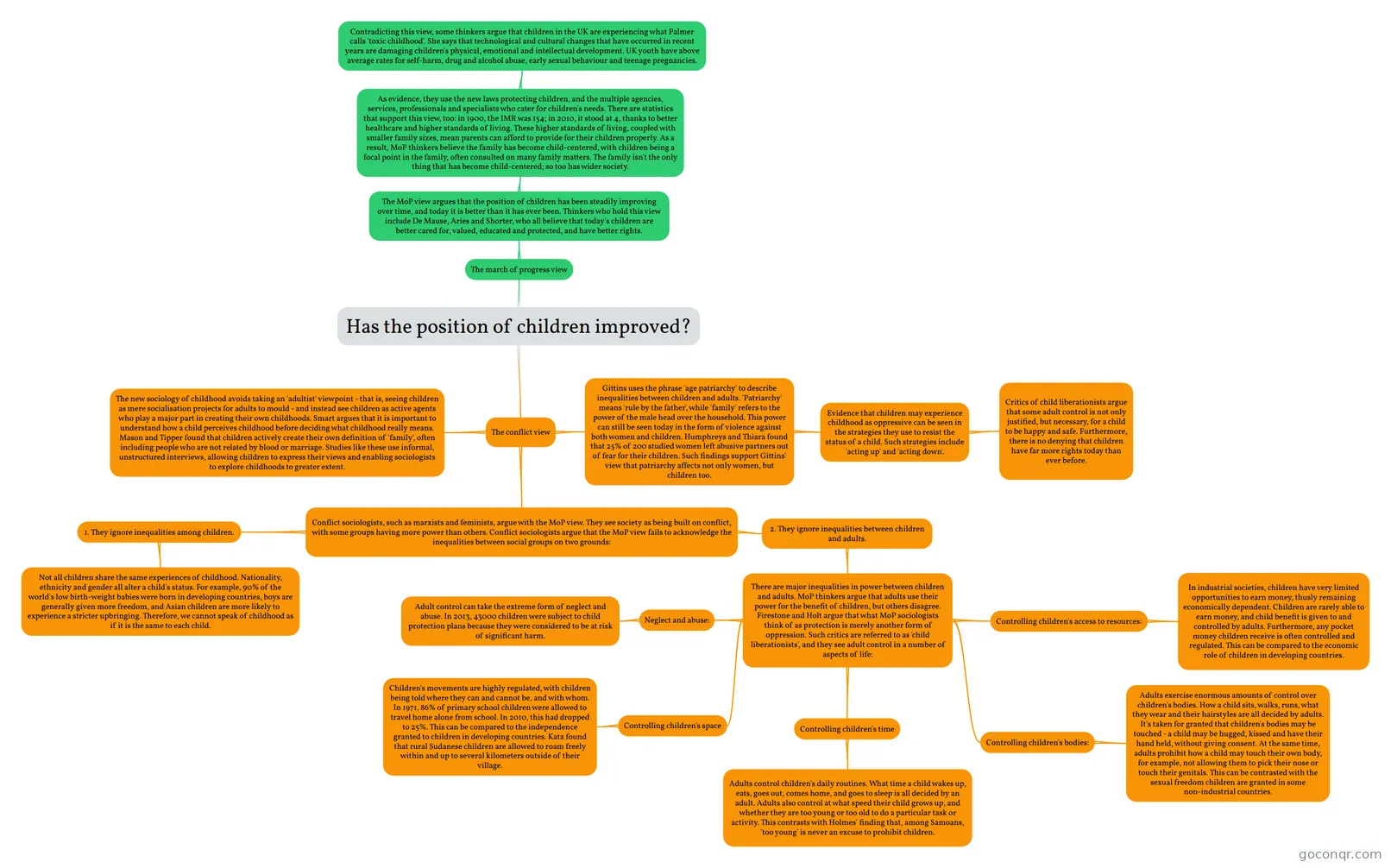
Mind map: has the position of children improved
Map content
Has the position of children improved?
The march of progress view
- The MoP view argues that the position of children has been steadily improving over time, and today it is better than it has ever been. Thinkers who hold this view include De Mause, Aries and Shorter, who all believe that today's children are better cared for, valued, educated and protected, and have better rights.
- As evidence, they use the new laws protecting children, and the multiple agencies, services, professionals and specialists who cater for children's needs. There are statistics that support this view, too: in 1900, the IMR was 154; in 2010, it stood at 4, thanks to better healthcare and higher standards of living. These higher standards of living, coupled with smaller family sizes, mean parents can afford to provide for their children properly. As a result, MoP thinkers believe the family has become child-centered, with children being a focal point in the family, often consulted on many family matters. The family isn't the only thing that has become child-centered; so too has wider society.
- Contradicting this view, some thinkers argue that children in the UK are experiencing what Palmer calls 'toxic childhood'. She says that technological and cultural changes that have occurred in recent years are damaging children's physical, emotional and intellectual development. UK youth have above average rates for self-harm, drug and alcohol abuse, early sexual behaviour and teenage pregnancies.
- As evidence, they use the new laws protecting children, and the multiple agencies, services, professionals and specialists who cater for children's needs. There are statistics that support this view, too: in 1900, the IMR was 154; in 2010, it stood at 4, thanks to better healthcare and higher standards of living. These higher standards of living, coupled with smaller family sizes, mean parents can afford to provide for their children properly. As a result, MoP thinkers believe the family has become child-centered, with children being a focal point in the family, often consulted on many family matters. The family isn't the only thing that has become child-centered; so too has wider society.
- The MoP view argues that the position of children has been steadily improving over time, and today it is better than it has ever been. Thinkers who hold this view include De Mause, Aries and Shorter, who all believe that today's children are better cared for, valued, educated and protected, and have better rights.
The conflict view
- Conflict sociologists, such as marxists and feminists, argue with the MoP view. They see society as being built on conflict, with some groups having more power than others. Conflict sociologists argue that the MoP view fails to acknowledge the inequalities between social groups on two grounds:
- 1. They ignore inequalities among children.
- Not all children share the same experiences of childhood. Nationality, ethnicity and gender all alter a child's status. For example, 90% of the world's low birth-weight babies were born in developing countries, boys are generally given more freedom, and Asian children are more likely to experience a stricter upbringing. Therefore, we cannot speak of childhood as if it is the same to each child.
- 2. They ignore inequalities between children and adults.
- There are major inequalities in power between children and adults. MoP thinkers argue that adults use their power for the benefit of children, but others disagree. Firestone and Holt argue that what MoP sociologists think of as protection is merely another form of oppression. Such critics are referred to as 'child liberationists', and they see adult control in a number of aspects of life:
- Neglect and abuse:
- Adult control can take the extreme form of neglect and abuse. In 2013, 43000 children were subject to child protection plans because they were considered to be at risk of significant harm.
- Controlling children's space
- Children's movements are highly regulated, with children being told where they can and cannot be, and with whom. In 1971, 86% of primary school children were allowed to travel home alone from school. In 2010, this had dropped to 25%. This can be compared to the independence granted to children in developing countries. Katz found that rural Sudanese children are allowed to roam freely within and up to several kilometers outside of their village.
- Controlling children's time
- Adults control children's daily routines. What time a child wakes up, eats, goes out, comes home, and goes to sleep is all decided by an adult. Adults also control at what speed their child grows up, and whether they are too young or too old to do a particular task or activity. This contrasts with Holmes' finding that, among Samoans, 'too young' is never an excuse to prohibit children.
- Controlling children's bodies:
- Adults exercise enormous amounts of control over children's bodies. How a child sits, walks, runs, what they wear and their hairstyles are all decided by adults. It's taken for granted that children's bodies may be touched - a child may be hugged, kissed and have their hand held, without giving consent. At the same time, adults prohibit how a child may touch their own body, for example, not allowing them to pick their nose or touch their genitals. This can be contrasted with the sexual freedom children are granted in some non-industrial countries.
- Controlling children's access to resources:
- In industrial societies, children have very limited opportunities to earn money, thusly remaining economically dependent. Children are rarely able to earn money, and child benefit is given to and controlled by adults. Furthermore, any pocket money children receive is often controlled and regulated. This can be compared to the economic role of children in developing countries.
- Neglect and abuse:
- There are major inequalities in power between children and adults. MoP thinkers argue that adults use their power for the benefit of children, but others disagree. Firestone and Holt argue that what MoP sociologists think of as protection is merely another form of oppression. Such critics are referred to as 'child liberationists', and they see adult control in a number of aspects of life:
- 1. They ignore inequalities among children.
- Gittins uses the phrase 'age patriarchy' to describe inequalities between children and adults. 'Patriarchy' means 'rule by the father', while 'family' refers to the power of the male head over the household. This power can still be seen today in the form of violence against both women and children. Humphreys and Thiara found that 25% of 200 studied women left abusive partners out of fear for their children. Such findings support Gittins' view that patriarchy affects not only women, but children too.
- Evidence that children may experience childhood as oppressive can be seen in the strategies they use to resist the status of a child. Such strategies include 'acting up' and 'acting down'.
- Critics of child liberationists argue that some adult control is not only justified, but necessary, for a child to be happy and safe. Furthermore, there is no denying that children have far more rights today than ever before.
- Evidence that children may experience childhood as oppressive can be seen in the strategies they use to resist the status of a child. Such strategies include 'acting up' and 'acting down'.
- The new sociology of childhood avoids taking an 'adultist' viewpoint - that is, seeing children as mere socialisation projects for adults to mould - and instead see children as active agents who play a major part in creating their own childhoods. Smart argues that it is important to understand how a child perceives childhood before deciding what childhood really means. Mason and Tipper found that children actively create their own definition of 'family', often including people who are not related by blood or marriage. Studies like these use informal, unstructured interviews, allowing children to express their views and enabling sociologists to explore childhoods to greater extent.
- Conflict sociologists, such as marxists and feminists, argue with the MoP view. They see society as being built on conflict, with some groups having more power than others. Conflict sociologists argue that the MoP view fails to acknowledge the inequalities between social groups on two grounds:
Information
- Description
- AS level Sociology AS - Families and Households (Childhood) Mind Map on Has the position of children improved?, created by Em Maskrey on 28/01/2017.
- Created by
- Em Maskrey
- Views
- 8
- Rating