
Mind map
Ch. 21- Evolution of Populations
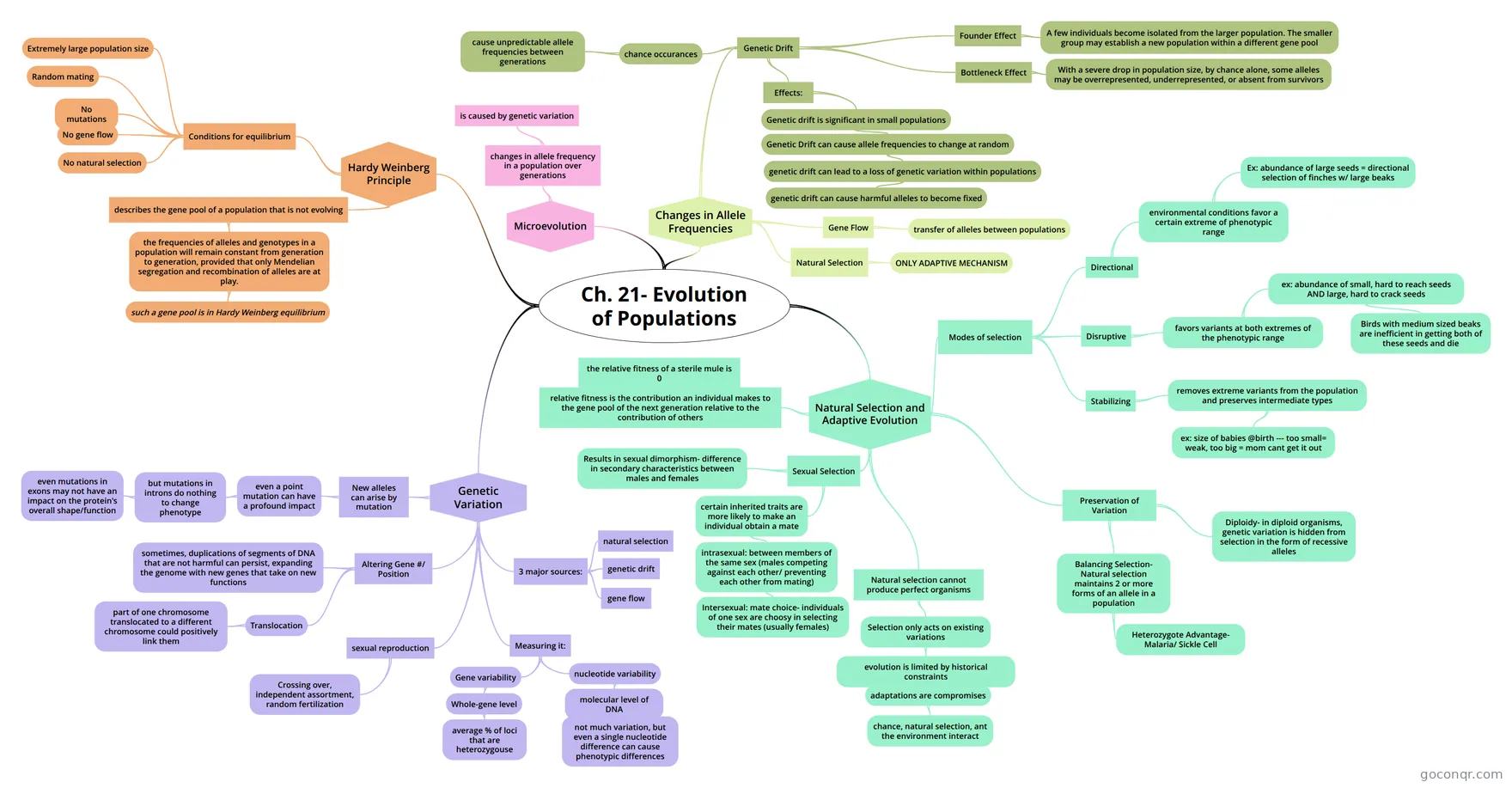
Mind map: Evolution of populations
Map content
Ch. 21- Evolution of Populations
Microevolution
- changes in allele frequency in a population over generations
- is caused by genetic variation
- changes in allele frequency in a population over generations
Genetic Variation
- 3 major sources:
- natural selection
- gene flow
- genetic drift
- Measuring it:
- Gene variability
- Whole-gene level
- average % of loci that are heterozygouse
- Whole-gene level
- nucleotide variability
- molecular level of DNA
- not much variation, but even a single nucleotide difference can cause phenotypic differences
- molecular level of DNA
- Gene variability
- New alleles can arise by mutation
- even a point mutation can have a profound impact
- but mutations in introns do nothing to change phenotype
- even mutations in exons may not have an impact on the protein's overall shape/function
- but mutations in introns do nothing to change phenotype
- even a point mutation can have a profound impact
- Altering Gene #/ Position
- Translocation
- part of one chromosome translocated to a different chromosome could positively link them
- sometimes, duplications of segments of DNA that are not harmful can persist, expanding the genome with new genes that take on new functions
- Translocation
- sexual reproduction
- Crossing over, independent assortment, random fertilization
- 3 major sources:
Hardy Weinberg Principle
- describes the gene pool of a population that is not evolving
- the frequencies of alleles and genotypes in a population will remain constant from generation to generation, provided that only Mendelian segregation and recombination of alleles are at play.
- such a gene pool is in Hardy Weinberg equilibrium
- the frequencies of alleles and genotypes in a population will remain constant from generation to generation, provided that only Mendelian segregation and recombination of alleles are at play.
- Conditions for equilibrium
- No mutations
- Random mating
- No natural selection
- Extremely large population size
- No gene flow
- describes the gene pool of a population that is not evolving
Changes in Allele Frequencies
- Natural Selection
- ONLY ADAPTIVE MECHANISM
- Genetic Drift
- chance occurances
- cause unpredictable allele frequencies between generations
- Founder Effect
- A few individuals become isolated from the larger population. The smaller group may establish a new population within a different gene pool
- Bottleneck Effect
- With a severe drop in population size, by chance alone, some alleles may be overrepresented, underrepresented, or absent from survivors
- Effects:
- Genetic drift is significant in small populations
- Genetic Drift can cause allele frequencies to change at random
- genetic drift can lead to a loss of genetic variation within populations
- genetic drift can cause harmful alleles to become fixed
- genetic drift can lead to a loss of genetic variation within populations
- Genetic Drift can cause allele frequencies to change at random
- Genetic drift is significant in small populations
- chance occurances
- Gene Flow
- transfer of alleles between populations
- Natural Selection
Natural Selection and Adaptive Evolution
- relative fitness is the contribution an individual makes to the gene pool of the next generation relative to the contribution of others
- the relative fitness of a sterile mule is 0
- Modes of selection
- Directional
- environmental conditions favor a certain extreme of phenotypic range
- Ex: abundance of large seeds = directional selection of finches w/ large beaks
- environmental conditions favor a certain extreme of phenotypic range
- Disruptive
- favors variants at both extremes of the phenotypic range
- ex: abundance of small, hard to reach seeds AND large, hard to crack seeds
- Birds with medium sized beaks are inefficient in getting both of these seeds and die
- ex: abundance of small, hard to reach seeds AND large, hard to crack seeds
- favors variants at both extremes of the phenotypic range
- Stabilizing
- removes extreme variants from the population and preserves intermediate types
- ex: size of babies @birth --- too small= weak, too big = mom cant get it out
- removes extreme variants from the population and preserves intermediate types
- Directional
- Sexual Selection
- Results in sexual dimorphism- difference in secondary characteristics between males and females
- certain inherited traits are more likely to make an individual obtain a mate
- intrasexual: between members of the same sex (males competing against each other/ preventing each other from mating)
- Intersexual: mate choice- individuals of one sex are choosy in selecting their mates (usually females)
- intrasexual: between members of the same sex (males competing against each other/ preventing each other from mating)
- Preservation of Variation
- Diploidy- in diploid organisms, genetic variation is hidden from selection in the form of recessive alleles
- Balancing Selection- Natural selection maintains 2 or more forms of an allele in a population
- Heterozygote Advantage- Malaria/ Sickle Cell
- Natural selection cannot produce perfect organisms
- Selection only acts on existing variations
- evolution is limited by historical constraints
- adaptations are compromises
- chance, natural selection, ant the environment interact
- adaptations are compromises
- evolution is limited by historical constraints
- Selection only acts on existing variations
- relative fitness is the contribution an individual makes to the gene pool of the next generation relative to the contribution of others
Information
- Description
- AP Biology (Unit 6- Evolution) Mind Map on Ch. 21- Evolution of Populations, created by Luke Detlor on 22/02/2017.
- Created by
- Luke Detlor
- Views
- 6
- Rating
More on Population Genetics and Evolutionary Mechanisms