
Mind map
EVOLUTION: change over time that can be passed down.
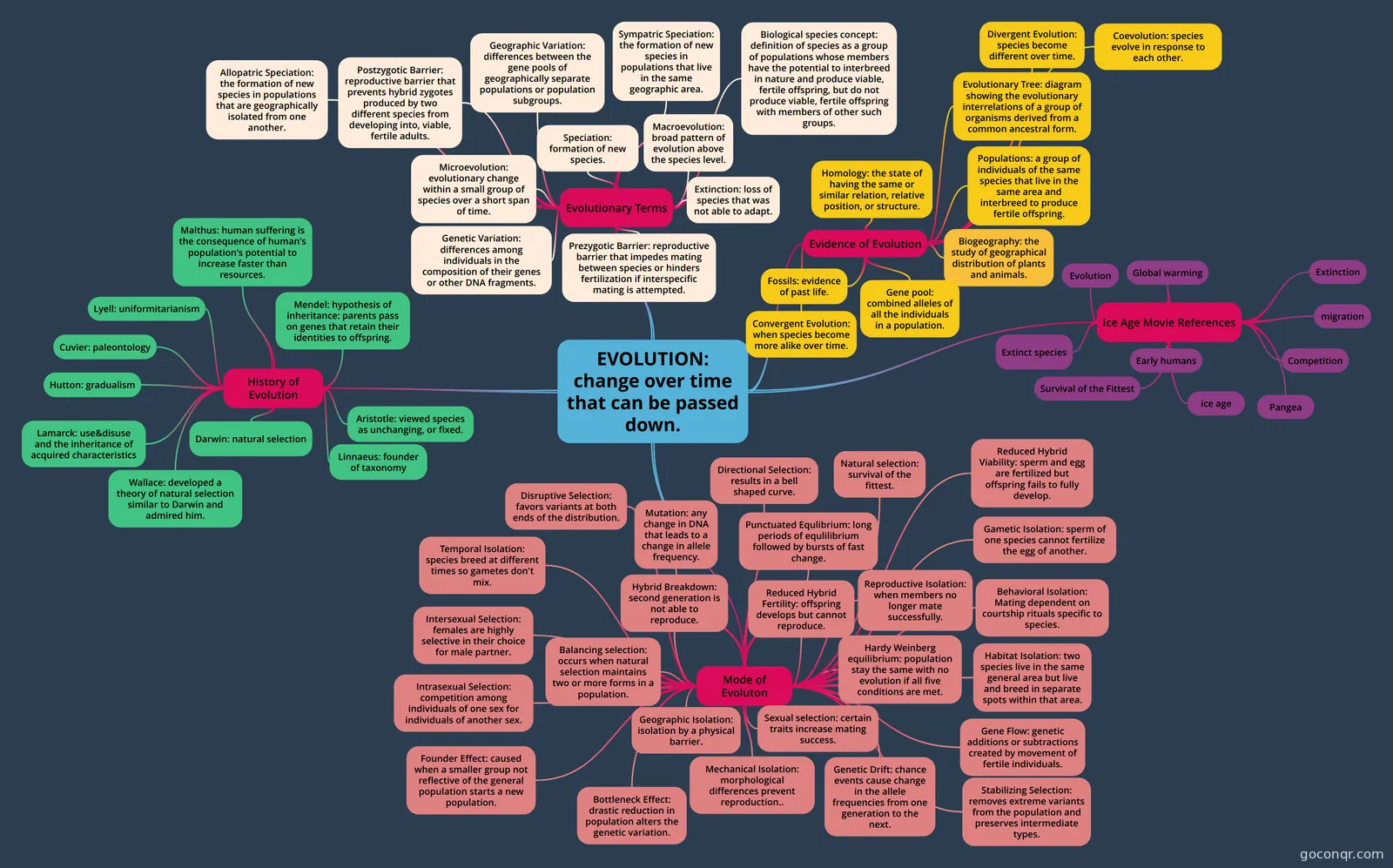
Mind map: Evolution
Map content
EVOLUTION: change over time that can be passed down.
Ice Age Movie References
- migration
- Extinction
- Competition
- ice age
- Early humans
- Survival of the Fittest
- Evolution
- Extinct species
- Global warming
- Pangea
Evidence of Evolution
- Biogeography: the study of geographical distribution of plants and animals.
- Populations: a group of individuals of the same species that live in the same area and interbreed to produce fertile offspring.
- Fossils: evidence of past life.
- Evolutionary Tree: diagram showing the evolutionary interrelations of a group of organisms derived from a common ancestral form.
- Homology: the state of having the same or similar relation, relative position, or structure.
- Gene pool: combined alleles of all the individuals in a population.
- Convergent Evolution: when species become more alike over time.
- Divergent Evolution: species become different over time.
- Coevolution: species evolve in response to each other.
Evolutionary Terms
- Microevolution: evolutionary change within a small group of species over a short span of time.
- Speciation: formation of new species.
- Extinction: loss of species that was not able to adapt.
- Genetic Variation: differences among individuals in the composition of their genes or other DNA fragments.
- Geographic Variation: differences between the gene pools of geographically separate populations or population subgroups.
- Macroevolution: broad pattern of evolution above the species level.
- Biological species concept: definition of species as a group of populations whose members have the potential to interbreed in nature and produce viable, fertile offspring, but do not produce viable, fertile offspring with members of other such groups.
- Prezygotic Barrier: reproductive barrier that impedes mating between species or hinders fertilization if interspecific mating is attempted.
- Postzygotic Barrier: reproductive barrier that prevents hybrid zygotes produced by two different species from developing into, viable, fertile adults.
- Allopatric Speciation: the formation of new species in populations that are geographically isolated from one another.
- Sympatric Speciation: the formation of new species in populations that live in the same geographic area.
Mode of Evoluton
- Genetic Drift: chance events cause change in the allele frequencies from one generation to the next.
- Bottleneck Effect: drastic reduction in population alters the genetic variation.
- Founder Effect: caused when a smaller group not reflective of the general population starts a new population.
- Gene Flow: genetic additions or subtractions created by movement of fertile individuals.
- Intrasexual Selection: competition among individuals of one sex for individuals of another sex.
- Intersexual Selection: females are highly selective in their choice for male partner.
- Habitat Isolation: two species live in the same general area but live and breed in separate spots within that area.
- Temporal Isolation: species breed at different times so gametes don't mix.
- Behavioral Isolation: Mating dependent on courtship rituals specific to species.
- Mechanical Isolation: morphological differences prevent reproduction..
- Gametic Isolation: sperm of one species cannot fertilize the egg of another.
- Reduced Hybrid Viability: sperm and egg are fertilized but offspring fails to fully develop.
- Hybrid Breakdown: second generation is not able to reproduce.
- Reduced Hybrid Fertility: offspring develops but cannot reproduce.
- Punctuated Equlibrium: long periods of equlilibrium followed by bursts of fast change.
- Geographic Isolation: isolation by a physical barrier.
- Sexual selection: certain traits increase mating success.
- Natural selection: survival of the fittest.
- Directional Selection: results in a bell shaped curve.
- Disruptive Selection: favors variants at both ends of the distribution.
- Stabilizing Selection: removes extreme variants from the population and preserves intermediate types.
- Balancing selection: occurs when natural selection maintains two or more forms in a population.
- Hardy Weinberg equilibrium: population stay the same with no evolution if all five conditions are met.
- Reproductive Isolation: when members no longer mate successfully.
- Mutation: any change in DNA that leads to a change in allele frequency.
History of Evolution
- Darwin: natural selection
- Linnaeus: founder of taxonomy
- Hutton: gradualism
- Lamarck: use&disuse and the inheritance of acquired characteristics
- Cuvier: paleontology
- Lyell: uniformitarianism
- Aristotle: viewed species as unchanging, or fixed.
- Malthus: human suffering is the consequence of human's population's potential to increase faster than resources.
- Mendel: hypothesis of inheritance: parents pass on genes that retain their identities to offspring.
- Wallace: developed a theory of natural selection similar to Darwin and admired him.
Information
- Description
- 12th grade Biology Mind Map on EVOLUTION: change over time that can be passed down., created by Harini Kota on 22/03/2017.
- Created by
- Harini Kota
- Views
- 0
- Rating