
Mind map
Manipulating genomes
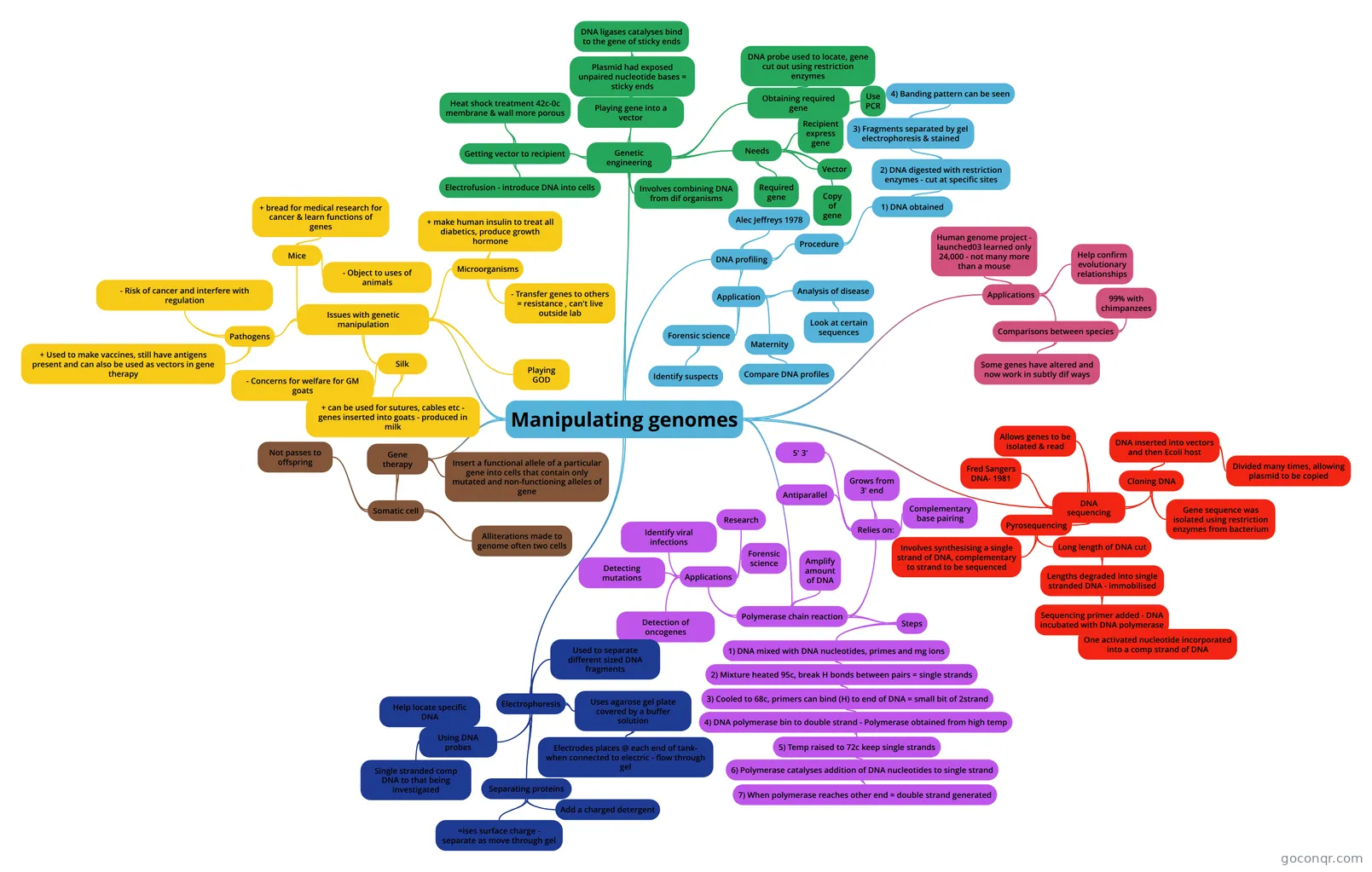
Mind map: Manipulating genomes
Map content
Manipulating genomes
DNA sequencing
- Fred Sangers DNA- 1981
- Pyrosequencing
- Involves synthesising a single strand of DNA, complementary to strand to be sequenced
- Long length of DNA cut
- Lengths degraded into single stranded DNA - immobilised
- Sequencing primer added - DNA incubated with DNA polymerase
- One activated nucleotide incorporated into a comp strand of DNA
- Sequencing primer added - DNA incubated with DNA polymerase
- Lengths degraded into single stranded DNA - immobilised
- Allows genes to be isolated & read
- Cloning DNA
- Gene sequence was isolated using restriction enzymes from bacterium
- DNA inserted into vectors and then Ecoli host
- Divided many times, allowing plasmid to be copied
Applications
- Human genome project - launched03 learned only 24,000 - not many more than a mouse
- Comparisons between species
- 99% with chimpanzees
- Some genes have altered and now work in subtly dif ways
- Help confirm evolutionary relationships
DNA profiling
- Alec Jeffreys 1978
- Procedure
- 1) DNA obtained
- 2) DNA digested with restriction enzymes - cut at specific sites
- 3) Fragments separated by gel electrophoresis & stained
- 4) Banding pattern can be seen
- 3) Fragments separated by gel electrophoresis & stained
- 2) DNA digested with restriction enzymes - cut at specific sites
- 1) DNA obtained
- Application
- Forensic science
- Identify suspects
- Maternity
- Compare DNA profiles
- Analysis of disease
- Look at certain sequences
- Forensic science
Polymerase chain reaction
- Amplify amount of DNA
- Relies on:
- Antiparallel
- 5' 3'
- Grows from 3' end
- Complementary base pairing
- Steps
- 1) DNA mixed with DNA nucleotides, primes and mg ions
- 2) Mixture heated 95c, break H bonds between pairs = single strands
- 3) Cooled to 68c, primers can bind (H) to end of DNA = small bit of 2strand
- 4) DNA polymerase bin to double strand - Polymerase obtained from high temp
- 5) Temp raised to 72c keep single strands
- 6) Polymerase catalyses addition of DNA nucleotides to single strand
- 7) When polymerase reaches other end = double strand generated
- 6) Polymerase catalyses addition of DNA nucleotides to single strand
- 5) Temp raised to 72c keep single strands
- 4) DNA polymerase bin to double strand - Polymerase obtained from high temp
- 3) Cooled to 68c, primers can bind (H) to end of DNA = small bit of 2strand
- 2) Mixture heated 95c, break H bonds between pairs = single strands
- 1) DNA mixed with DNA nucleotides, primes and mg ions
- Applications
- Detection of oncogenes
- Detecting mutations
- Identify viral infections
- Forensic science
- Research
Electrophoresis
- Used to separate different sized DNA fragments
- Uses agarose gel plate covered by a buffer solution
- Electrodes places @ each end of tank- when connected to electric - flow through gel
- Separating proteins
- Add a charged detergent
- =ises surface charge - separate as move through gel
- Using DNA probes
- Single stranded comp DNA to that being investigated
- Help locate specific DNA
Genetic engineering
- Involves combining DNA from dif organisms
- Needs
- Required gene
- Copy of gene
- Vector
- Recipient express gene
- Obtaining required gene
- DNA probe used to locate, gene cut out using restriction enzymes
- Use PCR
- Playing gene into a vector
- Plasmid had exposed unpaired nucleotide bases = sticky ends
- DNA ligases catalyses bind to the gene of sticky ends
- Plasmid had exposed unpaired nucleotide bases = sticky ends
- Getting vector to recipient
- Heat shock treatment 42c-0c membrane & wall more porous
- Electrofusion - introduce DNA into cells
Issues with genetic manipulation
- Microorganisms
- + make human insulin to treat all diabetics, produce growth hormone
- - Transfer genes to others = resistance , can't live outside lab
- Mice
- + bread for medical research for cancer & learn functions of genes
- - Object to uses of animals
- Silk
- + can be used for sutures, cables etc - genes inserted into goats - produced in milk
- - Concerns for welfare for GM goats
- Pathogens
- + Used to make vaccines, still have antigens present and can also be used as vectors in gene therapy
- - Risk of cancer and interfere with regulation
- Playing GOD
- Microorganisms
Gene therapy
- Insert a functional allele of a particular gene into cells that contain only mutated and non-functioning alleles of gene
- Somatic cell
- Alliterations made to genome often two cells
- Not passes to offspring
Information
- Description
- A level biology Mind Map on Manipulating genomes, created by Finn Patterson on 28/03/2017.
- Created by
- Finn Patterson
- Views
- 0
- Rating