
Mind map
The Gilded Age
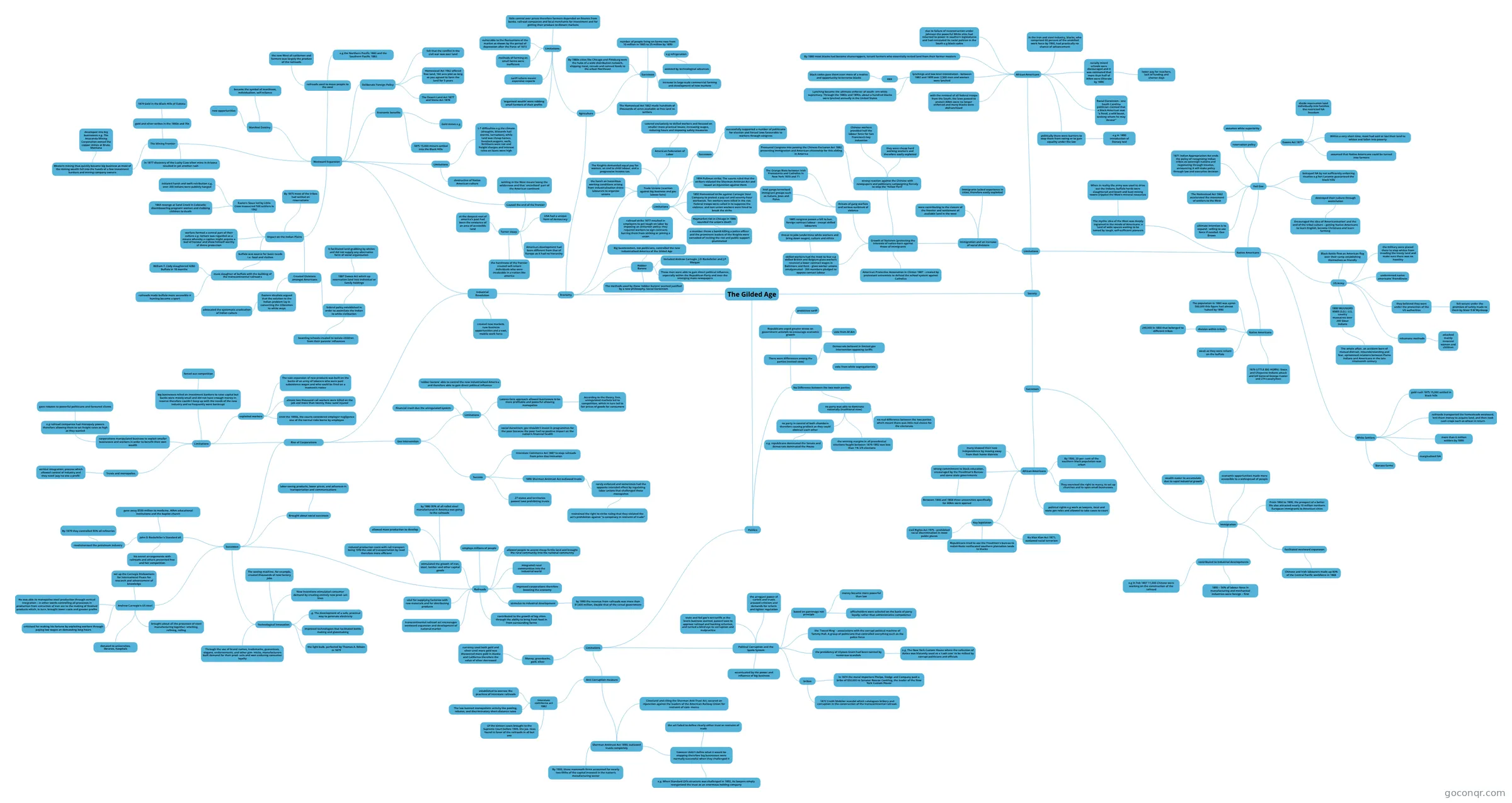
Mind map: The Gilded Age
Map content
The Gilded Age
Society
- Limitations
- Immigration and an increase of social divisions
- Growth of Nativism (protecting the interests of native-born against those of immigrants
- strong reaction against the Chinese with newspapers and politicians campaigning fiercely to stop the 'Yellow Peril'
- Pressured Congress into passing the Chinese Exclusion Act 1882 preventing immigration and American citizenship for this eliding in America
- Chinese workers provided half the labour force for San Francisco's key industries
- they were cheap hard working workers and therefore easily exploited
- threats of gang warfare and serious outbreak of violence
- The Orange Riots between Irish Protestants and Catholics in New York 1870 and 71
- Irish gangs terrorised immigrant groups such as Italians, Jews and Poles.
- skilled workers had the most to fear e.g skilled British and Belgium glass workers received a lower contract wages in Baltimore and Kent - glass worker unions amalgamated - 300 members pledged to oppose contact labour
- threat to jobs (undermine white workers and bring down wages), culture and ethics
- 1885 congress passes a bill to ban foreign contract labour - except skilled labourers
- threat to jobs (undermine white workers and bring down wages), culture and ethics
- American Protective Association in Clinton 1887 - created by protestant extremists to defend the school system against Catholics
- strong reaction against the Chinese with newspapers and politicians campaigning fiercely to stop the 'Yellow Peril'
- were contributing to the closure of the frontier and settlement of available land in the west
- Immigrants lacked experience in cities, therefore easily exploited
- Growth of Nativism (protecting the interests of native-born against those of immigrants
- Native Americans
- The mythic idea of the West was deeply ingrained in the minds of Americans: a land of wide spaces waiting to be tamed by tough, self-sufficient pioneers
- When in reality the army was used to drive out the Indians, buffalo herds were slaughtered and boom and bust mining towns crippled the West's mineral resources
- Fed Gov
- The Homestead Act 1862 accelerated the movement of settlers to the West
- reservation policy
- assumes white superiority
- betrayed NA by not sufficiently enforcing treaties e.g fort Laramie guaranteed the black hills
- ultimate intention is to expand - willing to use force if needed -Dee Brown
- Dawes Act 1877
- divide reservation land individually into families tho restricted NA freedom
- Within a very short time, most had sold or lost their land to whites and fallen into poverty
- assumed that Native Americans could be turned into farmers
- 1871 Indian Appropriation Act ends the policy of recognizing Indian tribes as sovereign nations and negotiating through treaties, announcing it will make policy through law and executive decision
- destroyed their culture through assimilation
- Encouraged the idea of ‘Americanisation’ and the end of the tribal culture – getting Native Americans to learn English, become Christians and learn farming
- US Army
- undermined native americans' friendliness
- they believed they were under the protection of the US authorities
- felt secure under the promises of safety made to them by Maor E.W Wynkoop
- Black Kettle flew an American flag over their camp establishing themselves as friendly
- inhumane methods
- attacked mainly innocent women and children
- the military were placed there to stop whites from invading the treaty land and make sure there was no hostility
- 1890 WOUNDED KNEE (S.D.). U.S. cavalry massacres over 200 Sioux Indians
- The whole affair, an accident born of mutual distrust, misunderstanding and fear, epitomised relations between Plains Indians and Americans in the late nineteenth century
- Native Americans
- The population in 1860 was apron 500,000 this figure had almost halved by 1890
- division within tribes
- 240,000 in 1860 that belonged to different tribes
- weak as they were reliant on the buffalo
- 1876 LITTLE BIG HORN): Sioux and Cheyenne Indians attack and kill General George Custer and 274 cavalrymen
- White Settlers
- marginalised NA
- railroads transported the homesteads westward, lent them money to acquire land, and then took cash crops such as wheat in return
- more than 6 million settlers by 1890
- gold rush 1875 15,000 settled in black hills
- 'Bonaza farms'
- The mythic idea of the West was deeply ingrained in the minds of Americans: a land of wide spaces waiting to be tamed by tough, self-sufficient pioneers
- African-Americans
- with the removal of all federal troops from the South, the laws passed to protect AfAm were no longer enforced and many blacks were disfranchised
- politically there were barriers to stop them from voting or to gain equality under the law
- e.g in 1890 introduction of literacy test
- lynchings and low-level intimidation - between 1882 and 1899 over 2,500 men and women were lynched
- KKK
- black codes gave them even more of a motive and opportunity to terrorise blacks
- Lynching became the ultimate enforcer of south- ern white supremacy. Through the 1880s and 1890s, about a hundred blacks were lynched annually in the United States
- KKK
- racially mixed schools were discouraged and it was estimated that more than half of AfAm were illiterate by 1890
- lower pay for teachers, lack of funding and shorter days
- due to failure of reconstruction under Johnson the powerful White elite had returned to power in southern legislatures and had reinstated its racist policies in the South e.g black codes
- By 1880 most blacks had become sharecroppers, tenant farmers who essentially rented land from their former masters
- Racial Darwinism - one South Carolina politician claimed that a black American was "a fiend, a wild beast, seeking whom he may devour"
- In the iron and steel industry, blacks, who comprised 60 percent of the unskilled work force by 1900, had practically no chance of advancement
- Immigration and an increase of social divisions
- Successes
- African Americans
- many showed their new independence by moving away from their home districts
- They exercised the right to marry, to set up churches and to open small businesses
- strong commitment to black education, encouraged by the Freedman's Bureau and some state governments
- Between 1866 and 1868 three universities specifically for AfAm were opened
- political rights e.g work as lawyers, local and state gov roles and allowed to take cases to court
- Key legislation
- Ku Klux Klan Act 1871; outlawed racial terrorism
- Civil Rights Act 1975 - prohibited racial discrimination in most public places
- Republicans tried to use the Freedmen's bureau to redistribute confiscated southern plantation lands to blacks
- By 1900, 20 per- cent of the southern black population was urban
- Immigration
- economic opportunities made more accessible to a widespread of people
- wealth easier to accumulate due to rapid industrial growth
- contributed to industrial developments
- e.g In Feb 1867 11,000 Chinese were working on the construction of the railroad
- 1890 – 56% of labour force in manufacturing and mechanical industries were foreign – first
- facilitated westward expansion
- Chinese and Irish labourers made up 80% of the Central Pacific workforce in 1868
- From 1860 to 1890, the prospect of a better life also attracted nearly 10 million northern European immigrants to American cities
- African Americans
- Limitations
Politics
- Limitations
- Political Corruption and the Spoils System
- the 'Tweed Ring' - associations with the corrupt political machine of Tammy Hall. A group of politicians that controlled everything such as the police force
- accentuated by the power and influence of big business
- the presidency of Ulysses Grant had been tainted by numerous scandals
- e.g. The New York Custom House where the collection of duties was blatantly used as a 'cash cow' to be milked by corrupt politicians and officials
- the arrogant power of cartels and trusts aroused criticism and demands for reform and tighter regulation
- based on patronage not principle
- money became more powerful than law
- officeholders were selected on the basis of party loyalty rather than administrative competence
- bribes
- In 1874 the metal importers Phelps, Dodge and Company paid a bribe of $50,000 to Senator Roscoe Conkling, the leader of the New York Custom House
- 1872 Credit Mobilier scandal which catalogues bribery and corruption in the construction of the transcontinental railroad.
- state and fed gov's set tariffs at the levels business wanted, passed laws to approve railroad and banking schemes, and turned a blind eye to corruption and malpractice
- Money; greenbacks, gold, silver
- currency used both gold and silver until more gold was discovered more gold in Alaska and California therefore the value of silver decreased
- Anti Corruption measure
- Sherman Antitrust Act 1890; outlawed trusts completely
- however didn't define what it would be stopping therefore big businesses were normally successful when they challenged it
- the act failed to define clearly either trust or restraint of trade
- e.g. When Standard Oil’s structure was challenged in 1892, its lawyers simply reorganized the trust as an enormous holding company
- By 1900, these mammoth firms accounted for nearly two-fifths of the capital invested in the nation’s manufacturing sector
- Cleveland and citing the Sherman Anti-Trust Act, secured an injunction against the leaders of the American Railway Union for restraint of com- merce
- however didn't define what it would be stopping therefore big businesses were normally successful when they challenged it
- Interstate commerce act 1882
- established to oversee the practices of interstate railroads
- The law banned monopolistic activity like pooling, rebates, and discriminatory short-distance rates
- Of the sixteen cases brought to the Supreme Court before 1905, the jus- tices found in favor of the railroads in all but one
- Sherman Antitrust Act 1890; outlawed trusts completely
- Political Corruption and the Spoils System
- No Difference between the two main parties
- no party was able to dominate nationally (traditional view)
- no party in control of both chambers therefore causing gridlock as they could obstruct each other
- e.g. republicans dominated the Senate and democrats dominated the House
- no real difference between the two parties which meant there was little real choice for the electorate
- the winning margins in all presidential elections fought between 1876-1892 was less than 1% 3/5 elections
- no party in control of both chambers therefore causing gridlock as they could obstruct each other
- There were differences among the parties (revised view)
- Republicans urged greater stress on government activism to encourage economic growth
- protective tariff
- vote from Af.Am
- Democrats believed in limited gov intervention opposing tariffs
- vote from white segregationists
- Republicans urged greater stress on government activism to encourage economic growth
- no party was able to dominate nationally (traditional view)
- Limitations
Economy
- Agriculture
- Successes
- The Homestead Act 1862 made hundreds of thousands of acres available as free land to settlers
- number of people living on farms rose from 10 million in 1865 to 25 million by 1890
- increase in large-scale commercial farming and development of new markets
- assisted by technological advances
- e.g refrigeration
- assisted by technological advances
- By 1880s cities like Chicago and Pittsburg were the hubs of a wide distribution network, shipping meat, cereals and canned foods to the urban Northeast
- Limitations
- little control over prices therefore farmers depended on finance from banks, railroad companies and local merchants for investment and for getting their produce to distant markets
- vulnerable to the fluctuations of the market as shown by the period of depression after the Panic of 1873
- methods of farming on small farms were inefficient
- tariff reform meant expensive exports
- 'organised wealth' were robbing small farmers of their profits
- Successes
- Industrial Revolution
- created new markets, new business opportunities and a vast, mobile work force
- Rise of Corporations
- Limitations
- Trusts and monopolies
- vertical integration; process which allowed control of industry and they need 'pay no one a profit'
- corporations manipulated business to exploit smaller businesses and workers in order to benefit their own wealth
- e.g railroad companies had monopoly powers therefore allowing them to set freight rates as high as they wanted
- gave rebates to powerful politicians and favoured clients
- e.g railroad companies had monopoly powers therefore allowing them to set freight rates as high as they wanted
- big businesses relied on investment bankers to raise capital but banks were mostly small and did not have enough money in reserve therefore couldn't keep up with the needs of the new industry and so frequently went bankrupt
- forced out competition
- exploited workers
- The vast expansion of new products was built on the backs of an army of laborers who were paid subsistence wages and who could be fired on a moment’s notice
- almost two thousand rail workers were killed on the job and more than twenty thou- sand injured
- Until the 1890s, the courts considered employer negligence one of the normal risks borne by employee
- Trusts and monopolies
- Successes
- John D Rockefeller's Standard oil
- revolutionised the petroleum industry
- By 1879 they controlled 90% oil refineries
- gave away $550 million to medicine, AfAm educational institutions and the baptist church
- his secret arrangements with railroads and others prevented free and fair competition
- revolutionised the petroleum industry
- Andrew Carnegie's US steel
- brought about all the processes of steel manufacturing together- smelting, refining, rolling
- criticised for making his fortune by exploiting workers through paying low wages an demanding long hours
- donated to universities, libraries, hospitals
- set up the Carnegie Endowment for International Peace for research and advancement of knowledge
- He was able to monopolise steel production through vertical integration – in other words controlling all processes in production from extraction of iron ore to the making of finished products which, in turn, brought lower costs and greater profits
- Railroads
- vital for supplying factories with raw materials and for distributing products
- employs millions of people
- integrated rural communities into the industrial world
- allowed people to access cheap fertile land and brought the rural community into the national community
- improved corporations therefore boosting the economy
- stimulated the growth of iron, steel, lumber and other capital goods
- by 1880 90% of all rolled steel manufactured in America was going to the railroads
- allowed mass production to develop
- reduced production costs with rail transport being 10% the cost of transportation by road therefore more efficient
- stimulus to industrial development
- by 1890 the revenue from railroads was more than $1,000 million, double that of the cereal government
- transcontinental railroad act encourages westward expansion and development of national market
- contributed to the growth of big cities through the ability to bring fresh food in from surrounding farms
- Technological Innovation
- New Inventions stimulated consumer demand by creating entirely new prod- uct lines
- .g. The development of a safe, practical way to generate electricity
- improved technologies that facilitated bottle making and glassmaking
- the light bulb, perfected by Thomas A. Edison in 1879
- Through the use of brand names, trademarks, guarantees, slogans, endorsements, and other gim- micks, manufacturers built demand for their prod- ucts and won enduring consumer loyalty
- The sewing machine, for example, created thousands of new factory jobs
- Brought about social successes
- labor-saving products, lower prices, and advances in transportation and communications
- John D Rockefeller's Standard oil
- Gov Intervention
- Limitations
- Lassiez-faire approach allowed businesses to be more profitable and powerful allowing monopolies
- According to the theory, free, unregulated markets led to competition, which in turn led to fair prices of goods for consumers
- 'robber barons' able to control the new industrialised America and therefore able to gain direct political influence
- financial crash due the unregulated system
- social darwinism; gov shouldn't invest in programmes for the poor because the poor had no positive impact on the nation's financial health
- Lassiez-faire approach allowed businesses to be more profitable and powerful allowing monopolies
- Success
- Interstate Commerce Act 1887 to stop railroads from price discrimination
- 1890 Sherman Antitrust Act outlawed trusts
- rarely enforced and sometimes had the opposite intended effect by regulating labor unions that challenged these monopolies
- restrained the right to strike ruling that they violated the act's prohibition against "a conspiracy in restraint of trade"
- rarely enforced and sometimes had the opposite intended effect by regulating labor unions that challenged these monopolies
- 27 states and territories passed laws prohibiting trusts
- Limitations
- Limitations
- Westward Expansion
- Manifest Destiny
- new opportunities
- became the symbol of manliness, individualism, self-reliance
- railroads used to move people to the west
- e.g the Northern Pacific 1883 and the Southern Pacific 1883
- the new West of cattlemen and farmers was largely the product of the railroads
- Limitations
- destructive of Native American culture
- L-T difficulties e.g the climate (droughts, blizzards hail storms, tornadoes), while land was cheap horses, livestock,wagons, wells, fertilisers were not and freight charges and interest rates on loans were high
- Economic benefits
- Gold mines e.g
- 1875 15,000 miners settled into the Black Hills
- Caused the end of the frontier
- settling in the West meant losing the wilderness and that 'uncivilised' part of the American continent
- Turner essay
- at the deepest root of america's past had been the existence of an area of accessible land
- the harshness of the frontier created self-reliant individuals who were invaluable in a nation like america
- America's development had been different from that of Europe as it had no hierarchy
- USA had a unique form of democracy
- Deliberate Foreign Policy
- felt that the conflict in the civil war was over land
- Homestead Act 1962 offered free land, 160 acre plot as long as you agreed to farm the land for 5 years
- The Desert Land Act 1877 and Stone Act 1878
- The Mining Frontier
- gold and silver strikes in the 1860s and 70s
- 1874 Gold in the Black Hills of Dakota
- In 1877 discovery of the Lucky Cuss silver mine in Arizona resulted in yet another rush
- Western mining thus quickly became big business as most of the mining wealth fell into the hands of a few investment bankers and mining company owners
- developed into big businesses e.g. The Anaconda Mining Corporation owned the copper mines at Brute, Montana
- gold and silver strikes in the 1860s and 70s
- Impact on the Indian Plains
- buffalo was source for basic needs i.e. food and clothes
- mass slaughter of buffalo with the building of the transcontinental railroad s
- William F. Cody slaughtered 4280 Buffalo in 18 months
- railroads made buffalo more accessible it hunting became a sport
- mass slaughter of buffalo with the building of the transcontinental railroad s
- warfare formed a central part of their culture e.g. torture was regarded as a means whereby a captive might acquire a bad of honour and show himself worthy of divine protection
- Eastern Sioux led by Little Crow massacred 500 settlers in 1962
- initiated harsh and swift retribution e,g, over 300 indians were publicly hanged
- 1864 revenge at Sand Creek in Colorado; disemboweling pregnant women and clubbing children to death
- By 1875 most of the tribes had settled on reservations
- Created Divisions amongst Americans
- Eastern idealists argued that the solution to the Indian problem lay in converting the tribesmen to white ways
- advocated the systematic eradication of Indian culture
- federal policy established in order to assimilate the Indian to white civilisation
- boarding schools created to isolate children from their parents' influences
- 1887 Dawes Act which up reservation land into individual or family holdings
- it facilitated land-grabbing by whites and did not supply any alternative form of social organisation
- Eastern idealists argued that the solution to the Indian problem lay in converting the tribesmen to white ways
- buffalo was source for basic needs i.e. food and clothes
- Manifest Destiny
- Trade Unions (reaction against big business and gov laissez faire)
- the harsh an hazardous working conditions arising from industrialisation drove labourers to organise unions
- Successes
- successfully supported a number of politicians for election and forced laws favourable to workers through congress
- Limitations
- Haymarket riot in Chicago in 1886 sounded the union's death
- a member threw a bomb killing a police officer and the prominent leaders of the Knights were convoked of inciting the riot and public support plummeted
- railroad strike 1877 resulted in employers to get tough on labor by imposing an antiunion policy: they required workers to sign contracts barring them from striking or joining a union
- 1892 Homestead strike against Carnegie Steel Company to protest a pay cut and seventy-hour workweek. Ten workers were killed in the riot. Federal troops were called in to suppress the violence, and non-union workers were hired to break the strike
- 1894 Pullman strike; The courts ruled that the strikers violated the Sherman Antitrust Act and issued an injunction against them
- Haymarket riot in Chicago in 1886 sounded the union's death
- The Knights demanded equal pay for women, an end to child labour, and a progressive income tax.
- American Federation of Labor
- catered exclusively to skilled workers and focused on smaller more practical issues; increasing wages, reducing hours and imposing safety measures
- Robber Barons
- Big businessmen, not politicians, controlled the new industrialised America of the Gilded Age
- These men were able to gain direct political influence, especially within the Republican Party and over the emerging mass newspapers
- The methods used by these ‘robber barons’ seemed justified by a new philosophy, Social Darwinism
- Included Andrew Carnegie, J.D Rockefeller and J.P Morgan
- Agriculture
Information
- Description
- A level American History Mind Map on The Gilded Age, created by Niamh Quinn on 12/04/2017.
- Created by
- Niamh Quinn
- Views
- 8
- Rating