
Mind map
Child Language Aquisition
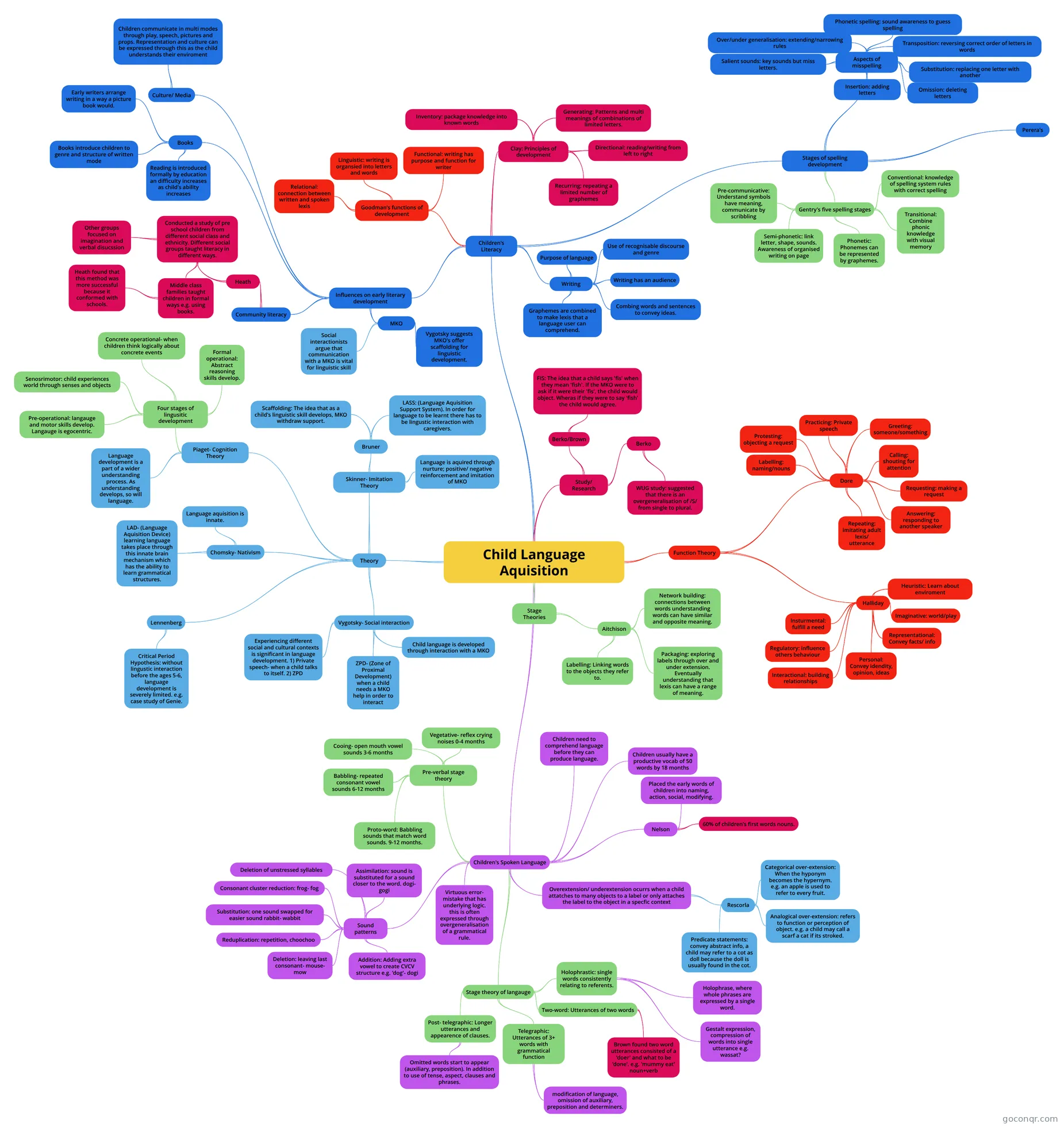
Mind map: Child language acquisition
Map content
Child Language Aquisition
Stage Theories
- Aitchison
- Labelling: Linking words to the objects they refer to.
- Packaging: exploring labels through over and under extension. Eventually understanding that lexis can have a range of meaning.
- Network building: connections between words understanding words can have similar and opposite meaning.
- Aitchison
Function Theory
- Dore
- Labelling: naming/nouns
- Repeating: imitating adult lexis/ utterance
- Answering: responding to another speaker
- Requesting: making a request
- Calling: shouting for attention
- Greeting: someone/something
- Practicing: Private speech
- Protesting: objecting a request
- Halliday
- Insturmental: fulfill a need
- Regulatory: influence others behaviour
- Interactional: building relationships
- Personal: Convey idendity, opinion, ideas
- Representational: Convey facts/ info
- Imaginative: world/play
- Heuristic: Learn about enviroment
- Dore
Theory
- Skinner- Imitation Theory
- Language is aquired through nurture; positive/ negative reinforcement and imitation of MKO
- Bruner
- LASS: (Language Aquisition Support System). In order for language to be learnt there has to be lingustic interaction with caregivers.
- Scaffolding: The idea that as a child's linguistic skill develops, MKO withdraw support.
- Vygotsky- Social interaction
- Child language is developed through interaction with a MKO
- ZPD- (Zone of Proximal Development) when a child needs a MKO help in order to interact
- Experiencing different social and cultural contexts is significant in language development. 1) Private speech- when a child talks to itself. 2) ZPD
- Chomsky- Nativism
- Language aquisition is innate.
- LAD- (Language Aquisition Device) learning language takes place through this innate brain mechanism which has the ability to learn grammatical structures.
- Lennenberg
- Critical Period Hypothesis: without lingustic interaction before the ages 5-6, language development is severely limited. e.g. case study of Genie.
- Piaget- Cognition Theory
- Language development is a part of a wider understanding process. As understanding develops, so will language.
- Four stages of lingusitic development
- Pre-operational: langauge and motor skills develop. Langauge is egocentric.
- Senosrimotor: child experiences world through senses and objects
- Concrete operational- when children think logically about concrete events
- Formal operational: Abstract reasoning skills develop.
- Skinner- Imitation Theory
Study/ Research
- Berko
- WUG study: suggested that there is an overgeneralisation of /S/ from single to plural.
- Berko/Brown
- FIS: The idea that a child says 'fis' when they mean 'fish'. If the MKO were to ask if it were their 'fis', the child would object. Wheras if they were to say 'fish' the child would agree.
- Berko
Children's Spoken Language
- Children need to comprehend language before they can produce language.
- Pre-verbal stage theory
- Vegetative- reflex crying noises 0-4 months
- Cooing- open mouth vowel sounds 3-6 months
- Babbling- repeated consonant vowel sounds 6-12 months
- Proto-word: Babbling sounds that match word sounds. 9-12 months.
- Children usually have a productive vocab of 50 words by 18 months
- Nelson
- Placed the early words of children into naming, action, social, modifying.
- 60% of children's first words nouns.
- Overextension/ underextension ocurrs when a child attatches to many objects to a label or only attaches the label to the object in a specfic context
- Rescorla
- Categorical over-extension: When the hyponym becomes the hypernym. e.g. an apple is used to refer to every fruit.
- Analogical over-extension: refers to function or perception of object. e.g. a child may call a scarf a cat if its stroked.
- Predicate statements: convey abstract info, a child may refer to a cot as doll because the doll is usually found in the cot.
- Rescorla
- Sound patterns
- Addition: Adding extra vowel to create CVCV structure e.g. 'dog'- dogi
- Deletion: leaving last consonant- mouse- mow
- Reduplication: repetition, choochoo
- Substitution: one sound swapped for easier sound rabbit- wabbit
- Consonant cluster reduction: frog- fog
- Deletion of unstressed syllables
- Assimilation: sound is substituted for a sound closer to the word. dogi- gogi
- Stage theory of langauge
- Holophrastic: single words consistently relating to referents.
- Holophrase, where whole phrases are expressed by a single word.
- Gestalt expression, compression of words into single utterance e.g. wassat?
- Two-word: Utterances of two words
- Brown found two word utterances consisted of a 'doer' and what to be 'done'. e.g. 'mummy eat' noun+verb
- Telegraphic: Utterances of 3+ words with grammatical function
- modification of language, omission of auxiliary, preposition and determiners.
- Post- telegraphic: Longer utterances and appearence of clauses.
- Omitted words start to appear (auxiliary, preposition). In addition to use of tense, aspect, clauses and phrases.
- Holophrastic: single words consistently relating to referents.
- Virtuous error- mistake that has underlying logic. this is often expressed through overgeneralisation of a grammatical rule.
Children's Literacy
- Writing
- Graphemes are combined to make lexis that a language user can comprehend.
- Combing words and sentences to convey ideas.
- Writing has an audience
- Use of recognisable discourse and genre
- Purpose of language
- Clay: Principles of development
- Recurring: repeating a limited number of graphemes
- Directional: reading/writing from left to right
- Generating: Patterns and multi meanings of combinations of limited letters.
- Inventory: package knowledge into known words
- Goodman's functions of development
- Functional: writing has purpose and function for writer
- Linguistic: writing is organsied into letters and words
- Relational: connection between written and spoken lexis
- Influences on early literary development
- MKO
- Vygotsky suggests MKO's offer scaffolding for linguistic development.
- Social interactionists argue that communication with a MKO is vital for linguistic skill
- Community literacy
- Heath
- Conducted a study of pre school children from different social class and ethnicity. Different social groups taught literacy in different ways.
- Middle class families taught children in formal ways e.g. using books.
- Heath found that this method was more successful because it conformed with schools.
- Other groups focused on imagination and verbal disucssion
- Middle class families taught children in formal ways e.g. using books.
- Conducted a study of pre school children from different social class and ethnicity. Different social groups taught literacy in different ways.
- Heath
- Books
- Reading is introduced formally by education an difficulty increases as child's ability increases
- Books introduce children to genre and structure of written mode
- Early writers arrange writing in a way a picture book would.
- Culture/ Media
- Children communicate in multi modes through play, speech, pictures and props. Representation and culture can be expressed through this as the child understands their enviroment
- MKO
- Stages of spelling development
- Gentry's five spelling stages
- Pre-communicative: Understand symbols have meaning, communicate by scribbling
- Semi-phonetic: link letter, shape, sounds. Awareness of organised writing on page
- Phonetic: Phonemes can be represented by graphemes.
- Transitional: Combine phonic knowledge with visual memory
- Conventional: knowledge of spelling system rules with correct spelling
- Aspects of misspelling
- Insertion: adding letters
- Omission: deleting letters
- Substitution: replacing one letter with another
- Transposition: reversing correct order of letters in words
- Phonetic spelling: sound awareness to guess spelling
- Over/under generalisation: extending/narrowing rules
- Salient sounds: key sounds but miss letters.
- Perera's
- Gentry's five spelling stages
- Writing
Information
- Description
- A level English Mind Map on Child Language Aquisition, created by Ellie Bennett on 19/04/2017.
- Created by
- Ellie Bennett
- Views
- 10
- Rating