
Mind map
Cellular respiration 2
Map content
Cellular respiration 2
Learning objectives
- Overview of the oxidation of glucose by glycolysis to produce pyruvate
- Control of glycolysis to meet the energy demands of the cell
- The role of creatine phosphate in short term energy generation
- The fate of pyruvate in aerobic and anaerobic conditions: the generation of acetyl-CoA and lactate
- Control of pyruvate dehydrogenase and its importance
Glucose as a fuel
- Glucose = important fuel molecule in most cells
- Cellular glucose - transported into cells via glucose transporters (GLUT)
- GLUT transporter proteins are transmembrane proteins which catalyse the facilitative diffusion of glucose down its concentration gradient
- Concentration gradient maintained by rapid cellular metabolism of glucose
- There are 4 GLUT isoform - varying affinities for glucose and different tissue distributions
- GLUT transporter proteins are transmembrane proteins which catalyse the facilitative diffusion of glucose down its concentration gradient
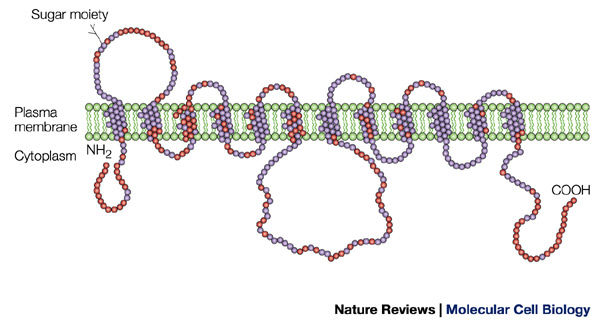
GLUT transporter structure
- Highly hydrophobic side chains, polypeptide clustering
- Some groups glycosylated = addition of sugar
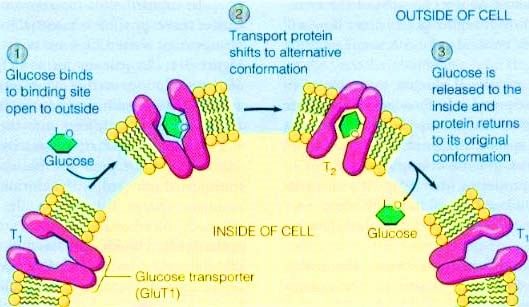
- Glucose transport into the cytoplasm
- Conformational change allows glucose to be released into cytoplasm
- Conformational change = change of shape of macromolecule, often induced by environmental factors. - macromolecules are often flexible and dynamic.
- Conformational change allows glucose to be released into cytoplasm
The GLUT family members
- GLUT1 - most cells, inc. RBCs. Intermediate Km.
- Ubiquitous = found everywhere
- GLUT2 - liver and pancreatic B-cells. High Km
- GLUT3 - mainly brain. Low Km.
- GLUT4- Primarily muscle and adipose - intermediate Km. INSULIN SENSITIVE
- Found intracellularly in presence of insulin
- Low Km = high enzyme affinity = less substrate required for enzyme to be active at maximum rate. High Km = requires more substrate for enzyme to be maximumly active.
- GLUT5- fructose transporter- primarily found in intestine and kidney
- GLUT1 - most cells, inc. RBCs. Intermediate Km.
Overview of glycolysis
- Glucose is oxidised through the pathway of glycolysis to form 2 pyruvate molecules
- glucose (C6H12O6) + 2NAD+ + 2ADP +Pi --> 2pyruvate (C3H4O3) + 2NADH + 2H+ +2ATP +2H20
- small net ATP gain for each molecule of glucose oxidised
- Cytostolic pathway occuring in all cells
- cytostolic = occurs in the cytoplasm
- Unusually, it can occur aerobically and anaerobically
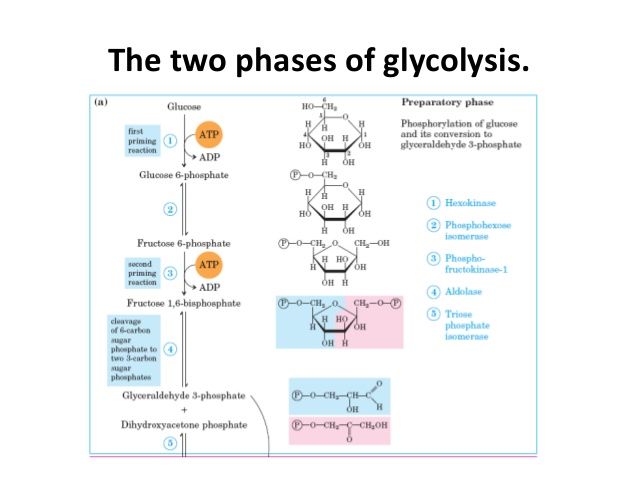
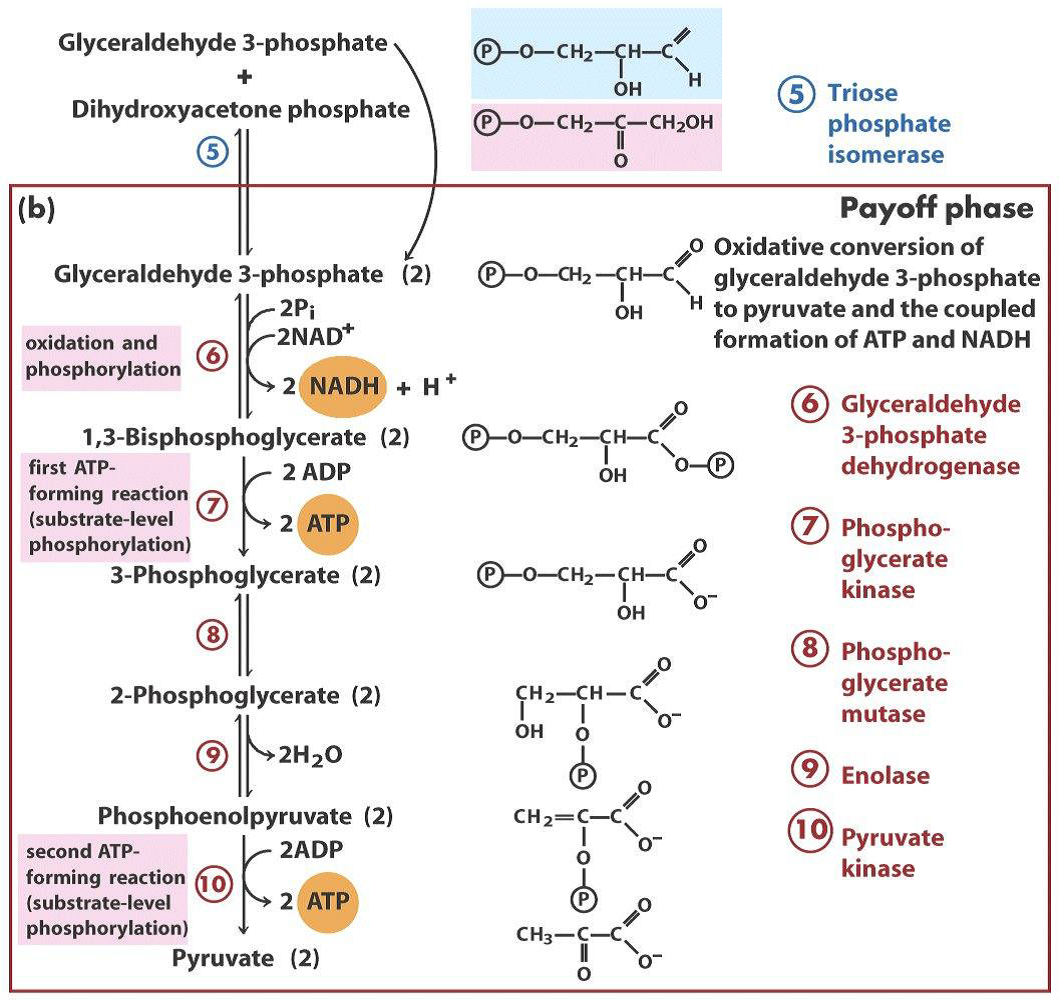
- 10 enzyme catalysed steps which can be split into two phases - PREPARATORY phase and PAYOFF phase
- Glucose is oxidised through the pathway of glycolysis to form 2 pyruvate molecules
Control of glycolysis
- Glycolysis has 3 key rate limiting steps - control flux through the pathway
- HEXOKINASE, PHOSPHOFRUCTOKINASE, PYRUVATE KINASE
- control the 3 R.L steps - allow rate of glycolysis determined by ATP demand of cells
- Catalyse exorgenic reactions which are essentially irreversible
- Reactions involved have -ve G.
Control 1: Hexokinase
- glucose + ATP --> glucose 6P + ADP
- HK relatively high affinity for glucose, inhibited by the reaction product G-6-P
- acts as a non-competetive inhibitor
- Allosteric regulation, -ve feedback inhibition
- HK gene expression subject to regulation by hormones
- LIVER and PANCREATIC B CELLS contain isoenzyme glucokinase GK, lower glucose affinity for glucose than HK.
- GK regulated differently, not subject to product inhibition
- GK only catalyses glucose phophorylation when [glucose]blood is high
Control 2: Phosphofructokinase-1
- Fructose-6-P + ATP --> fructose-1,6-BP +ADP
- PFK-1 subject to complex regulation, allows glycolysis to respond to energy status
- Glycolysis slows when ATP demand drops and ATP high in cell. vice versa
- Fructose 2,6-BP important activator of PFK-1 (allosteric activator)
- Citrate and H+ inhibit enzyme - build up during anaerobic respiration
- PFK-1 gene expression regulated by INSULIN (activated) and GLUCAGON (inhibits) - long term regulation, opposing effects
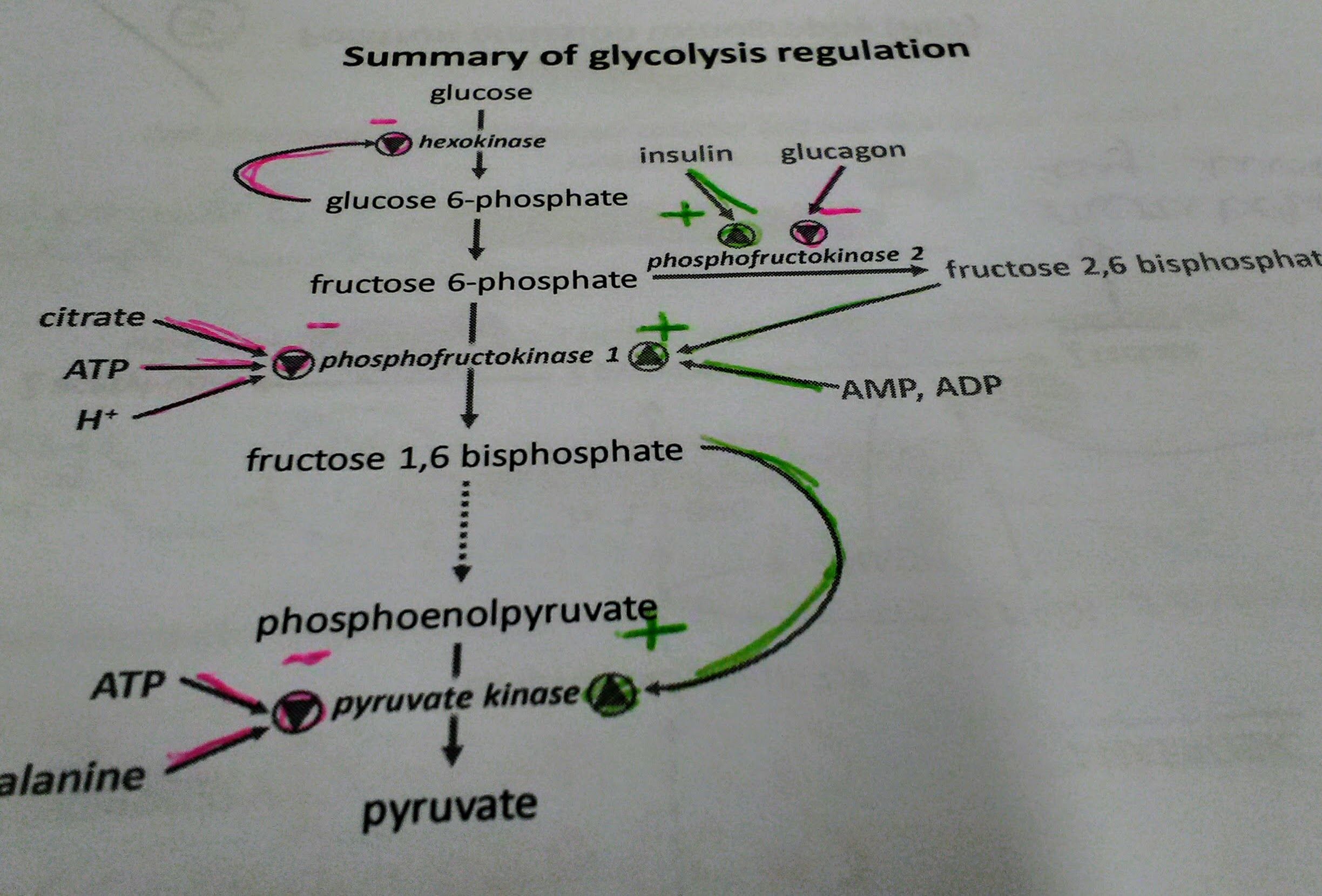
Summary of glycolysis regulation
- glc-6-p allosterically inhibits hexokinase
- Insulin activates pfk-2 while glucagon inhibits pfk-2
- F-2,6-BP and AMP,ADP activate PFK1, while citrate, ATP and H+ inhibit PFK-1
- F-1,6-BP activates PK, while ATP and alanine inhibit PK
- F-2,6-BP and AMP,ADP activate PFK1, while citrate, ATP and H+ inhibit PFK-1
- Insulin activates pfk-2 while glucagon inhibits pfk-2
- glc-6-p allosterically inhibits hexokinase
Control 3: Pyruvate kinase
- PEP + ADP --> pyruvate + ATP
- PK catalyses final reaction in glycolysis and produces ATP by substrate level phophorylation
- PK allosterically inhibited by ATP and alanine
- PK allosterically activated by F-1,6-P2 - feed forward activation, ensures intermediates of glycolysis do not accumulate.
- PK regulated by phosphorylation in response to hormones
- GLUCAGON PHOSPHORYLATES - inhibit
- INSULIN DEPHOSPHORYLATES - activate
- PK deficiencies in RBCs cause haemolytic anaemia
- see practicals
Pathways that link with glycolysis
- Glycogen --> glucose 1-P --> glucose 6-P
- Glucose 6P --> pentose phosphate pathway (PPP)
- produces large amount of cofactor NADPH as well as other sugars
- 1,3-BPG --> 2,3-BPG
- 2,3-BPG regulates O2 binding affinty of haemoglobin, Hb
Aerobic v anaerobic glycolysis
- Anaerobic - pyruvate converted to LACTATE to generate NAD+ so glycolysis can continue
- using LACTATE DEHYDROGENASE enzyme
- lactate metabolised by liver
- NADH builds up if not oxidised by mitochondria in oxidative phosphorylation
- Aerobic - pyruvate converted to acetyl-coA using PYRUVATE DEHYDROGENASE
- Anaerobic - pyruvate converted to LACTATE to generate NAD+ so glycolysis can continue
The importance of anaerobic glycolysis
- Anerobic glycolysis important in:
- RBCs - do not contain mitochondria
- RBCs are entirely reliant on glycolysis
- Anaerobically respiring muscle - intense exercise
- Tumour cells - O2 low in centre
- Hypoxic conditions
- RBCs - do not contain mitochondria
- Generates 2ATP per glucose, lactate must be removed to prevent ACIDOSIS
- Lactate transported out of cell and metabolised by LIVER
- Anerobic glycolysis important in:
Images and files in the map
Information
- Description
- AHS1. Cardiorespiratory. Biochemistry. Cellular respiration 2
- Created by
- Florence Papworth
- Views
- 8
- Rating