
Notes
Pre-clinical development
Content of the notes (7)
Page 1
Drug discovery
i) What is drug discovery?
Creating new compounds from scratch or isolating them from natural sources...
...testing them in vitro - then on animal models...
...determine their efficacy & safety...
...before advancing them on to clinical trials for human testing!
Drug discovery combines the fields of synthetic & natural product chemistry
ii) Why do we need new drugs?
Unmet medical needs
Tackle new diseases - i.e. AIDS, obesity, CJD
Improve on low efficacy rates - dementia & cancer drugs
Filter out unwanted/harmful side-effects - antidepressants, antipsychotics
Overcome drug resistance - antibiotics
Treat diseases earlier so downstream costs for treatment/disease management are lower - Alzheimer's, spinal injuries
Cost of therapy - interleukins used in HIV therapy
Social costs to individuals/countries - Depression
Create employment
Page 2
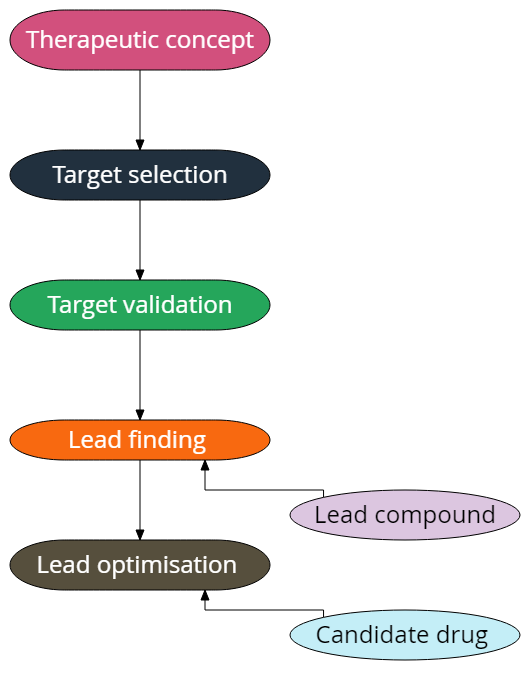
Steps in drug discovery
Page 3
Therapeutic concept
Firstly, we define a particular disease with a therapeutic need to be met
Examples might include:
Alzheimer's disease - improve cognition
Schizophrenia - reduce frequency or severity of psychotic episodes
HIV - prevent virus from inflitrating cells
Therapeutic concept = Identification of a biochemical, cellular or pathophysiological mechanism in a disease
Look at the various levels & stages of our chosen disease to see where the problem/s are occuring
Examples:
Relationship of a gene mutation with pathology of disease
How bacteria/virus/fungus infiltrates cell & destroys it
Identifying why the immune system is attacking certain cells/organs
Target selection
Particular molecular target is selected & validated
Hone in on specific action we want drug to have
Example:
Enzyme inhibitors
Target DNA
Receptor agonists & antagonists
Page 4
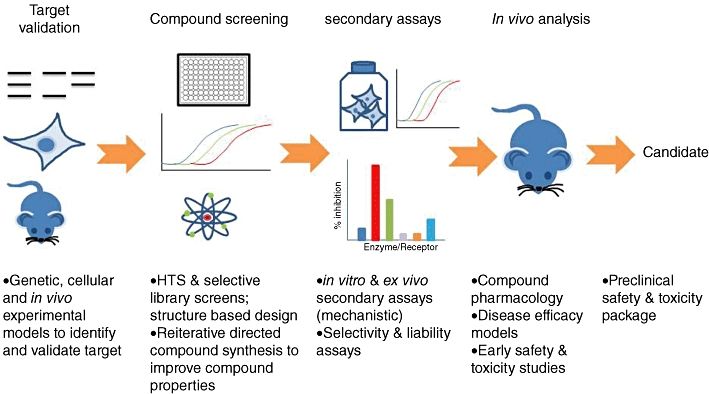
Target validation
i) High throughput screening
Used to filter millions of potential compounds into a few hundred
'Hits' are identified through their activity with a particular assay - show specific effects
'Artefacts' are the remaining few hundred drugs - show no specific effects
Use 2 different mechanisms:
Biochemical assays:
Assess protein-protein interactions
Provide info on nature of molecular interactions (binding affinity, regions of protein interactions & kinetics)
Cannot determine cellular impact - only structure & target (region & site)
Cell-based assays:
Based on iPS culture
Measure features such as:
Growth
Cell metabolism changes
Morphology
Changes in 2nd messenger activity
CBAs can distinguish agonists & antagonists - biochem cannot
ii) Structure activity relationships (SAR)
Relationship between chemical structure of a molecule & its biological activity
Useful substructures within the lead series are defined & maintained....
...whilst other structural features that have no defined purpose are varied/changed
Medicinal chemists use chemical synthesis - insert new chemical groups into the compound & test their biological effects
iii) Rational drug design
Uses natural endogenous mediator as lead compound & makes modifications (the biological macromolecule implicated in disease pathology acts as a starting point)
Based on the idea that modulation of a specific biological target may have therapeutic value
Alternative to blindly testing hundreds of molecules to see if one or more will bind to cellular/molecular targets
Difficult start point - they're usually too polar & have v high Mr
Chemists must:
Reduce Mr
Reduce number of polar OH groups
Eliminate chiral centres
'Me-too' drugs = use pre-existing drugs as a chemical start point
Need to make sig. improvements on 'parent' drug (due to patency issues) - needs to have better absorption, pharmacokinetics or receptor affinity
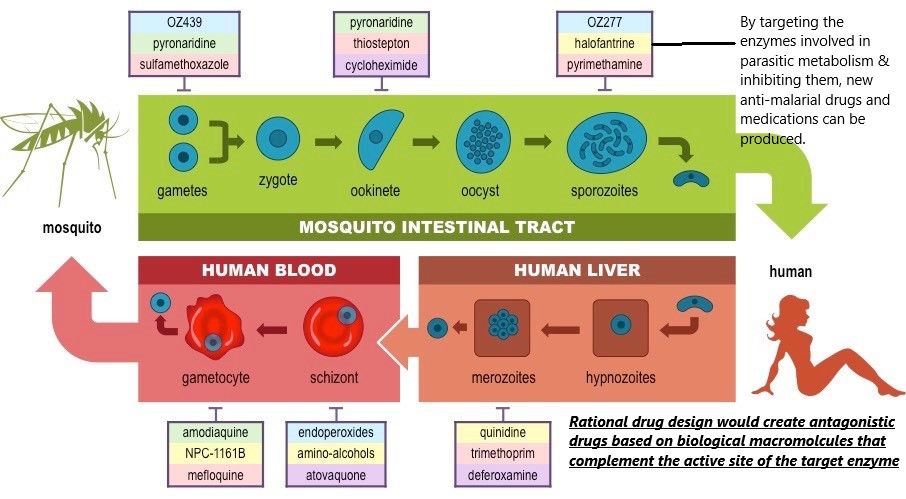
iv) Structure based design
Historically used to make enzyme inhibitors
Carried out in 5 steps:
X-ray crystal structure of target in its biologically active form is found
Ligand is co-crystallised with target protein
Ligand analysed to find its binding domain
Biological relevance of interactions confirmed by site-directed mutagenesis (changing DNA sequence of gene)
Ligand is continually redesigned to optimise interactions
SARS, Rational drug design & Structure-based design eliminate futher artefacts
Reduce potential drug list from hundreds down to approx 10 - 'Lead series'
Page 5
Lead finding
Drug metabolism/pharmacokinetic & toxicological properties of remaining potential drugs examined - DMPK & toxcitiy ipS assays
~3 drugs remain in 'lead series'
Liver activity assays
Liver microsome/hepatocyte survival after drug exposure recorded - drug conc. & effects also noted
Lots of SAR info collected
Activity CYP450 enzymes assayed to predict drug interactions (allow us predict how drug will interact with P450 enzymes - multiple drug interactions!!)
Intestinal absorption assays
Drug permeability through Caco-2 cells (Intestinal epithelial cells)
Drug applied apical side cell - conc. measured on basolateral side
Determines absorption & bioavailability
BBB absorption assays
in-vitro assays using brain endothelial cells
Drug applied blood-facing side of cells - measured on brain side
Compound profiling = Drug properties (pharmacoK, toxicity, metab) discovered in target validation & lead finding phase are compiled & catalogued - Other researchers can know properties of specific compounds without needing to re-use assays
Page 6
Lead optimisation
Drug optimisation = key!
Want to improve affinity, selectivity & DMPK parameters (plasma 1/2 life, oral bioavailability etc) of leads
Want to maintain physiocochemical properties - esp. aqueous solubility
Want to make the drug pharmaceutically 'easy-to-make' - intrinsic solubility (solubility @ pH where drug is un-ionised), dissolution rate & stability (want to have long shelf-life, no demand for V specific storage environment)
Pharmacists may carry out more tests in:
Permability
Receptor-specificity,
CYP450 inhibition/activation
Genotoxicity
Page 7
Animal testing
i) Animal models
Why do we need to use animal models in pre-clinical drug development?
Many human diseases involve interactions between multiple organs & tissues
These interactions cannot be fully understood through sole use of cell & molecular biological assays
Animal models allow researchers to view the physiological impact of a drug - not just its cellular/biochemical
Animal screening = expensive
Occurs after extensive in-vitro studies
Main aim of animal testing = Evaluation therapeutic index
Ideal animal model:
Produces valid results
Displays selectivity
Predictable (Oncology & CNS diseases are most unpredictable in animal models - researchers prefer use of iPs (induced pluripotent stem cells) derived from patients with onco/CNS genetic disease)
Reproducible results
ii) Pharmacokinetics
Rat, dog, pig or primate models
Establishing ADME characteristics (See Pharmacokinetics lectures :)
Bioavailabilty
Tissue distribution
Active metabolite formation
Elimination test compound
Tests typically last less than 48hrs
Also used to establish appropriate administration methods (oral, bolus, intraperitoneal)
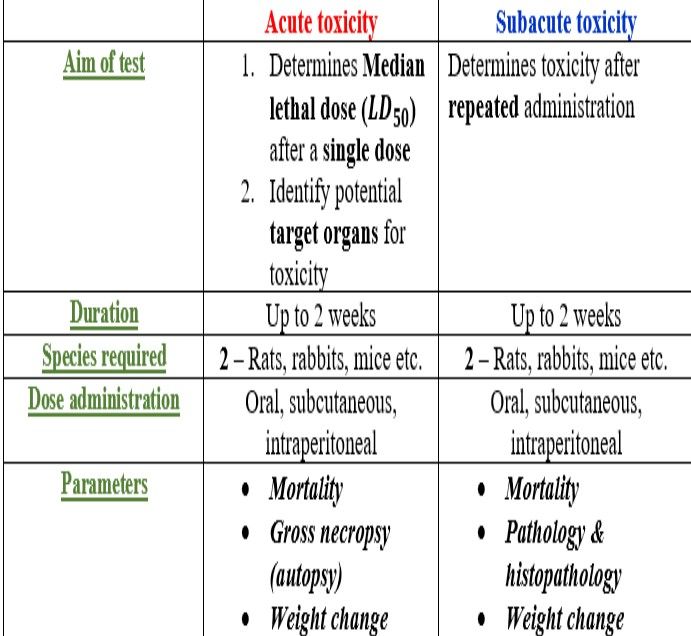
iii) Toxicity
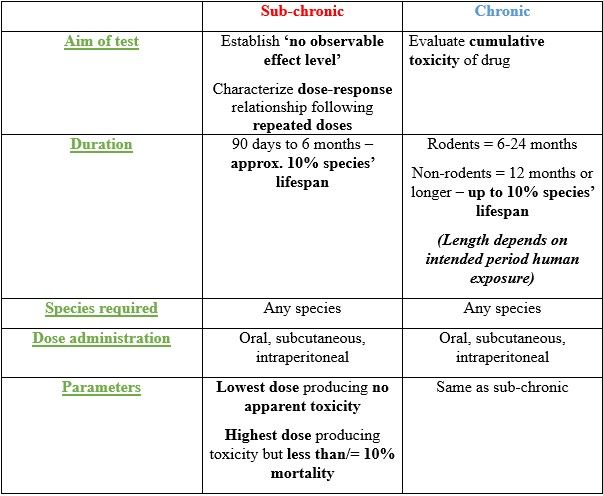
Acute vs subacute toxicity
Chronic vs subchronic toxicity
Reproductive toxicity
Reproductive toxicity
Determine potential adverse effects of drugs on:
Gametogenesis
Foetal organogenesis
Parturition
Lactation
Neonatal survival
Vitality of newborn
Carried out in rodents & rabbits
Divided into 3 segments:
Segment I (pre-conception):
Treatment during gametogenesis
Females = 60 days
Males = 15 days
Segment II (pre-implantation):
Treatment during gestation
Rodents = day 6-15
Rabbits = day 6-18
Segment III (perinatal to postnatal):
Treatment through at least 15 days of gestation
Plus 21 days lactation
Information
- Description
- Pharmacology (Clinical development ) Note on Pre-clinical development , created by Niamh McLoughlin on 05/11/2017.
- Created by
- Niamh McLoughlin
- Views
- 94
- Rating