
Notes
Function of major bacterial components
Content of the notes (1)
Page 1
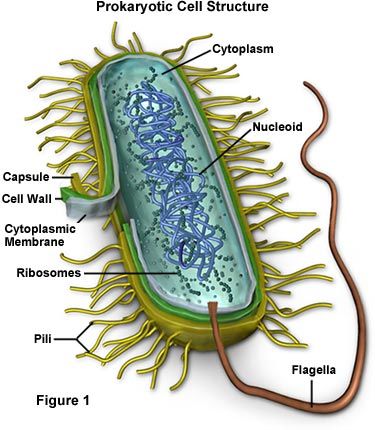
Capsule: not present on all, when it is they compete.
Protect against drying out so that they can survive outside the body for long periods of time.
Reduces phagocytosis as it hides the organism from the immune system (not optimized/tagged).
Allows attachment to surfaces.
A biofilm is a collection of microorganisms stuck together, this leads to persistence and resistance.
Flagella (flagellum): can be up to 3/4x cell size they give the cell MOTILITY as it has the ability to swim and move, ATP causes the spinning of the flagellum anticlockwise or clockwise which in turn change if the bacteria goes fowrard or backward..
Monotrichous: single polar flagellum
Lophotrichous: two or more at one/both ends
Amphitrichous: single polar flagellum at each end
Peritrichous: distributed over entire cell eg. flagella bundled at one end (anticlockwise rotation). flagella are all pushed apart by clockwise rotation disorientating the cell allowing it to change direction.
CHEMOTAXIS allow the microorganism to move towards things they like and away from things that are disliked by using concentration gradient.
FImbrae: are hook like structure that allow early attachment
Pili: join two bacterial cells together during conjugation (DNA tranfer)
Cell Wall: a complexed semi rigid structure surronding the cell membrane that prevents the membrane rupturing by osmosis.
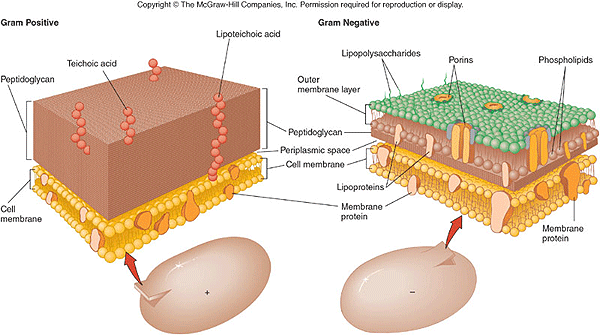
Gram Positive: has lots of peptidogycan layers that allow molecules to enter easily. The peoptidoglycan is made of N-acetyglucosamine(NAG) and N-acetylmuramic acid (NAM) cross linked by peptide side chains.
Gram Negative: a single layer of peptidoglycan that is inbetween two membranes. Proteins allow passage of molecules. Lipopolysaccarides (LPS) form O antigen
Cytoplasmic membrane: a lipid bilayer with a polar head and non polar tail that encloses the cytoplasm of the cell. It has protein channel to allow molecules through.
Cytoplasm: internal matrix of the cell ~80% water with proteins, lipids, DNA, ribosomes and inclusion bodies.
Bacterial Genome:
Single circular chromosome with no envelope.
Plasmids are circular DNA with none essential genes within the cytplasm able to reproduce themselves and transfer to other cells, this speads antibiotic resistance and causes super bugs.
TRANSFORMATIOM - gain a plasmid, CONJUGATIOM - copy and exchange plasmid, TRANSDUCTION - transferred via a virus.
Bacterial Endospores: not all bacteria generally only gram positive bacteria (clostridium and bacillus). 1 spore is one vegetative cells
Persistant and highly resistant
Formed inside then released either at one end (terminally), near one end (subterminally) or centrally
SPORULATION is where the cell packages up its essential DNA at one end of the cell and surrounds it in a plasma membrane and then a spore coat forms. The rest of the cell then dies away freeing the spore.
GERMINATION is the opposite of sporulation. When the optimum conditions are present swelling occurs and the vegetative cell becomes active.
Ribosomes: they are for protein synthesis
In bacteria 2 subunits 30s and 50s = 70s
In eukaryotes 80s
Inclusion bodies: reserve deposits in the short term.
Phosphate stored as volutin.
Glycogen is stored as polysaccharide.
Toxins
Exotoxins are produced inside the bacteria then released, they are specific, blood soluble and know where they are going. This is mainly done by gram positive bacteria with a quick onset of symptoms. eg. Clostridium botulinum which inhibits release of acetylcholine and Clostridium tetani which inhibits removal of acetylcholine.
Endotoxins are part of the gram negative bacteria cell wall. The symptoms are the same regardless of the species.
Information
- Description
- University Microbiology Note on Function of major bacterial components, created by Beckie Thorne on 17/04/2015.
- Created by
- Beckie Thorne · Apr 2015
- Updated
- Feb 19, 2016
- Views
- 1
- Rating