
Notes
World War II Notebook
Content of the notes (8)
Page 1
Day 1 - Stalin's Soviet Union
Stalin's Soviet Union
launched five-year plan to transform Soviet society along socialist lines
From Lenin to Stalin
Lenin & Bolsheviks face economic disintegration, famine, riots, rebellion
New Economic Policy - reestablish economic freedom & rebuild agriculture & industry
could sell surplus in free markets; railroads, banks, and heavy industry nationalized
compromise with peasants, but brought rapid recovery to industry & economy
power struggle after Lenin's death; Stalin won more support over Trotsky
The Five-Year Plans
goal: industry up 250%, agriculture 150%, frenzy to modernize
Stalin committed to socialism & want to catch up to capitalists
peasants wanted land, thought they would become capitalists
collectivize by creating state-controlled estates from individual peasant farms
better-off peasants (kulaks) stripped of land, starved or in labor camps
slaughter animals & burn crops in protest; not productive & no financial contribution
wanted to destroy Ukrainian nationalism & break peasants' will
purge political elite, high grain quota; great famine (Holodomor)
industry up 4x, many migrated to cities to become industrial workers
funds for factories collected by hidden sales taxes; labor discipline, no trade unions
foreign engineers (Americans) hired to plan factories; modeled on America's
Life and Culture in Soviet Society
reduced consumption, shortages, housing problems
received pensions, medical services & education, day-care, no unemployment
leave egalitarian policies, trained experts needed for industrialization, upper class
Bolshevik Revolution gave women equal rights - Stalin wanted traditional family
women work in farms & factories, became specialists; propaganda & indoctrination culture
Stalinist Terror and the Great Purges
Sergei Kirov killed, launch reign of terror; Old Bolsheviks confess in show trials
arrest & torture party officials & new members, & ordinary citizens
executed or sent to gulags (labor camps) to fuel industrialization
new Communist Party members join seeking opportunities & rewards
Richard Pipes on Communism
revolution needed enemies
Kirov's murder eliminate potential rival & allow campaign to eliminate Lenin's top people
terror & interrogation make wish for death, confess to false crimes
citizens brought before troikas (regional party secretary, procurator, police chief)
sentenced to death, hard labor, or exile, fulfill quotas
many of higher education; more likely to conspire
forced to report subversive activity
nomenklatura class monopolize authority, unique privileges, hereditary
humans travesty of what they could, should, and had to become; could be killed
destroy free speech; close non-Bolshevik press, censorship bureau (Glavlit)
not until 1930s told authors what to write; no travel abroad/foreign publications
Socialist Realism; social ethics decline
deification of Stalin, fear assassins, watch films
Cheka - GPU & OGPU - NKVD - KGB main source of terror
Class Notes
capital now at Moscow
now called the USSR
lost land became Finland
Lenin dies - Trotsky has credit, but Stalin becomes chairman, exile Trotsky
Trotsky has affair in Mexico, assassinated in Mexico 2nd attempt
5 year plans - 250% industry, 150% agriculture
goal to modernize, doesn't care about death, nobody is safe
no progressive ideas, methods are conservative, goals are radical
advancing nation with brutal methods
collectivization - peasants destroy fields and animals for no benefit
Stalin sets conditions for famine
move farmers in country to factories
targets Kulaks, Ukraine wants independence
blockades Ukraine to starve them, biggest country in Europe
soviet propaganda about future, not past; leader omnipotent
race doesn't matter in communism, cult of the leader
too good a job in nomenklatura, gets killed
exile in Siberia, hard, pointless labor
Women had better opportunities under Stalin
Page 2
Day 2 - The Rising Sun: Japan Before WWII
From Liberalism to Ultranationalism in Japan
most of Japan Japanese; build nationalistic, modern state, resisting imperialism
master technology, victory against Russia and China, took German holdings
economy expands as profits won markets Europe couldn't supply
nationalists want to enlighten and protect Asia; some want peacefully
naval limitation with West, give Shandong to China, reducing tensions
democracy; men > 25 years could vote; 2 party competition, increased living standards & literacy rates
few natural resources, vulnerable to ups and downs of world trade, support colonial empire
colonies for prestige & defense; now needed for resources & economic growth
zaibatsu in economy, dominated sector of unorganized farmers & peasants
financial oligarchy, corrupt government officials, weak middle class
elites (emperor, government officials, businessmen, military leaders), power struggle; ultranationalism
ultranationalism: reject West (democracy, big business, Marxism), destroy old Japan
stress emperor's divinity & samurai code of honor
assassinate moderate leaders & armed uprisings against party politics
foreign expansion, Kita Ikki, believed in "noble mission"
Great Depression: exports & wages down, unemployment up, peasants starve
Japan Against China
young Japanese army officers in Manchuria from peasantry, army budget declined
Chinese nationalism (Guomindang unification) challenge Japanese control, use aggression
Japan made Manchuria an independent state, use Puyi (Qing) as puppet emperor
resign from League of Nation to protest disapproval of aggression, army independent
try to create economic bloc for industry in East Asia; news glorify empire
for China, distract from modernization, boycott social reform, land reform & poverty
unequal landownership, many own 1/6 land, starved & in debt
nationalists with Jiang Jieshi try to destroy Communists, who retreated in Long March
Mao Zedong rebuilt forces & won peasant support - (no pillage/rape, schools, health clinics, help peasants with agriculture, tried warlords & landlords
Japan military & ultranationalists in control, general attack
took Beijing & Shanghai, "Rape of Nanjing", in stalemate
called the Second Sino-Japanese War - conflicting nationalism
Class Notes
Greater East Asia Co-Prosperity Sphere
White Man's Burden
need food and resources, seize Manchuria, fuel industry
WWII starts in 1937 in Asia
Page 3
Day 3 - Hitler and Nazism in Germany
Hitler and Nazism in Germany
The Roots of Nazism
Nazism grew from extreme nationalism & racism, led by Adolf Hitler
son of Austrian customs officer, join extreme Austro-German nationalists
found racism, anti-Semitism & hate Slavs - Social Darwinism, racial conflict inevitable
Jews direct finance capitalism, Marxist socialism, against German unity/race
WWI gain meaning - blamed Jews & Marxists for surrender
joined German Workers' Party - socialism would abolish capitalism - Nazi Party
Weimar Republic hyperinflation, von Hindenburg became president, Hitler's unsuccessful coup
Hitler's Road to Power
denounce Weimar Republic, need legal power; Mein Kampf - anti-semitic, expansion, Fuhrer dictator
built Nazis during stability, promise salvation during Depression, gain success
reject free-market capitalism, advocate recovery - middle & lower classes & skilled workers
many desert conservative & moderate for Nazis - become largest party
appeal to German youth, national recovery, exciting change, & personal advancement appeal
Depression made republican leaders look corrupt, Communists didn't unite with Social Democrats
gain business & army support, thinking he would help them; von Hindenburg appoint chancellor
The Nazi State and Society
blamed Communists for Reichstag building fire, made president abolish liberties & new elections
Nazis lost election, outlaw Communists & arrest, sign Enabling Act, giving Hitler 4 years dictatorship
Nazis top in government, outlaw strikes & unions, independent organizations to Nazis, publishers & schools controlled by Nazis, no modern art/architecture; dynamism & total obedience
SS (elite personal guard) kill Nazi storm troopers, army surrender, Himmler & SS take over police
Jews banned from work, Nuremberg laws take citizenship, many emigrate
Kristallnacht - destruction of Jewish buildings, difficult for Jews to leave after
Hitler's Popularity
public works, rearmament, standard of living up, employment up, profits up
except Jews, Slavs, Gypsies, Jehovah's Witnesses, communists, and gays, more equality & opportunity
relaxed educational requirements, tolerate privilege and wealth
well-educated retain advantages (social leveling), hire women during labor shortages
Communists & socialists, Catholics & Protestants, & army officers oppose
Class Notes
Beer Hall Putsch (1923)
Reichstag Fire (Feb 1933) - dictators need a crisis - blame the communists
Enabling Act passed - dictatorial power
Night of Long Knives - first purge
liked WWI - Austrian, good soldier
returns to Vienna, meets Austro-German nationalists - monarchy & aristocracy in capital, Slavs, Jews, Communists, and capitalists - hate everyone but the nationalists
goes to Germany, try to seize power at Beer Hall Putsch
Nazis had 12 seats at Reichstag 1930
1932 - 39% of seats/vote, biggest party, not majority
named Chancellor
Hitler uses the system legally
purge the SA - Nazi army (Brownshirts, 400,000) biggest army
top thousand brownshirts purged by brownshirts (can't invade, only thugs)
race & living space (Empire)
allows to get the Reichswahr, better trained army, on his side
economic depression, government cannot stop dictator
Hitler's Nazi Party - militaristic
Page 4
Day 4 - Hitler and Nazism in Germany, Round 2
Aggression and Appeasement, 1933 - 1939
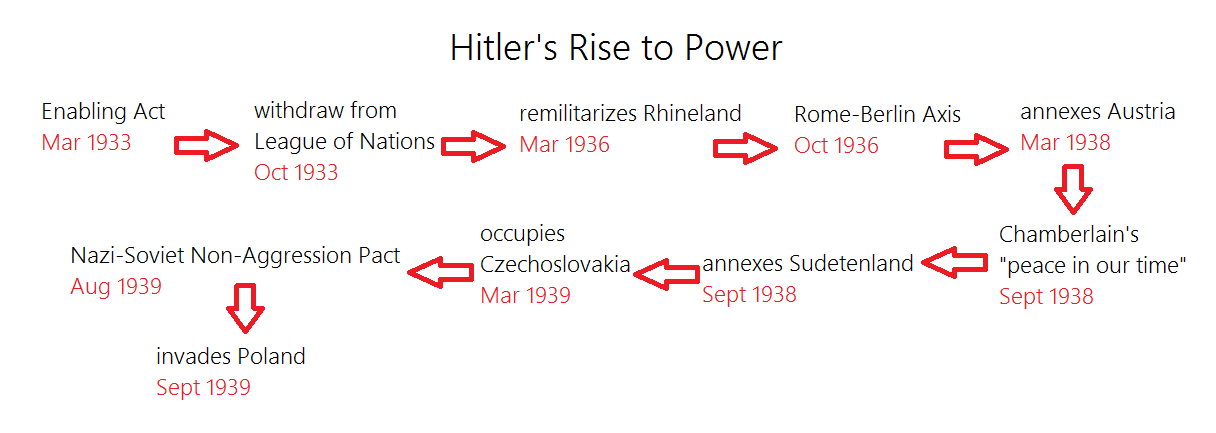
Treaty of Versailles limit German army to 100,000 - withdraw from League of Nations
military draft, France, Britain, & Italy protest his actions
Britain appease to avoid war - underestimate Hitler, worried about Soviet Communism
Churchill disliked appeasement, but not prepared in France or Britain for war
Hitler invaded Rhineland; Britain refused intervention, France couldn't act without
Mussolini attacked Ethiopia, Italy join Germany in Rome-Berlin Axis
Japan join for support in Manchuria
Germany & Italy help Fascist Franco in Spanish Civil War
Republican Spain only helped by Soviet Union
Hitler threaten Austrian chancellor, Austria became part of Germany
target Sudetenland, Czechoslovakia try defense, Chamberlain ceded to them
no self-determination, use Czechs and Slovaks as captives
refer to Slavs as Untermenschen (inferior), sign non-aggression pact
Stalin distrust West, need time for industry & military, was offered territory
Germans attack Poland, Britain & France declare war on Germany
capitalism - liberal, democratic
socialism - control large industries
communism - government complete control
fascism - 1 leader, worship dictator (Nazi)
Democratic
- free speech
- private ownership
- upper class appeal
Communist
- guarantee jobs
- run by workers
- lower class appeal
Fascist
- union benefits
- effects of Treaty & Depression
- nationalism
- mixed class appeal
Class Notes
annex Austria, Britain and France allow Germany, self-determination
wants land
with Stalin, promise to divide Eastern Europe
Blitzkreig - 1939 Poland, Oct 1939 - Mar 1940 - Phony War
Maginot Line - fortifications at border, Germans went through less fortified Belgium - useless
Hitler invades France; falls in 6 weeks
Luftwaffe - German air force to take Britain, no land invasions
Operation Barbarossa - take Soviet Union, largest invasion 1800 mi, 3 million men - huge gains
Page 5
Day 5 - Japan: Empire in the Pacific
Japan's Asian Empire
crush peasant Nationalists & Communists - Rape of Nanjing, Sino-Japanese War
ultranationalists call liberation mission, worship semidivine emperor
join Axis alliance, Vichy gave French Indochina to block aid for China
U.S. supply 90% of oil, few reserves; embargo to Japan, declare war
Pearl Harbor - sank American battleships (aircraft carriers at sea), destroy air force in Philippines
Hitler declare war, Japan seize islands, Philippines
support for Japan decline through war; no equal, no governments, cut wages, drafts
kill wounded and POWs, rape nurses, Korean comfort women
Page 6
Day 6 - The War in Europe and Asia
The Second World War, 1939 - 1945
Britain, US, & Soviet Union form Grand Alliance
Hitler's Empire in Europe, 1939 - 1945
Hitler's Blitzkrieg (lightning war) take Poland quickly
Soviet Union took east Poland, Lithuania, Estonia, & Latvia
Germans attack France through Belgium; Petain form Vichy, surrender
French support Petain, but then he collaborated with the Nazis
Battle of Britain - bomb with airforce before invading on land
broke Soviet pact - take Leningrad/Moscow, winter stopped invasion
racial imperialism dictate New Order: Dutch/Norway/Swede/Dane, French, Jews/Slavs
hoped Poles, Ukrainians & Russians would die, more room for Germans
The Holocaust
force Jews into ghettos, German sent to Poland - arrest, camps, murder
Catholics & Protestants rarely protest, most Germans sympathetic to Nazis
The Grand Alliance
Churchill's Europe First Policy - Hitler, then Japan, no treaties/division; best military
The War in Europe, 1942 - 1945
Hitler defeated at Stalingrad, pushed back; Germany enlist women & slaves
Allies attack through North Africa, British defeat at Battle of El Alamein
Italians depose Mussolini, surrender; Germans save Mussolini for puppet government
Germans surrender in Italy; Mussolini executed soon after
Eisenhower (American & British) at Normandy, France, invade Germany; Soviets met at Elbe River
The War in the Pacific, 1942 - 1945
America defend Port Moseby in Battle of the Coral Sea, won Battle of Midway for naval equality
island hopping with Australia; bombing & hand to hand combat
kill Japanese after Battle of Guadalcanal mercilessly
MacArthur at Battle of Leyte Gulf, Japanese navy down
Iwo Jima & Okinawa, bloodiest battles; destroyed by bombings
Stalin gave Japan hope of diplomacy; plan to seize territories
Potsdam Declaration demand surrender, unclear of emperor's safety
atomic bombs, Soviet invade Manchukuo, avoid both by surrendering
Nazism
1. Fascism
- authoritarian rule
- ultranationalism
- empire
2. race & living space
- Austria and Sudetenland } German nationalism
- Czechoslovakia and Poland } no German nationals
3. militarism
4. emphasizes continuity with past
5. hate communism
Japan agrees with all but 4 and 5
Luftwaffe - small German planes
Hitler doesn't dedicate industry as fully to war production
will can overcome - nationalism
doesn't need to suffer; wants consumer goods at home
Operation Barbarossa - invade Russia
Soviet Union would have defeated Germany without D-day
Eastern Theater was the most important
Stalin has the industrial capacity to make a comeback and the will to slaughter Russians
the difference between WWI and WWII is great leadership
Page 7
Day 7 - The Start of the Cold War
Goals of Hiroshima and Nagasaki:
force the surrender of Japan
establish America's supremacy in the world
boost America's authority in postwar dealings with Soviet Union
shock factor - psychologically force them to stop fighting
beat Soviet Union to it, because they could have taken Japan themselves
5/8/45 - VE Day
8/6/45 - Hiroshima
8/8/45 - OSSR (Manchuria) invasions
8/9/45 - Nagasaki
8/15/45 - VJ Day
8/8 - military generals in Japan voted on whether they should surrender; split vote
Czechoslovakia ruled by:
1914 - Austria Hugary
1919 - 1929 - independent
1940 - Germany
1950 - USSR
Poland ruled by:
1914 - Germany/Russia
1919 - 1929 - independent
1940 - Nazi Germany/Russia
1950 - USSR
Iron Curtain: border of Russian territory post-war
FDR - Federal Democratic Republic
GDR - German Democratic Republic
GDR is communist East Germany
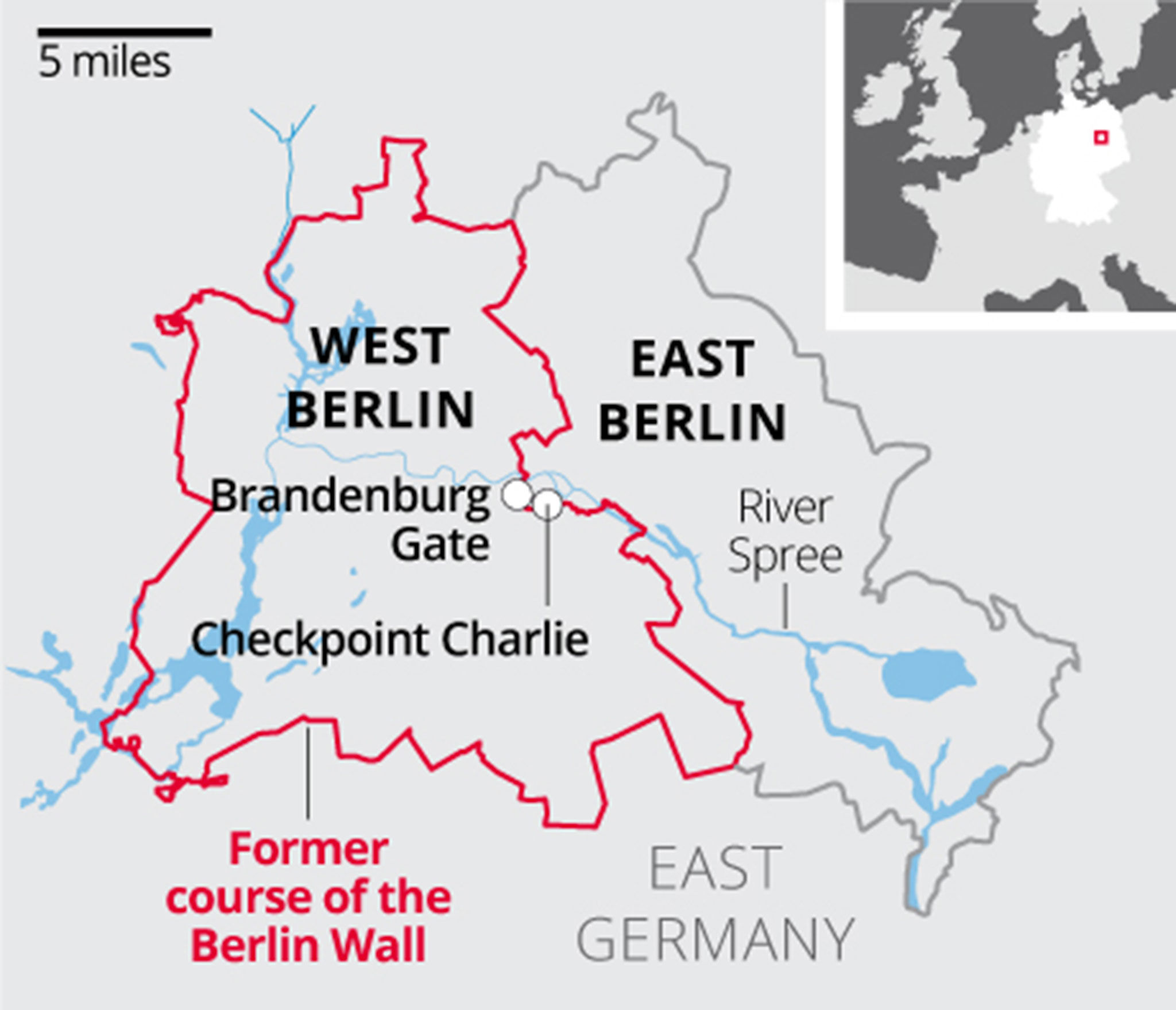
11% of East German population flees through West Berlin
Berlin Wall built around West Berlin, on East German soil
closes off the escape route
3 fences, serious about not letting them leave
Page 8
Day 8 - Cold War and the Berlin Wall
Berlin Wall
East German economy suffered as people left
collectivization
industry, sacrifice consumer goods for weaponry
thought control
Information
- Description
- Complete Archive of Homework and Class Notes
- Created by
- jenniferfish2014
- Views
- 870
- Rating