
Notes
Psychopathology
Content of the notes (6)
Page 1
Definitions of Abnormality
Statistical Deviation
This occurs when an individual has a less common characteristic, for example being more depressed or less intelligent than most of the population. Someone is considered 'abnormal' in their behavior if it is more than 2 standard deviation points away from the norm.
Deviation from Social Norms
This is behaviour that is different from the accepted standards of behaviour in a community or society. This definition however can change depending on the culture due to the fact that each culture or society will have a different idea about what is 'normal'.
Failure to Function adequately
This occurs when someone is unable to cope with ordinary demands of day-to-day living. This means they struggle with the simple functions of everyday living such as maintaining basic standards of nutrition and hygiene.
Deviation from Ideal Mental Health
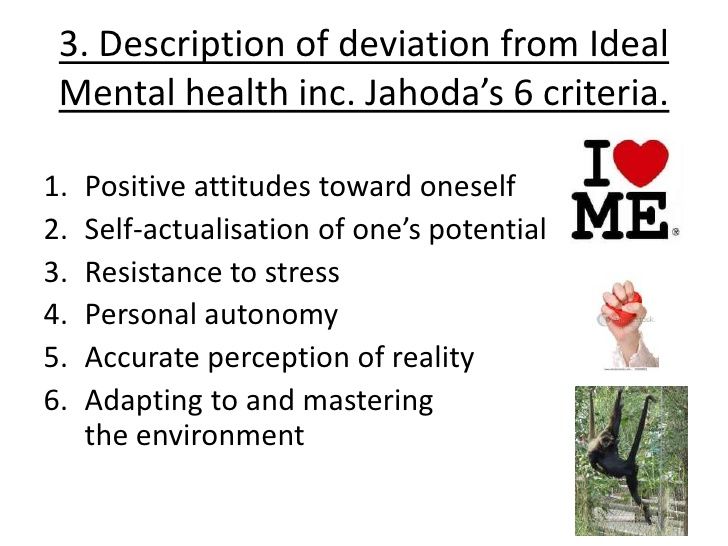
When someone does not meet a set criteria for good mental health. Marie Jahoda (1958) suggested that we are in good mental health if we meet the following criteria:
Page 2
Phobias
An irrational fear of an object or situation. The extent of the fear is out of proportion to any real danger presented by the phobic stimulus.
Behavioural Characteristics
Panic - A phobic person may panic in response to the presence of the phobic stimulus. Panic may involve a range of behaviours including crying, screaming or running away.
Avoidance - Unless the sufferer is making a conscious effort to face their fear they tend to go to a lot of effort to avoid coming into contact with the phobic stimulus. This can make it hard to go about daily life.
Endurance - The alternative to avoidance is endurance, in which a sufferer remains in the presence of the phobic stimulus but continues to experience high levels of anxiety. This may be unavoidable in some situations, for example having a phobia of flying.
Emotional Characteristics
Anxiety - Phobias are classed as anxiety disorders and by definition they involve an emotional response of anxiety or fear. Anxiety is an unpleasant state of high arousal and this prevents the sufferer from relaxing and makes it very difficult to experience any positive emotion. Anxiety can be long term.
Example: Arachnophobia - This is the fear of spiders. Someone who has arachnophobia will have increased anxiety levels whenever they enter a place associated with spiders. The anxiety is a general response to the situation. When they actually see a spider they may experience fear.
Emotional responses rare unreasonable - The emotional response we experience in relation to phobic stimuli go beyond what are reasonable. They are disproportional to the threat that is presented by the phobic stimulus.
Cognitive Characteristics
Selective attention to the phobic stimulus - If a sufferer can see the phobic stimulus it is hard to look away from it. Keeping out attention on something really dangerous is a good thing as it gives us the best chance of reacting quickly to a threat, but this is not so useful when the fear is irrational.
Irrational Beliefs - A phobic may hold irrational beliefs in relation to the phobic stimuli.
Cognitive Distortions - The phobic's perceptions of the phobic stimulus may be distorted. so, for example someone with arachnophobia is likely to see them as alien looking and aggressive.
Depression
Behavioural Characteristics
Activity Levels - Sufferers of depression have reduced levels of energy,making them lethargic. This has a knock on effect, with sufferers tending to withdraw from work, education and social life.
Disruption to sleep and eating behaviour - Sufferers may experience reduced sleep, premature walking, or an increased need for sleep. Also, eating may increase or decrease, leading to weight gain or weight loss.
Aggression and Self-harm - Sufferers of depression are often irritable, and in some cases they can become verbally or physically aggressive. This can have serious knock on effects on a number of aspects of their life.
Emotional Characteristics
Lowered Mood - A defining emotional element of depression but it is more pronounced than in the daily ind of experience of feeling lethargic and sad.
Anger - Sufferers of depression frequently experience anger, sometimes extreme anger. This can be directed at the self or others. This can also lead to behaviour such as self-harming.
Lowered self-esteem - Sufferers of depression tend to report low self-esteem, in other words they like themselves less than usual.
Cognitive Characteristics
Poor Concentration - Depression is associated with poor levels of concentration. The sufferer may find themselves unable to stick with a task they usually would, or they might find it hard to make decisions that they would normally find straightforward.
Attending to and dwelling on the negative - When suffering from depression the sufferer is more inclined to focus on the negative aspects of their life rather than the positives.
Absolutist Thinking - Most situations are not all good or bad, but when sufferer is depressed they tend to think of it in these terms. It is also referred to as 'black and white' thinking.
Page 3
Obsessive - Compulsive Disorder (OCD)
Behavioural
Compulsions - Compulsions are repetitive as they feel compelled to repeat a behaviour. They also reduce anxiety and around 10% of sufferers of OCD show compulsive behaviour and no obsessions.
Avoidance - The behaviour of OCD sufferers may also be characterised by their avoidance as they attempt to reduce anxiety by keeping away from situations that trigger it. Sufferers of OCD tend to try to manage their OCD by avoiding situations that trigger anxiety. However, this avoidance can lead people to avoid very ordinary situations.
Emotional Characteristics
Anxiety and Distress - OCD is regarded as a particularly unpleasant emotional experience because of the powerful anxiety that accompanies both obsessions and compulsions. Obsessive thoughts are unpleasant and frightening, and the anxiety that goes with these can be overwhelming. The urge to repeat a behaviour creates anxiety.
Accompanying Depression - OCD is often accompanied by depression, so anxiety can be accompanied by low mood and lack of enjoyment in activities.
Guilt and Disgust - As well as anxiety and depression, OCD sometimes involves other negative emotions such as irrational guilt, for example over minor moral issues, or disgust, which may be directed against something external like dirt or at the self.
Cognitive Characteristics
Obsessive Thoughts - For around 90% of OCD sufferers the major cognitive feature of their condition is obsessive thoughts. These vary considerably from person to person but are always unpleasant.
Cognitive Strategies to deal with obsessions - Obsessions are the major cognitive aspect of OCD, but people also respond by adopting coping strategies. For example, a religious person tormented by obsessive guilt may respond by praying or meditating. This may help manage anxiety but can make the person appear abnormal to others and can distract them from everyday tasks.
Insight into excessive anxiety - People suffering from OCD are aware that their obsessions and compulsions are not rational. In fact this is necessary for a diagnosis of OCD. If someone really believed their obsessive thoughts were based on reality that would be a symptom of a quite different mental disorder. However, in spite of this insight, OCD sufferers experience catastrophic thoughts about the worst case scenarios that might result if their anxieties were justified.
Behavioural Approach to explaining phobia
The Two-Process model
The behavioural approach emphasises the role of learning in the acquisition of behaviour. The approach focuses on behaviour - what we can see.
Hobart Mowrer (1960) proposed the two-process model based on the behavioural approach to phobias. This states that phobias ar acquired by Classical Conditioning and then continue because of operant conditioning.
Acquisition by classical conditioning - This involves learning to associate something of which we initially have no fear (neutral stimulus) with something that already triggers a fear response (unconditional stimulus). Watson and Raynor (1920) created a phobia in a 9 month old baby called 'Little Albert'. They managed to create a phobia by whenever the presented a rat they made a loud banging noise near Albert's ear. Over time he began to associate the loud noise with the rat and this created the phobia.
Maintenance by Operant Conditioning - Responses acquired by classical conditioning usually tend to decline over time. However, phobias are often long lasting. Mowrer has explained this as a result of operant conditioning. Operant Conditioning takes place when our behaviour is reinforced (rewarded) or punished. Reinforcement tends to increase the frequency of a behaviour. This is true of both negative and positive reinforcement. In the case of negative reinforcement an individual avoids a situation that is unpleasant. Such a behaviour results in a desirable consequence, which means the behaviour will be repeated. This reduction in fear reinforces the avoidance behaviour and so the phobia is maintained.
Page 4
Behavioural Approach to Treating Phobias
Systematic Desensitisation
This is a behavioural therapy designed to gradually reduce phobic anxiety through the principle of classical conditioning. If the sufferer can learn to relax in the presence of the phobic stimulus they will be cured. Essentially a new response to the phobic stimulus is learned. This learning of a different response is called counter-conditioning.
In addition it is impossible to be afraid and relaxed at the same time, so one emotion prevents the other. There are three processes involved in SD:
1. The anxiety Hierarchy - Put together by the therapist and the patient it is a list of all situations related to the phobic stimulus that provoke anxiety arranged in order from least to most frightening.
2. Relaxation - Therapist teaches the patient to relax as deeply as possible. This might involve breathing exercises or, alternatively, the patient might learn mental imagery techniques. Patients can be taught to imagine themselves relaxing.
3. Exposure - Finally the patient is exposed the the phobic stimulus while in a relaxed state. This occurs over several sessions, starting at the bottom of the anxiety hierarchy.
Flooding
Flooding also involves exposing phobic patients to their phobic stimulus but without a gradual build up in an anxiety hierarchy. Instead flooding involves immediate exposure to a very frightening situation.
Flooding stops phobic responses very quickly. This may be because without the option of avoidance behaviour, the patient quickly learns that the phobic stimulus is harmless. In some cases the patient may achieve relaxation in the presence of the phobic stimulus simply because they become exhausted by their own fear response!
Flooding is not unethical per se but it is an unpleasant experience so it is important that patients give fully informed consent to this traumatic procedure and that they are fully prepared before the flooding session.
Cognitive Approach to Explaining Depression
Beck's Cognitive theory of depression
Beck (1967) suggested a cognitive approach to explaining why some people are more vulnerable to depression than others. It is a person's cognition that create this vulnerability i.e the way we think. Beck suggested three parts to this cognitive vulnerability.
Faulty information processing
When depressed we attend to the negative aspects of a situation and ignore positives. They also tend to blow small problems out of proportion.
Negative self-schema's
A schema is a package of ideas and information developed through experience. They act as a mental framework for the interpretation of sensory information. Having a negative self- schema would mean interpreting all information about ourselves in a negative way.
The Negative Triad
A person develops a dysfunctional view of themselves because of three types of negative thinking that occur automatically, regardless of the reality of what is happening at the time. These three elements are called the negative triad and they include negative view of the world, negative view of the future and negative view of the self.
Ellis's ABC model
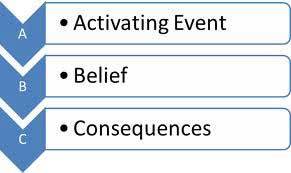
Ellis (1962) suggested a different cognitive explanation of depression. He proposed that good mental health is the result of of rational thinking, defined as thinking in ways that allow people to be happy and free of pain. Ellis believed that conditions such as anxiety and depression result from irrational thoughts. Ellis used the ABC model to explain how irrational thoughts affect our behaviour and emotional state.
Page 5
Cognitive Approach to treating depression
CBT is most commonly used psychological treatment for depression and a range of other mental health problems. If you see a clinical psychologist for a mental health problem the chances are you will receive CBT.
CBT begins with an assessment in which the patient and the cognitive behaviour therapist work together to clarify the patient's problems. One of the central tasks is to identify where there might be a negative or irrational thoughts that will benefit from challenge.
CBT then involves working to change negative and irrational thoughts and finally put more effective behaviours into place.
CBT: Beck's cognitive therapy
The idea behind cognitive therapy is to identify automatic thoughts about the world, the self and the future - this is the negative triad. Once identified these thoughts must be challenged. This is the central component of the therapy. As well as challenging these thoughts directly, cognitive therapy aims to help patients test the reality of their negative beliefs. This can include them being set homework.
CBT: Ellis's rational behaviour therapy
REBT extends the ABC model to and ABCDE. D stands for Dispute and E for Effect. The central technique of REBT is to identify and dispute (challenge) irrational thoughts. This can involve rigorous argument between the patient and the therapist and the intended effect is to change the irrational belief and so break the link between negative life events and depression.
Behavioural activation
Alongside the purely cognitive aspects of CBT the therapist may also work to encourage a depressed patient to become more active and engage in enjoyable activities. This behavioural activation will provide more evidence for the irrational nature of beliefs.
Page 6
Behavioural approach to explaining OCD
Genetic Explanation
Some mental disorders appear to have a stronger biological component than others, and OCD is a good example of a condition that may be largely understood as biological in nature.
Genes are involved in individual vulnerability to OCD. Lewis (1936) observed that of his OCD patients 37% had parents with OCD and 21% had siblings with OCD. This suggests that OCD runs in the families, although what is probably passed from one generation to the next is genetic vulnerability not the certainty of OCD.
The diathesis-stress model argues that certain genes leave some people more likely to suffer a mental disorder but it is not certain - some environmental stress is necessary to trigger the condition.
Candidate Genes - Researchers have identified genes, which create vulnerability for OCD, called Candidate Genes. Some of these genes are involved in regulating the development of the serotonin system.
OCD is Polygenic - This means that OCD is not caused by one single gene but that several genes are involved.
Different Types of OCD - One group of genes may cause OCD in one person but a different group of genes may cause the disorder in another person. The term used to describe this is hetrogeneous which means that different types of OCD may be the result of particular genetic variations.
Neural Explanations of OCD
The Role of Serotonin
One explanation for OCD concerns the role of the neurotransmitter serotonin, which is believed to help regulate mood. Neurotransmitters are responsible for relaying information from one neuron to another. If a person has low levels of Serotonin then normal Transmission of mood-relevant information does not take place and mood and other mental processes are affected.
Decision Making System
Some cases of OCD, and in particular hoarding disorder, seem to be associated with impaired decision making. This in turn may be associated with abnormal functioning of the lateral of the frontal lobes of the brain. The frontal lobes are the front part of the brain that are responsible for logical thinking and making decisions.
There is also evidence to suggest that an area called the left parahippocampal gyrus, associated with processing unpleasant emotions, functions abnormally in OCD.
Biological approach to treating OCD
Drug Therapy
Drug therapy for mental disorders aims to increase or decrease levels of neurotransmitters in the brain or to increase/decrease their activity.
SSRI's
This is the standard medical procedure used to tackle symptoms of OCD and it involves a particular type of anti-depressant drug called a selective serotonin reuptake inhibitor (SSRI). These work on the serotonin system in the brain. Serotonin is released by certain neurons in the brain and is released by the presynaptic neurons and travels across a synapse. SSRIs work by preventing the re-absorption and breakdown of Serotonin which increases the levels within the synapse and thus continue to stimulate the postsynaptic neuron. This compensates for whatever is wrong with the serotonin system in OCD.
Combining SSRIs with other treatments
Drugs are often used alongside CBT to treat OCD. The drugs reduce a patients emotional symptoms, such as feeling anxious or depressed. This means the patient can engage more effectively with the CBT.
Alternatives to SSRIs
Where an SSRI is not effective after three or four months the dose can be increased or it can be combined with other drugs. Sometimes different anti - depressants are tried. Patients respond very differently to different drugs and alternatives work well for some people and not all for others.
Tricycles - (older type of anti-depressants) are sometimes used, such as Clomipramine. These have the same effect on the serotonin system as SSRIs.
SNRIs - In the last five years a different class of anti-depressant drugs, called SNRIs has also been used to treat OCD.
Information
- Description
- Note on Psychopathology, created by Blake Broadbent on 25/11/2016.
- Created by
- Blake Broadbent
- Views
- 0
- Rating