
Notes
Photosynthesis
Content of the notes (1)
Page 1
PHOTOSYNTHESIS
Photosynthesis is the process by which plants and some other organisms convert light energy into chemical energy. The chemical equation for photosynthesis is:
6CO2 + 6H2O + energy from photons--*chlorophyll*----> C6H12O6 + 6O2
Photosynthesis is a 2 stage process which takes place in chloroplasts.
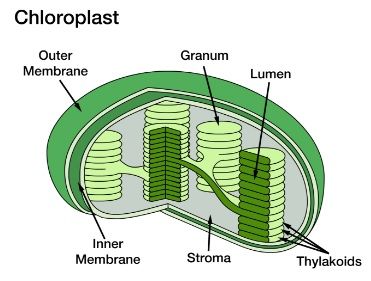
Chloroplasts
Surrounded by an envelope
Outer membrane is permeable to small ions
Inner membrane is less permeable
Folded into lamellae
One granum consists of several stacked thylakoids
Between grana is the intergranal lamellae
The stroma is the fluid filled matrix, which contains the necessary enzyme to carry out the light dependent reactions
Chloroplast Adaptations
Many grana provide a large surface area for photosynthetic pigments
Photosynthetic pigments are arranged into photosystems
Proteins embedded in grana to hold the photosystems in place
Light Dependent Stage
Photophosphorylation
When a photon hits a chlorophyll molecule, the energy is transferred to 2 electrons exciting them
“Photoionisation”
Electrons captured by electron carriers and passed along a series of electron carriers
Energy is used to pump protons across the thylakoid membranes
Proton gradient is formed and protons flow down the concentration gradients through ATP channels
This is chemiosmosis
This produces a force which joins ADP and Pi to form ATP
ATP is used in the light independent stage of the reaction
The making of ATP using light energy is called photophosphorylation
Cyclic Photophosphorylation
Only uses PS1
Electrons pass to an electron acceptor, then return to the chlorophyll molecule from which they were lost
No photolysis of water
No generation of reduced NADP
Small amounts of ATP made
This may be used in the light independent reaction to actively transport potassium into the cell, lowering the water potential and causing ions to flow in by diffusion
This causes the guard cells to swell and the stomata to open
Non-cyclic Photophosphorylation
Involves both PS1 and PS2
Light strikes PS2, exciting a pair of electrons
Electrons leave the chlorophyll molecule from the primary pigment reaction centre
Electrons pass along the chain of electron carriers
Energy is released, which is used to synthesize ATP
Light strikes tPS1, causing the release of 2 electrons
Electrons from oxidized PS2 replace those lost from PS1
Electrons from photolysed water replace those lost from PS2
Protons fro photolysed water take part in chemiosmosis, to make ATP
They are captured in NADP in the stoma and used in the light-independent stage
Non light dependent stage
This takes place in the stroma
It is called the Calvin Cycle
Although light is not used, the products of the light-dependent stage are used, so the light independent stage will soon cease if light supply ceases
The Calvin Cycle
Carbon dioxide from the air diffuses into the leaf
Diffuses through air spaces and reaches the spongy palisade layer
Diffuses through the cellulose cell walls and into the chloroplast envelope
In the stroma, carbon dioxide combines with the 5C ribulose bisphosphate
Reaction is catalysed by the rubisco enzyme
Two 3C compounds, called glycerate phosphate (GP) are produced
Some GP is used to make amino acids and fatty acids
GP is reduced and photophosphorylated to another 3C compound, triose phosphate (TP)
ATP and reduced NADP are used in this reaction
ATP and redNADP are also used in converting GP into glyceraldehyde phosphate (GALP)
5/6 TPs are recycled to ribulose bisphosphate
Pairs of TP combine to form hexose sugars
Conversion of Energy
Light converted through cyclic phosphorylation and non-cyclic phosphorylation
Both of which are light –dependent
In Cyclic phosphorylation:
Light energy absorbed by PS1
Energy excites electrons, raising their energy level
This causes electrons to be transferred to carriers
As electrons drop down energy levels, they release energy
Energy is used to pump H+ ions through ATP synthase from thylakoid space to the stroma
This is the process of chemiosmosis
In this process, ATP is produced
This process is used to make glucose
In non-cyclic phosphorylation:
Light energy causes hydrolysis of water
This is photolysis
2 electrons are produced, which pass into the PS2
They are excited and transferred to the electron carriers
As they pass along the carriers, they release energy,
This is used to pump H+ ions into the stroma at the same time
Role of Water in the Light Dependent Stage
Photosystem 2 contain an enzyme that can split water into protons, electrons and oxygen
This is photolysis
Some of the oxygen is used in aerobic respiration
Water is a source of hydrogen ions, which are used in chemiosmosis
Protons are accepted by a coenzyme NADP, which is reduced to reduced NADP and used in the light independent stage
Role of Carbon Dioxide in Light Independent Stage
Carbon dioxide is the source of carbon and oxygen for the production of all large organic molecules
These molecules are used as energy stores for all life forms
EXAM TIP
Yes - it’s a lot - but you need to know the specifics listed above about the process of photosynthesis in order to reach top marks
Factors Affecting the Rate of Photosynthesis
The rate of photosynthesis is highly sensitive to 3 main factors:
Light Intensity
If light intensity was dramatically reduced:
Levels of ATP and NADP would fall, as the light dependent reaction cannot occur
Conversion of GP to TP requires ATP and reduced NADP, so this process will slow down
As ATP is used to convert TP to ribulose bisphosphate, levels of this will also fall
Reduction in ribulose bisphosphate means less carbon dioxide can react
Eventually the whole cycle stops
Carbon Dioxide
If carbon dioxide concentration was dramatically increased:
More carbon dioxide fixation allows for more GP, TP and ribulose bisphosphate to be created
Stomata will be open more, causing an increased loss of water and wilting
Stress response will close the stomata
This will reduced carbon dioxide supply
Photosynthesis rate will slow
Temperature
If temperature were raised:
Below 25 degrees activity in light dependent stages is minimally affected
Activity of molecules in the Calvin cycle are dramatically affected as they gain more kinetic energy
Higher temperatures will increase transpiration and cause the plant to wilt
Stress reaction will cause the stomata to close, reducing carbon dioxide availability
High temperatures may denature rubisco
At higher temperatures, rubisco is more likely to bind to oxygen than carbon dioxide
Photosynthesis rate will start to decrease
Information
- Description
- notes on photosynthesis for a2 aqa biology for new 2015 spec
- Created by
- Jess Tambe
- Views
- 15
- Rating