
Quiz
MO30 Phase 1 Drug Metabolism
Este quiz tem tipos de pergunta que abrem no player de sempre.
Perguntas do quiz (12)
1Identify the major and minor products of aliphatic oxidation of pentobarbital.

- Amajor product
- Bminor product
2Label the compounds by their active groups, and also label the chemical vs enzymatic pathways.
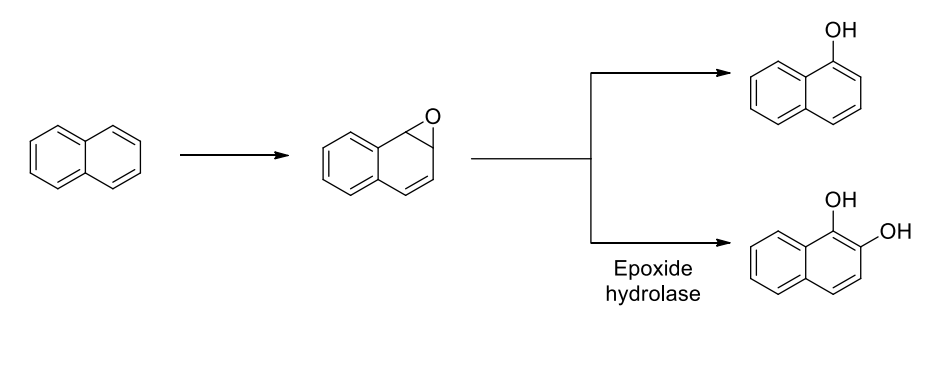
- Aepoxide
- Bphenol
- Cdiol (catechol)
- DEnzymatic
- EChemical
3Reactivity in Aromatic Oxidation mechanism is analogous to electrophilic aromatic substitution reactions
in organic chemistry:
• electron-donating substituents [blank_start]enhance[blank_end] metabolic oxidation
• electron-withdrawing substituents [blank_start]reduce or prevent[blank_end] oxidation
• oxidation occurs at the [blank_start]least[blank_end] hindered position
• if two rings are present [blank_start]only one is[blank_end] usually oxidised- Aenhance
- Breduce or prevent
- Cleast
- Dmost
- Eonly one is
- Fboth are
4Dealkylation is loss of alkyl groups attached to [blank_start]O, N or S[blank_end] atoms.
The mechanism is [blank_start]hydroxylation[blank_end] of the nearest aliphatic/alpha [blank_start]carbon[blank_end], followed by hydrolytic cleavage to give the corresponding [blank_start]phenols, amines and thiols[blank_end]. Forms an [blank_start]ether[blank_end] as well.
There must be an alpha [blank_start]hydrogen[blank_end] present, i.e. Aromatic ring—X—CR3 would be resistant (X = O, N or S).- AO, N or S
- Bhydroxylation
- Ccarbon
- Dphenols, amines and thiols
- Eether
- Fhydrogen
5In O-deakylation, the hemiacetal intermediate is unstable and dissociates to form an aldehyde or ketone.
- AVerdadeiro
- BFalso
6Choose the incorrect statement.
- AIn O-deakylation, the hemiacetal intermediate is unstable and dissociates to form an aldehyde or ketone.
- BN-dealkylation proceeds via a carbinolamine which is unstable and dissociates to form an amine and an aldehyde.
- CS-dealkylation is rather uncommon because sulfur containing drugs are uncommon and the S atom is more susceptible to oxidation than the adjacent C-H bond.
7Primary aliphatic amines with no alpha-H like are oxidised to [blank_start]hydroxylamines[blank_end]. [blank_start]Secondary[blank_end] amines are also oxidised to hydroxylamines. Tertiary amines are oxidised to [blank_start]N-oxides[blank_end]. These N-oxidations are catalysed by either [blank_start]CYP450s[blank_end] or flavin-containing monooxygenases ([blank_start]FMOs[blank_end]).
- Ahydroxylamines
- BN-oxides
- CSecondary
- DCYP450s
- EFMOs
8Label the amines and product amine groups.
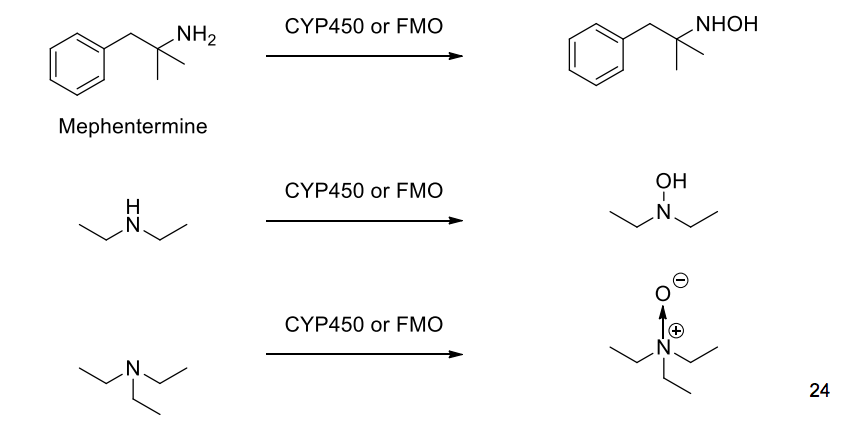
- APrimary amine
- BSecondary amine
- CTertiary amine
- DPrimary amine
- ESecondary amine
- FTertiary amine
- GPrimary amine
- HSecondary amine
- ITertiary amine
- JHydroxylamine
- KN-oxide
- LHydroxylamine
- MN-oxide
- NHydroxylamine
- ON-oxide
9S-oxidation is catalysed by the enzyme flavin-containing monoxygenase.
- AVerdadeiro
- BFalso
10Deamination occurs when the [blank_start]C-N[blank_end] bond linking the amino group to the bulk of the molecule is cleaved. Oxidative deamination converts primary aliphatic amines to [blank_start]aldehydes/ketones[blank_end]. Most deamination is via [blank_start]monoamine oxidase (MAO)[blank_end] which degrades endogenous catecholamines, but some still occur via [blank_start]CYP450s[blank_end].
- AC-N
- Baldehydes/ketones
- Cmonoamine oxidase (MAO)
- DCYP450s
11Oxidative dehalogenation is a common metabolic pathway for many halogenated hydrocarbons. The reaction catalysed by CYP450 (mainly [blank_start]CYP2E1[blank_end]) requires the presence of a halogen atom and a hydrogen on the same carbon. The hydrogen is made into a [blank_start]hydroxide[blank_end], and then a [blank_start]carbonyl[blank_end] group. The hydroxide's [blank_start]H[blank_end] leaves with the [blank_start]halogen[blank_end] to form X-H.
The rate increases with [blank_start]decreasing[blank_end] electronegativity (X = I > F) and [blank_start]increasing[blank_end] X (e.g. di-iodo, di-fluoro, etc.) on the same carbon.- ACYP2E1
- Bhydroxide
- Ccarbonyl
- DH
- Ehalogen
- Fdecreasing
- Gincreasing
12Choose the incorrect statement.
- AAzo (-N=N-) and nitro (-NO2) groups are reduced to primary amines by reductases plus NADPH and O2.
- BMost important hydrolysis reactions are those of esters, amides and thioesters.
- CAll hydrolysis reactions occur in the cytosol.
Informações
- Descrição
- PHCY211 (Molecules) Quiz sobre MO30 Phase 1 Drug Metabolism, criado por Mer Scott em 15-04-2018.
- Autor
- Mer Scott
- Idioma
- English
- Visualizações
- 9
- Etiquetas
- Avaliação
- Ainda sem avaliações Avalie este quiz