
Flashcards
Eyewitness Testimony
Flashcards do conjunto (56)
- 1Wells (1998)By March 1994, 40 people found to be wrongly convicted (due to advent of DNA testing in 1990), some had been sentenced to death. In 36 of these cases, mistaken EWT was the major evidence presented against them.
- 2Loftus (1974)Gave 3 groups of ppts different versions of a robbery and murder case - asked them to decide whether the defendent was guilty. All 3 groups received the same circumstantial evidence. With this info alone = 18% found the defendant guilty. With store clerk's EWT = 72% of 2nd group found defendant guilty. 3rd group got info that the store clerk was short-sighted = 68%. (demonstrates mistaken faith in EWT)
- 3Estimator Variablesfactors over which the justice system has no control e.g. stress and arousal, weapon focus, confidence of the witness, face recognition
- 4System Variablesfactors over which the justice system can have some control e.g. the way questions are asked or worded, the way in which a line up is constructed and conducted
- 5Ronald Cotton Case1984 - Jennifer Thompson was raped. She described someone who looked like Ronald Cotton. He worked nearby where it happened & had a history of sexual assualt - was convicted. Retrial - she confirmed it was RC & didn't recognise Bobby Poole. RC reconvicted. DNA evidence came out - Bobby Poole was real culprit. RC released after 11 years in prison.
- 6Ronald Cotton Case - why it happenedStressful situation (Yerkes-Dodson Law).
Weapon Focus - knife
Shown 6 photos at once - didn't spend very long (5 mins) studying the photos.
She was very confident - changed her memory of the event. - 7Post-event informationExperiences of witnesses between the event and trial that affect the encoding and memory of the event. Information can come from the media, friends, family, police, lawyers, other witnesses
- 8Reconstruction PrincipleWhen recalling a memory, we use a combination of information beginning with the retrieval cue, combining this with the memory trace and then fill in the gaps.
- 9Why do Schemas result in unreliable EWT?By forcing new situations to fit our schemas, we may distort them - the information encoded doesn't correspond to the real event. When recalling the info, the distortions are incorporated into the recall which therefore is inaccurate.
- 10What factors affect how a memory is constructed and reconstructed?Mis-leading post event information.
Leading questions - 11Year of Allport & Postman?1947
- 12Procedure of Allport & Postman?Ppts = white Americans. Shown picture of a white man threatening a black man with a razor blade. Task = describe picture to a 2nd ppt who described it to a 3rd & so on.
- 13Findings of Allport & Postman?Over half of the 7th ppts described the black man not the white man as holding the razor blade.
- 14Weakness of Allport & Postman?May be more related to how well ppts relay the information - not a realistic task
- 15Year of Loftus & Palmer?1974
- 16Procedure/ findings of Loftus & Palmer?found that ppts who were asked how fast cars were going when they 'smashed into' each other gave higher speed estimates than ppts who were asked how fast the cars were going when they 'hit' each other
- 17Weakness of Loftus & Palmer?Video - not realistic/ lack of ecological validity
- 18Year of Loftus & Zanni?1975
- 19Procedure/ findings of Loftus & Zanni?found that asking the ppts if they had seen 'the' broken headlight rather than 'a' broken headlight increased the likelihood that they would report seeing one, even though there was no broken headlight in the film.
- 20Weakness of Loftus & Zanni?Video is unrealistic (same as L&P)
- 21Year of Yuille & Cutshall?1986
- 22Procedure of Yuille & Cutshall?Examined recall of witnesses to a shooting in a town in Canada. Occurred in broad daylight, large number of witnesses. 15 witnesses interviewed.
- 23Findings of Yuille & Cutshall?Able to recall incidents in detail.
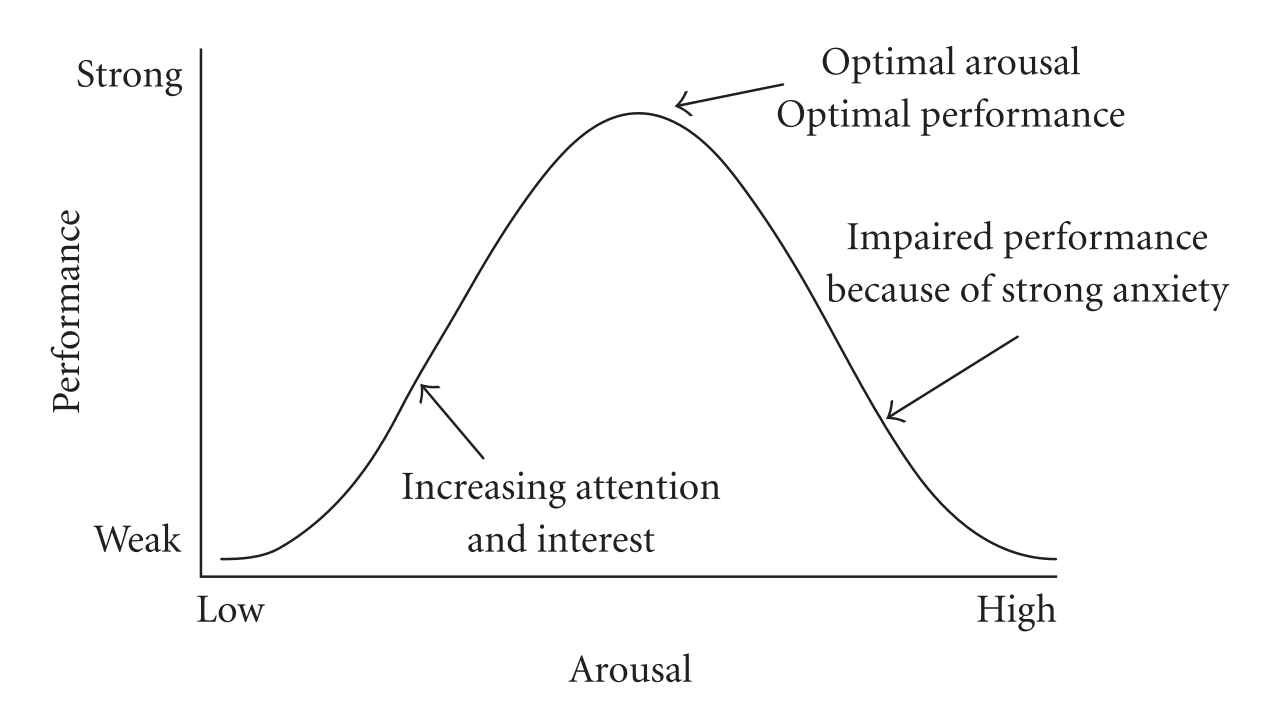
High level of agreement between the accounts given by the different witnesses. Witnesses' accounts didn't differ in response to leading questions. - 24Yerkes-Dodson LawWe perform poorly at both low and high levels of arousal and perform best at moderate levels of arousal - applied to witnesses to crime - their recall of events will be poor since it involves high levels of arousal/ stress.
- 25—
- 26Year of Macleod?1986
- 27Procedure of Macleod?Field study comparing 379 eyewitnesses reports to assaults with physical injury (high stress) to no physical injury (lower stress).
- 28Findings of Macleod?No overall difference in the degree of accuracy.
- 29Evaluation of Macleod?Large sample.
Assumes physical injury is high stress and no physical injury is low stress - ignores individual differences. - 30Year of Yuille et al?1986
- 31Findings of Yuille et al?the greater reported level of arousal, the more accurate the testimony
- 32Year of Clifford & Scott?1978
- 33Procedure/ findings of Clifford & Scott?Found that people who saw a film of a violent attack remembered fewer of the 40 items of information about the event than a control group who saw a less stressful version. A real life crime may be even more stressful.
- 34Year of Loftus & Burns?1982
- 35Procedure of Loftus & Burns?Ppts allocated to 1 of 2 conditions:
- Watched a violent short film of a boy shot in the head.
- Watched a non-violent short film of a crime. - 36Results of Loftus & Burns?Violent short film = less accurate recall
- 37Weakness of Loftus & Burns?Unethical.
Video is unrealistic. - 38Weapons FocusThe tendency for witnesses to violent crimes to focus their attention on the weapon used as it's the most obvious threat. Less of their attention is on the culprit & other events going on & therefore EWT is less accurate.
- 39Cognitive explanation for Weapons focusPeople have limited capacity for processing information - people are selective about what they take in. Under normal circumstances, people are good at this. Some sorts of info draw attention to themselves such as weapons and other threats - leads to less of processing of other info.
- 40Biological explanation for weapons focusViolent incidents increase anxiety & autonomic arousal = less accurate memory.
Yerkes-Dodson Law. - 41Alternative explanation of weapons focusThe unusualness of the situation is more important than the weapon
- 42Year of Pickel?1998
- 43Procedure of Pickel?Ppts watched a 2 minute video consisting of a scene from a hair salon, in which a man walks to the receptionist & hands him her money. Different groups saw him carrying nothing, scissors, handgun, wallet or raw chicken. Then asked to identify the perpetrator from a line-up.
- 44Results of Pickel?Results showed that accuracy was significantly poorer in the high unusualness conditions, rather than the presence of a weapon.
- 45Year of Maass and Kohnken?1989
- 46Procedure of Maass and Kohnken?Field experiment in which ppts were approached by a women holding either a pen or a syringe
- 47Findings of Maass and Kohnken?Ppts in the pen condition had more accurate descriptions of the woman (supports - field so high ecological val.)
- 48Year of Loftus?1987
- 49Procedure of Loftus36 students from University of Washington. Showed a series of pictures of customers in a restaurant. 2 versions: customer holding a gun, same customer holding a chequebook. Recognition of customer measured by 20 item questionnaire. Also shown 12 photos in random sequence & asked to rate the confidence of their identification.
- 50Findings of Loftus?Chequebook condition = 38.9% made accurate identification.
Gun condition = 11.1%.
Eye fixation data = average 3.72 secs on the gun, 2.44 secs on the cheque - 51Year of Christianson & Hubinette?1993
- 52Procedure of Christianson & Hubinette?Questioned 110 witnesses who between them had seen 22 genuine bank robberies. Some were onlookers while others were bank employees who had been directly threatened.
- 53Results of Christianson & Hubinette?The direct victims were more accurate in their recall and remembered more details than the bystanders. This persisted after 15 months.
- 54Year of Steblay?1992
- 55Procedure of Steblay?Meta-analysis examining 19 tests of weapon focus effect.
- 56Findings of Steblay?A SD between weapon-present and weapon-absent conditions found, with weapon presence leading to reduced identification accuracy.
Informações
- Descrição
- Reconstructive memory (post-event info & leading questions), Yerkes-Dodson Law, Weapons focus. 56 cards
- Criado por
- Ella Middlemiss
- Visualizações
- 2
- Avaliação