
Flashcards
Chapter 2 / Psychoanalysis

Flashcards do conjunto (31)
- 1Psychoanalysisa system of psychological theory and therapy that aims to treat mental disorders by investigating the interaction of conscious and unconscious elements in the mind and bringing repressed fears and conflicts into the conscious mind by techniques such as dream interpretation and free association.
- 2Sigmund FreudAustrian neurologist and the founder of psychoanalysis
- 3Free associationA practice in psychoanalytic therapy in which a client is asked to freely share thoughts, random words, and anything else that comes to mind, regardless of how coherent or appropriate the thoughts are
- 4RepressionThe psychological attempt made by an individual to direct one's own desires and impulses toward pleasurable instincts by excluding the desire from one's consciousness and holding or subduing it in the unconscious.
- 5ResistanceThe phenomenon often encountered in clinical practice in which patients either directly or indirectly exhibits paradoxical opposing behaviors in presumably a clinically initiated push and pull of a change process.
- 6Transference"the inappropriate repetition in the present of a relationship that was important in a person's childhood". Another definition is "the redirection of feelings and desires and especially of those unconsciously retained from childhood toward a new object".
- 7infantile sexualityIn psychoanalytic theory, the overlapping oral, anal, and phallic phases of psychosexual development that occur during the first 5 years of life.
- 8NeurosisAn emotional disturbance, but the disturbance is usually not so severe to preventing the individual a place in society
- 9infantile sexualityh
- 10psychoanalytic techniquesencouragement for the client to develop insights into their behavior and the meanings of symptoms, including ink blots, parapraxes, free association, interpretation (including dream analysis), resistance analysis and transference analysis.
- 11Conversion DisordersA mental condition in which a person has blindness, paralysis, or other nervous system (neurologic) symptoms that cannot be explained by medical evaluation
- 12Catharsisthe process of releasing, and thereby providing relief from, strong or repressed emotions.
- 13Unconscious ProcessThe processing of perception, memory, learning, thought, and language without being aware of it.
- 14Dream WorkThe processes by which the unconscious mind alters the manifest content of dreams in order to conceal their real meaning from the dreamer.
- 15Libidoterm used by in psychoanalytic theory to describe the energy created by the survival and sexual instincts. According to Sigmund Freud, the libido is part of the id and is the driving force of all behavior
- 16ErosIn Freudian psychology, eros, not to be confused with libido, is not exclusively the sex drive, but our life force, the will to live. It is the desire to create life, and favors productivity and construction.
- 17ThanatosAccording to Sigmund Freud, humans have a life instinct—which he named "Eros"—and a death drive, which is commonly called (though not by Freud himself) "Thanatos". ... Thanatology is the academic and scientific study of death among human beings
- 18Polymorphismin biology and zoology is the occurrence of two or more clearly different morphs or forms,
- 19Psychosexual Stages of DevelopmentOral Stage (0-1 year)
Anal Stage (1-3 years)
Phallic Stage (3 to 5 or 6 years)
Latency Stage (5 or 6 to puberty)
Genital Stage (puberty to adult)
References. - 20Psychosexual Stages
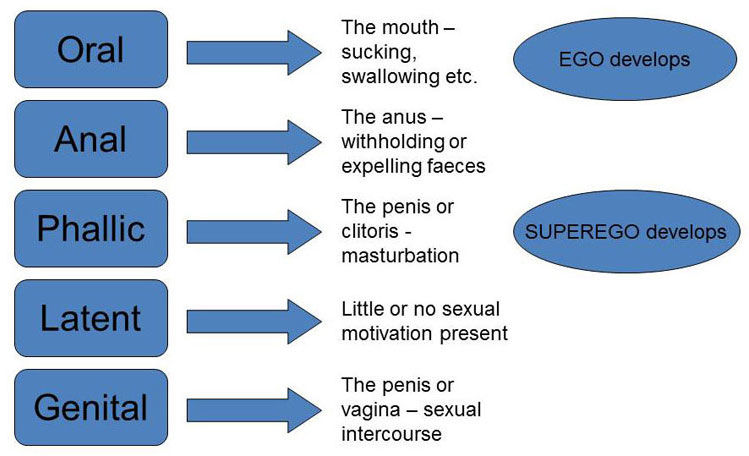
- 21Oral Stagethe term oral stage or hemitaxia denotes the first psychosexual development stage wherein the mouth of the infant is his or her primary erogenous zone.
- 22Anal StageThe anal stage is the second stage in Sigmund Freud's theory of psychosexual development, lasting from age 18 months to three years. According to Freud, the anus is the primary erogenous zone and pleasure is derived from controlling bladder and bowel movement.
- 23Phallic Stage(3-6) centers upon his or her genitalia as the erogenous zone.
- 24Latency StageFreud thought that most sexual impulses are repressed during the latent stage and sexual energy can be sublimated (re: defense mechanisms) towards school work, hobbies and friendships.
- 25The Genital StageThe genital stage in psychoanalysis is the term used by Sigmund Freud to describe the final stage of human psychosexual development.
- 26Idthe id is the personality component made up of unconscious psychic energy that works to satisfy basic urges, needs and desires. The id operates based on the pleasure principle, which demands immediate gratification of needs.
- 27EgoEgo means the extent to which one thinks highly of one's self
- 28SuperEgoThe superego's criticisms, prohibitions, and inhibitions form a person's conscience, and its positive aspirations and ideals represent one's idealized self-image, or “ego ideal.”
- 29reality principleThe ability of the mind to assess the reality of the external world, and to act upon it accordingly, as opposed to acting on the pleasure principle.
- 30Secondary Processa thought process connecting the preconscious and conscious, governed by the reality principle and reflecting the decision-making and problem-solving activity of the ego.
- 31—
Informações
- Descrição
- Psychology FlashCards sobre Chapter 2 / Psychoanalysis , criado por Joshlyn Hernandez em 28-08-2017.
- Criado por
- Joshlyn Hernandez
- Visualizações
- 3
- Avaliação