
Flashcards
memory
Flashcards do conjunto (93)
- 1Both Short and Long term memory differ in 3 main ways:The way the information enters the memory (coding)
The amount of information the memory can hold (capacity)
How long the information remains in the memory store (duration). - 2Coding Sensory MemoryCrowder (1993)
Supports the idea of sensory memory being coded into several stores based on sensory input
Echoic store for auditory information & Iconic store for visual information
Found information is retained in the iconic store for a few milliseconds & for 2-3 seconds in the echoic store - 3Coding Sensory Memory evaluations+ This suggests that we process and code information in different ways in sensory memory
- Even the iconic store may be split further into several sub-stores - 4coding Short term memoryConrad (1964)
Demonstrated acoustic STM coding.
Found that rhyming letters (e.g. P,B,V,T,G) and words (man, mat, cap, cat) are harder to recall than non-rhyming, due to ‘acoustic confusion errors’. - 5coding Short term memory evaluations+ This suggests that we process and code information acoustically in STM.
- Lacks ecological validity – carried out in a lab and involved an artificial task. - 6coding Long term memoryBaddeley (1966)
Procedure: Participants were given two lists to remember:
- Semantically similar – (Big, high, tall)
- Semantically dissimilar – (Wind, Box, Brown)
Recall was tested after an interval of 20 minutes
Findings:
The words remembered least well were those with similar meanings (semantically similar condition).
There was only 55% accuracy for semantically similar words
But 85% accuracy for semantically dissimilar words
Conclusions: Baddeley concluded that LTM codes information semantically.
This may be because there is less confusion on the word lists with distinct meanings because it is easier to discriminate between them. - 7coding Long term memory Evaluations;+ Research tells us that LTM codes information semantically
- Artificial research –In real life people rarely learn word lists so the recall task is not representative of everyday memory demands - 8Capacity Sensory MemorySperling (1960)
Flashed a 3 x 4 grid of letters onto a screen for one-twentieth of a second, and asked participants to recall the letters of one row
Recall of letters in the row indicated was high which suggests that the capacity of sensory memory (especially for the iconic store) is quite large - 9Capacity Sensory Memory evaluations+Other evidence exits that suggests that the iconic store can hold 15-20 images
- Experiments are highly artificial in nature and therefore lack mundane realism - 10Capacity Short term memoryMiller (1956)
Referred to ‘the magical number 7 plus or minus 2.’ Most people are able to retain between 5 and 9 items in STM before it becomes ‘full’.
Miller found that the amount of information retained can be increased by ‘chunking’ – packaging information into larger units – but STM will still only retain 7 + or – 2 of these chunks. - 11Capacity Short term memory evaluations+ Miller’s research involved reviewing previous research (meta-analysis), which implies his findings were consistent – high reliability.
- Contradictory evidence (meta-analysis) suggests the STM is limited to 4 chunks (Cowan, 2001) - 12Capacity Long term memoryWagenaar (1986)
Created a diary of 2,4000 events over 6 years and tested himself on recall of events rather than dates and found that he had excellent recall.
This suggest that the capacity of LTM is extremely large. - 13Capacity Long term memory evaluations+ The capacity of LTM is assumed to be limitless, as research has not been able to find a finite capacity
- Diary studies are similar to case studies, and therefore may not be representative of the general population - 14Duration Sensory MemoryWalsh & Thompson (1978)
Found that the Iconic sensory store has an average duration of 500 milliseconds, which decreases as individuals get older
This suggests that the duration of
sensory memories is limited, dependent on age - 15Duration Sensory Memory evaluations+ The brief duration of SM can be understood from an evolutionary perspective, as people only need to focus on perceptual information with an immediate survival value
- Treisman (1964) found that the echoic store has a limited duration of 2 seconds, which suggests differences in the duration of different stores - 16Duration Short term memoryPeterson and Peterson (1959)
Procedure: Investigated the duration of STM with their trigram experiment. They:
- Asked P’s to remember a nonsense syllable of 3 consonants (a trigram of letters such as BHJ, GFQ)
- Gave P’s an interference task (such as counting backwards in 3’s from 100) to stop them rehearsing the trigram.
(Preventing rehearsal is important to see STM in its pure form – any rehearsal of items starts to implicate LTM in the learning process).
- Tested their recall after 3, 6, 9, 12, 15 and 18 second intervals.
Findings: Average recall for trigrams was very good - 80% after 3 seconds
Fewer trigrams were recalled as time intervals lengthened
Recall dropped to just 10% after 18 seconds.
Conclusions: If rehearsal is prevented information vanishes rapidly from STM - 17Duration Short term memory evaluation+ Suggests that decay is the mechanism for forgetting in STM
- Trigrams are rather artificial things to remember and may not reflect everyday memory. - 18Duration Long term memoryBahrick et al (1975)
Tested 392 graduates from a U.S. high school people on face and name recognition of ex school friends.
P’s performed well up to about 34 years although performance was better on recognition tasks rather than on recall tasks. 90% accuracy in face and name recognition was found even after 48 years, but performance on all tests started to drop after this.
Therefore the duration of LTM can last a few minutes to a lifetime. - 19Duration Long term memory evaluation+ High ecological validity – real life study
- However, it is difficult to decide whether this deficit is due to the passage of time or to the ageing effects in the brains of older p’s. - 20who came up with the multi store modelAtkinson & Shiffrin (1971)
- 21Description of the Multi-Store modelInformation travels through a sequence of stores.
Sensory memory store/Register (SMS) holds information for a very brief period and without attention it will disappear. Sensory memory has two main sub-stores – Iconic memory and Echoic Memory
If significant attention has been paid to the information it will transfer to Short term memory (STM), which is a store limited by capacity (about 7 items) and also duration (18 seconds).
Maintenance rehearsal occurs when we repeat material to ourselves over and over again. If material is rehearsed a number of times it is then passed onto Long term memory (LTM) which is a vast store having potentially infinite capacity and duration. However, if similar information enters the store it can interfere with the original information causing it to either be lost or changed. - 22Multi-Store model strengthsEvidence on The Primacy and Recency effect (Glanzer & Cunitz, 1966): If participants are shown a list of 20 words and then have to recall them in any order (free recall) the results will mirror those on the graph below which is known as the serial position curve.
The first and last words on a list are remembered better than those in the middle. Words at the beginning of the list are rehearsed into LTM while those at the end are still currently in STM. Words from the middle of the list are poorly recalled because they don’t have a chance to be rehearsed into LTM or enter into STM as its capacity is full.
This provides support for the multi-store model as it shows that our memory is split into different stores rather than just one. Information will remain in each store based on the capacity of the store and its duration.
Brain Damaged Patients can provide strong evidence for the distinction between STM and LTM. ‘HM’ has good LTM for events before his accident but now can’t transfer new info from STM to LTM. He is trapped in a world that lasts only as long as his STM. - 23Multi-Store model weaknessesA lot of the research that supports this model is based on artificial tasks in lab settings – therefore lacks ecological validity and is therefore difficult to generalise to everyday memory.
It has been argued that the Multi-store Model is too rigid and simplistic. The processes involved in memory are much more complex than this model suggests. The MSM consists of 3 stores yet there is evidence for the existence of more than one type of STM and LTM stores. WorkingMemory – suggests STM is an active store that can process sound and visual information (more than one store). In addition, ‘Incidental Learning’ suggests that it isn’t just rehearsal which creates LTM’s. Therefore it can be argued that the model ignores other factors
It doesn’t explain the mechanisms of the coding process as it changes information from acoustic in STM to semantic in LTM. Similarly, Levels of Processing Theory suggests it is the meaningfulness of information and not just rehearsal that creates LTM’s.
The MSM therefore overemphasises the role of maintenance rehearsal and underestimates the role of elabo - 24what did tulving argue?Tulving (1989) argued the Multi-Store Model’s view of LTM was too simplistic and inflexible and proposed that there are three types of LTM containing very different types of information
- 253 types of LTM:episodic memory, semantic memory & procedural memory.
- 26Episodic Memory:This is a long term memory store for personal events e.g. breakfast you ate that morning or a birthday party you went to last year. These memories are ‘time-stamped’ i.e. we remember when they happened. A memory of a single ‘episode’ will include several elements e.g. people, places, objects & behaviours – all of which are interwoven to produce a single episode. Memories from this store have to be retrieved consciously and with effort, although you may be able to do so fairly quickly.
- 27Semantic memory:This is a long term store for our knowledge of the world. This includes facts and our knowledge of what words and concepts mean e.g. what an orange tastes like, animals, love and One Direction. These memories are not ‘time-stamped’ e.g. we don’t remember when we first learned about One Direction. Semantic memory contains a huge amount of information that is constantly added to. These memories also need to be consciously retrieved.
- 28Procedural memory:This is a long term store for our knowledge of how to do things – skills and actions e.g. riding a bike, driving a car. These are skills that we might find quite hard to explain to someone else and we usually retrieve these without making a conscious effort.
- 293 types of LTM strengths:Clinical Evidence:
Case studies of HM (Shallice & Warrington, 1970) and Clive Wearing provide support for the existence of different types of long term memories. Episodic memory in both men was severely impaired as a result of amnesia but their semantic memories were relatively unaffected e.g. Clive Wearing could remember how to read music, sing and play the piano. This is clear evidence that not only are these types of memory different, but they are stored in different parts of the brain.
Neuro-imaging Evidence:
Tulving et al (1994) got their participants to perform various memory tasks whilst their brains were scanned using a PET scanner. They found that both episodic and semantic memories were recalled from an area of the brain called the prefrontal cortex. The left prefrontal cortex was involved in recalling semantic memories and episodic memories were recalled from the right prefrontal cortex. This research suggests a biological basis to long term memory and is an objective way of measuring cognitive processes.
Practical Applications:
There is some benefit of being able to dis - 303 types of LTM weaknesses:Problems with Supporting Evidence:
Case studies such as HM and Clive Wearing are unique and therefore it is difficult to make generalisations to the wider population. Tulving’s neuro-imaging studies also used very small samples and Tulving himself was one of the participants, along with his wife and a colleague. This means it may have been difficult to conduct the study and analyse the findings in an unbiased, objective manner.
Three types of Long Term Memory or Two?
Cohen and Squire (1980) disagree with Tulving’s division of long term memory into three types. They agree that procedural memories represent one type of long term memory. But they argue that episodic and semantic memories are stored together in one long term store that they called declarative memory i.e. memories that can be consciously recalled. In contrast procedural memories are non-declarative i.e. are not consciously recalled. - 31who came up with the working memory model why?Baddeley and Hitch (1974)
provided an alternative representation of short term memory that suggested that short term memory should be divided into sub-units co-ordinated by a central decision making system.
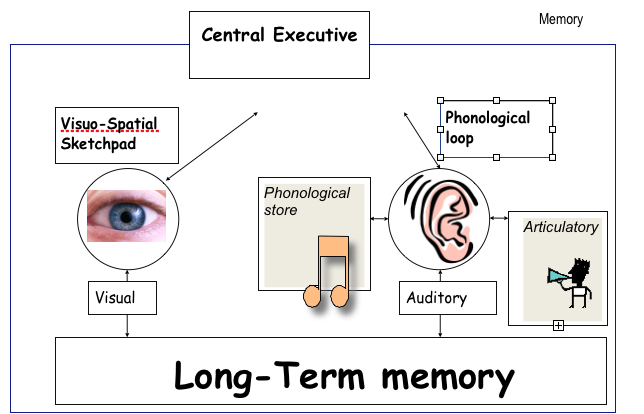
They chose the phrase ‘working memory’ instead of short-term memory to reflect their view that this is the area of memory that is active when you are working on information. - 32working memory model diagram
- 33Central ExecutiveThe most important component of the model
It controls attention, makes decisions and allocates resources/tasks to other components/slave-systems
It has a limited storage capacity so can only attend to a limited number of things at one time. - 34Visuo-spatial sketchpadStores visual and spatial information, such as faces – coding is visual.
Is responsible for setting up and manipulating mental images
Has a limited capacity – Baddeley (2003) argued this was 3 - 4 objects
Logie (1995) subdisvided the visuo-spatial sketchpad into:
-The visual cache which stores visual data
-The inner scribe which records the visual arrangement of objects in the visual field - 35Phonological loopDeals with auditory information – coding is acoustic.
It has two components:
-The phonological store (inner ear) which stores the words you hear
-The articulatory process (inner voice) allows maintenance rehearsal (repeating sounds in a loop to keep them in working memory while they are needed). The capacity of this loop is argued to be approx. 2 seconds worth of what you can say - 36Episodic BufferAdded to model by Baddeley in 2000
Temporary store for information, integrating visual, spatial & verbal information – visual & acoustic coding
It is the storage component of the central executive and has a limited capacity of approx. 4 chunks (Baddeley, 2012)
The episodic buffer links WM to LTM - 37WMM strengthsDual Task Experiments:
Baddeley et al (1975) asked participants to track a spot of light whilst also tracing the letter F. Participants demonstrated poor performance in the simultaneous completion of these two tasks; however they were capable of the tracking task if it was paired with an acoustic task. This suggests that the two visual tasks were both competing for the visuo-spatial sketchpad, which meant the capacity of this component was being stretched, whereas when the task used different components (visual and acoustic) the task was possible. This means there must be both visual and acoustic components of STM, not just acoustic as suggested by the MSM.
Clinical Evidence:
Shallice and Warrington’s (1970) case study of KF provides support for the different components of Working Memory. After brain damage occurred KF had poor STM ability for verbal information but could process visual information normally. i.e. he had difficulty with sounds but could recall letters and digits. This supports the existence of separate visual and acoustic stores in short term memory. - 38WMM weaknessesLack of Clarity over the Central Executive:
The exact role the Central Executive, which is thought to be the most important component of the WMM, remains unclear. This is because the complexities of this component (proposed by Baddeley and Hitch) such as its role in planning, attention, coordination of tasks, make it very difficult to investigate. This means that the WMM cannot provide a complete explanation of how our STM works. As a result further research being carried out and modifications are being made in light of this new research.
Problems with Supporting Evidence:
The Dual task experiments use simplistic stimuli. This means that the findings lack ecological validity and cannot be generalised to all memory processes in everyday life.
The case study of KF may not be reliable because it is a unique case of a patient who has suffered a traumatic experience and findings are therefore difficult to generalise to others. - 392 ways of forgetting?Interference Theory – Proactive & Retroactive
Retrieval Failure - 40Interference TheoryInterference occurs when two pieces of information conflict with each other, resulting in forgetting of one or both pieces of information, or some distortion of the memories.
Interference has been proposed mainly as an explanation of forgetting in long term memory. It is likely that if forgetting in long term memory occurs, the information is available, but there are problems locating or accessing the memories. - 41Proactive Interference:Forgetting occurs when older memories, already stored, disrupt the recall of newer memories – interference works forwards from old to new. The degree of forgetting is greater when the memories are similar. For example, the memory of an old phone number disrupts attempts to recall a new number.
- 42Retroactive Interference:Forgetting occurs when newer memories disrupt the recall of older memories already stored – interference works backwards from new to old. The degree of forgetting is again greater when memories are similar e.g. the memory of a new car registration number prevents recall of a previous one.
- 43Interference Theory Evaluation: StrengthsSupporting Evidence – Lab Experiments:
McGeoch & McDonald (1931) studies retroactive interference by changing the amount of similarity between two sets of materials. Participants had to learn a list of 10 words until they could remember them with 100% accuracy. They then learned a new list. There were 6 groups of participants who had to learn different types of lists e.g. synonyms (words with the same meanings as the originals), antonyms (words with the opposite meanings to the originals). When the participants had to recall the original list of words, their performance depended on the nature of the second list. The most similar material (synonyms) produced the worst recall. This shows that interference is strongest when the memories are similar. Lab experiments such as this are able to establish cause and effect and have been replicated e.g. Abel & Bauml (2013) and are therefore reliable.
Supporting Evidence – Correlation
Schmidt et al (2000) tested retroactive interference in a real life setting (therefore having high ecological validity) by using childhood memories of street name - 44Interference Theory Evaluation: WeaknessesProblems with Supporting Evidence
Lab experiments e.g. McGeoch & McDonald (1931) use very artificial materials. Learning lists of words is very different to the types of things we learn in everyday life e.g. people’s faces, birthdays – this means the findings lack ecological validity and it is very difficult to generalise the effects of interference in these situations to everyday life.
Studies in real life settings e.g. Schmidt et al (2000) also have their problems as extraneous variables may confound the results e.g. those participants who had played extensively in the neighbourhood or walked to school would probably have learned the street names better than those who didn’t.
Cognitive Processes not explained
Although studies show interference to play an important role in forgetting, they do not provide any explanation of the cognitive processes at work. - 45Retrieval FailureRetrieval failure occurs when we don’t have the necessary cues to access memory. The memory is available but not accessible unless a suitable cue is provided.
A cue is a ‘trigger’ of information that allows us to access a memory. Cues may be meaningful or may be coded at the time of learning. They may also be external (environmental) cues or internal (mood, drunkenness) cues. - 46Tulving (1983) proposedEncoding Specificity Principle
- 47Encoding Specificity Principlewhich argues if a cue is to help us recall information it has to be present at coding (when we learn material) and at retrieval (when we are recalling the material). Therefore, if cues available at encoding or retrieval are different or absent there will be some forgetting.
- 48Context-dependent forgettingThis occurs with external retrieval cues – i.e. when the external environment is different at recall from how it was at coding e.g. getting fewer marks in a test when sitting the test in a room you’re not familiar with than when sitting the test in the room you learnt the material in.
- 49State-dependent forgettingThis occurs with internal retrieval cues – i.e. when the internal environment is different at recall from how it was at coding e.g. trying to recall information learned when sober while you are drunk.
- 50Retrieval Failure Evaluation: StrengthsSupporting Evidence
Godden & Baddeley (1975) found support for context-dependent forgetting. They conducted a field experiment where they got divers to learn a list of words either on land or under water. They were then asked to recall the words either on land or under water. They had 4 conditions: 1. Learn on land-recall on land; 2. Learn on land-recall under water; 3. Learn under water-recall on land; 4. Learn under water-recall under water. Recall was found to be worse when it occurred in a different context to coding, than the same context – e.g. recalling words learned under water were recalled better when under water than when on land.
Carter and Cassaday (1998) found support for state-dependent forgetting. They gave anti-histamine drugs (for treating hay fever which have a slightly sedative effect) to their participants. These create a different internal state to the ‘normal’ state of being alert. They were then asked to learn lists of words and passages and then recall the information again. There were 4 conditions: 1. Learn on drug-recall on drug; 2. Learn on drug-recall no - 51Retrieval Failure Evaluation: WeaknessesProblems with Supporting Evidence: Experiments use simplistic stimuli – generally lists of words This means that the findings lack ecological validity and cannot be generalised to all memory processes in everyday life.
Problems with Context Effects
Baddeley (1997) argues context effects are actually not as strong in real life. It would be hard to find an environment as different from land as underwater. In contrast, for example, learning something in one room and recalling it in another is unlikely to result in much forgetting as these environments are not that different. This is a limitation because it means that forgetting in real life due to contextual cues does not explain much forgetting. The supporting evidence by Godden and Baddeley lacks ecological validity as the findings cannot be generalised to other settings.
Recall versus Recognition
Retrieval failure cannot explain all types of forgetting. Godden & Baddeley (1980) replicated their underwater experiment, but used a recognition test instead of recall. Participants had to say whether they recognised a word rather than - 52Eyewitness testimonyEvidence given by a witness to a significant event such as a crime or a serious accident
- 53Anxiety is a state of emotional and physiological arousalEmotions include worried thoughts and feelings; physical changes include and increased heart rate and sweatiness. Anxiety is a normal reaction to stressful situations but can affect recall.
- 54Problems in accuracy of EWT can occur at any point in the memory process:During acquisition (encoding)
During storage
During retrieval - 55Factors affecting EWT accuracy:Anxiety
Leading Questions
Post Event Discussion - 56The role of anxietySome crimes, especially those involving violence, are associated with high levels of anxiety in victims or bystanders. Anxiety experienced by witnesses at the time of the incident, affects the encoding stage of the memory process. Whether this anxiety leads to unreliable recall of specific details depends on a number of factors.
- 57Weapon focus Anxiety Can Make Eye Witness Testimony unreliable by?ANXIETY CREATES PHYSIOLOGICAL AROUSAL IN THE BODY WHICH PREVENTS US FROM PAYING ATTENTION TO IMPORTANT CUES, SO RECALL IS WORSE
- 58Weapon focus studyLoftus (1979)
Procedure:
Participants were exposed to one of two situations:
1. They overheard a low-key discussion in a laboratory about an equipment failure. A person then emerged from the lab holding a pen with grease on his hands.
They overheard a heated and hostile exchange between people in the laboratory. After the sound of breaking glass and crashing chairs, a man emerged from the lab holding a paper knife covered in blood.
2. They were then given 50 photos and asked to identify the person who had come out of the lab.
Findings: Those who had witnessed the man holding a pen accurately identified the person 49% of the time
Those who had witnessed the man holding the bloodstained paper knife were successful only 33% of the time.
Conclusions: Fear or anxiety induced by the sight of a weapon narrows the focus of attention and leads to very accurate recall of central details of the scene but less accurate recall of peripheral details. - 59Weapon focus evaluations strengthsFindings have led to the ‘weapon focus’ phenomenon, where the witness concentrates on the weapon and this distracts attention from the appearance of the perpetrator. The tunnel theory argues that a witness’s attention narrows to focus on a weapon , because it is a source of anxiety.
- 60Weapon focus evaluations weaknessesIt is mainly lab studies that produce this result. They can be accused of lacking ecological validity, as is demonstrated by research into witnessing a real life event (below)
The above study may test surprise rather than anxiety – people may focus on the weapon not because they are scared but because they are surprised. Pickel (1998) conducted an experiment using scissors, a handgun, a wallet, or a raw chicken as the handheld items in a hairdressing salon video (where scissors would be low anxiety as they are common in that scenario. Eyewitness recall was significantly lower in the high unusual ness conditions e.g. handgun and
chicken.
Demand Characteristics – participants are very likely to work out that they are watching a film/exposed to conditions for a reason and realise they are going to be asked questions on what has happened.
Creating anxiety is unethical - 61Anxiety Can Make Eye Witness Testimony reliabletHE STRESS OF WITNESSING A CRIME OR ACCIDENT CREATES PHYSIOLOGICAL AROUSAL AND THE FIGHT OR FLIGHT RESPONSE IS TRIGGERED. THIS INCREASES OUR ALERTNESS AND IMPROVES MEMORY AND WE BECOME MORE AWARE OF CUES, SO RECALL IS BETTER
- 62Witnessing a real life event Christianson and Hubinette (1993)Procedure:Questioned 110 witnesses who had, between them, witnessed a total of 22 genuine bank robberies.
Some of the witnesses were onlookers who happened to be in the banks at the time, whereas others were bank employees who had been directly threatened in the robberies.
Findings : Victims were more accurate in their recall of specific details about the robber than those who had been bystanders
This superior recall was still evident even after a 15-month interval.
Conclusions:People (especially victims) are good at remembering highly stressful events if they occur in real life rather than in artificial surroundings (a lab) - 63Witnessing a real life event: strengthsResearch highlights the importance of testing EWT in natural settings outside of the lab
Research recorded recall at two different time intervals – shortly after the event and 15-months after. This means the study has high external reliability - 64Witnessing a real life event: weaknessesIndividual differences – Differences in accuracy of recall may be more a reflection of how effective each person’s memory is or a reflection of how close the witness was to the perpetrator
Extraneous variables – as the study was carried out in natural settings it not possible to control all potential extraneous variables such as, time of day etc - 65Explaining these Contradictory Findings about anxiety:Kenneth Deffenbacher (1983) applied the Yerkes Dodson Law to eyewitness testimony. Lower levels of anxiety produce lower performance i.e. lower levels of recall. But memory becomes more accurate as the level of anxiety experienced increases – but only up to a certain point when an optimal level of anxiety is reached. This is the pint of maximum accuracy of recall – if an eyewitness experiences more stress than this, then their recall of the event declines.
- 66Misleading informationMemories laid down at the time of an event seem to be quite fragile and subject to distortion by post-event information. False information given to the witness after the event can serve to distort the original memory by removing some elements and inserting others. I
- 67Information given to the eyewitness usually after the event can take two main forms:Leading Questions
Post Event Discussion - 68Leading Questions: studyLoftus and Palmer (1974)
Procedure:Participants were shown a film of a car accident and then asked a question:
“How fast were the cars going when they hit each other?”
All participants were asked the same type of question except that the word ‘hit’ was replaced with ‘collided’, ‘smashed’, ‘bumped’, or ‘contacted’ for some participants.
Findings:The word used had an effect on speed estimation.
‘smashed’ produced the highest estimate (40.8 mph)
‘contacted’ produced the lowest estimate.
A week later participants were asked if they had seen any broken glass
Those in the ‘smashed’ group were consistently more likely to answer ‘yes’ (wrongly)
Conclusions: This suggests that people’s memory for an incident can be easily influenced by changing just a single word in a question.
This can even alter people’s memories for other details about the event when questioned at a later date. - ‘After-the-fact information’ questions - 69Leading Questions: strengthsThis research demonstrates the fallibility of eyewitness testimony’s due to leading questions.
This was a lab based study so has good control over extraneous variables.
Useful practical applications – has led to improved police interviewing strategies (See The Cognitive Interview) - 70Leading Questions: weaknessesAs the study was based in a lab it is an artificial environment, thus increasing the likelihood of demand characteristics
Also participants only saw a film of a car accident. They may react differently to leading questions if they witnessed a real accident, when they have also probably experienced much higher levels of anxiety.
Individual Differences – Evidence e.g. Anastasi & Rhodes (2006) found younger witnesses (aged 18-25 & 35-45)) were more accurate in recall than older participants (aged 55-78). - 71Post – Event DiscussionPost-Event Discussion (PED) occurs when there is more than one witness to an event. Witnesses may discuss what they have seen with co-witnesses or with other people. This may influence the accuracy of each witness’s recall of the event.
- 72Post – Event Discussion Gabbert et al (2003)Procedure: Studied participants in pairs
Each participant watched a video of the same crime, but filmed from different points of view. This meant that each participant could see elements in the event that the other could not.
Both participants then discussed what they had seen before individually completing a recall test
Findings:71% of the participants mistakenly recalled aspects of the event that they did not see in the video but had picked up during discussion.
In a control group, where there was no discussion, there was 0% mistaken recall
Conclusions:This suggests that witnesses often go along with each other to win social approval or because they believe other witnesses are right and they are wrong. This is called memory conformity. - 73Post – Event Discussion: strengthsThis research demonstrates the fallibility of eyewitness testimony’s due to post event discussion
This was a lab based study so has good control over extraneous variables. - 74Post – Event Discussion: weaknessesAs the study was based in a lab it is an artificial environment, therefore lacking mundane realism.
Demand characteristics – participants usually do not want to let the researcher down so when they are asked a question they may guess the answer, or in the case of experiments on PED use the information provided by others. EWT may in fact be more reliable than many studies suggest - 75Cognitive interviewMakes Eye Witness Testimony more reliable
The Cognitive Interview was developed by Fisher and Geiselman (1992) as a method of interviewing eyewitnesses to help them retrieve more accurate memories. It is based on the idea that there are several memory retrieval paths to each memory and that information not available through one technique may be accessible through another. - 76The interview technique is used by police investigators and is based on four techniques based on psychological insights into how memory works:To recreate the context of the original incident.
To report every detail.
To recall the event in different orders.
To change perspectives. - 77To recreate the context of the original incident.This involves returning to the scene ‘in their mind’ and imagine the environment e.g. weather and their emotions e.g. what they were feeling. This is based on the principles of context & state dependent forgetting.
- 78To report every detail.Witnesses are encouraged to include every single detail of the event even though it may seem irrelevant
- 79To recall the event in different orders.Events should be recalled in a different chronological order to the original sequence, from the middle to the beginning. This is done to prevent people reporting their expectations of how the event must have happened rather than the actual events
- 80To change perspectives.Witnesses should recall the incident from other people’s perspectives. For example how the event might have appeared to other witnesses or to the perpetrator. This is also done to prevent the effect of expectations or schema on recall.
- 81The Enhanced Cognitive Interview:Fisher et al (1987) developed some additional elements to the Cognitive Interview which focused on the social dynamics of the interaction. For example, when the interviewer should establish eye contact and when to relinquish it. Also – strategies for reducing eyewitness anxiety and minimising distratctions.
- 82The Enhanced Cognitive Interview: strengthsBekerian and Dennett (1993) carried out a meta-analysis and reviewed 27 studies involving the Cognitive Interview Schedule and found in all cases it has provided more accurate information than other interview procedures
Kohnken et al (1999) carried out another meta- analysis and reviewed data from 50 studies. They found the Enhanced Cognitive Interview consistently provided more correct information than the standard interview - 83The Enhanced Cognitive Interview: weaknessesThe Cognitive Interview is more time consuming that the standard interview. It also requires more training and many forces are unable to provide more than a few hours.
Milne & Bull (2002) found that using a combination of report everything and context reinstatement produced better recall than any of the other conditions. This suggests that some elements of the Cognitive Interview are more useful than others.
Kohnken et al (1999) found an 81% increase of correct information, but also found a 61% increase of incorrect information. This clearly suggests the police need to be aware that the recall of incorrect information is also increased. - 84Research into the effectiveness of the cognitive interviewGeiselman (1988)
Procedure: Compared the cognitive interview with a standard police interview.
89 students were shown videos of violent crimes
48 hours later they were interviewed by an American law enforcement officer trained in either standard police interviewing or the new Cognitive interview schedule.
Each interview was taped and analyzed for accuracy of recall.
The number of errors were recorded in two subgroups:
Incorrect items – the number of items incorrectly recalled.
Confabulated items – the number of items described that were not actually shown in the video.
Findings:Average number of items recalled:
Cognitive Standard
Correct items 41.5 29.4
Incorrect items 7.3 6.1
Confabulated items 0.7 0.4 - 85ConclusionsPeople are likely to recall considerably more items in a cognitive interview than in a standard interview.
- 86Effectiveness of the cognitive interview: strengthsControlled lab study – As study was carried out in a controlled environment the effect of extraneous variables is reduced.
- 87Effectiveness of the cognitive interview: weaknessesArtificial – Participants were undergraduate students who only watched videotapes of violent crimes.
- 88Extension Material Encoding - Short term memoryVisual encoding and well as acoustic encoding is also possible as Brandimonte et al (1992) Found that when participants were given a visual task they used visual encoding when prevented from doing verbal rehearsal in the retention interval. The verbal rehearsal involved saying la la la before performing the visual recall task and usually the STM converts visual images into verbal codes. This meant that verbal rehearsal was prevented and they used visual codes instead.
- 89Baddeley (1966)- encoding Additional Evaluation Long term memory+ As the study utilised the experimental method it is possible to infer a causal link between the type of encoding used in LTM and the accuracy of recall.
+ Through the use of the experimental method It is also easier to control any possible extraneous variables
- LTM may also be encoded visually, acoustically or by taste and smell. These different types of encoding were not investigated in this study. - 90Capacity Short term memory Jacobs (1887) – capacityAlso found the average STM span was between 5 and 9 items. Digits were recalled better (9.3 items) than letters (7.3) and STM span increases with age – 6.6 items for the average 8 yr old, 8.6 for 19 yr olds.
- 91Duration: Peterson & Peterson – Duration STM Additional Evaluations+ As the study utilised the experimental method it is possible to infer a causal link between the duration of information in STM and the accuracy of recall.
+ Through the use of the experimental method It is also easier to control any possible extraneous variables
- It is plausible that the interference task was responsible for the poor recall and not the differing time intervals - 92ddition Research - Duration Long term memoryLinton
Used a diary to record 3 every day events and found a 6% memory loss per year. - 93Working memory model Evaluation:+ The idea of ‘Working Memory’ has become a very popular and influential model of memory. This is because it explains the STM in much more detail, incorporating both a temporary store for information and the active processing of information. This means that the WMM is a more valid and useful explanation of how our STM works as it can explain evidence from brain damaged patients more effectively than the MSM. For example KF.
Informações
- Descrição
- Psychology (Paper 1) FlashCards sobre memory , criado por megan trent em 23-01-2019.
- Criado por
- megan trent
- Visualizações
- 0
- Avaliação